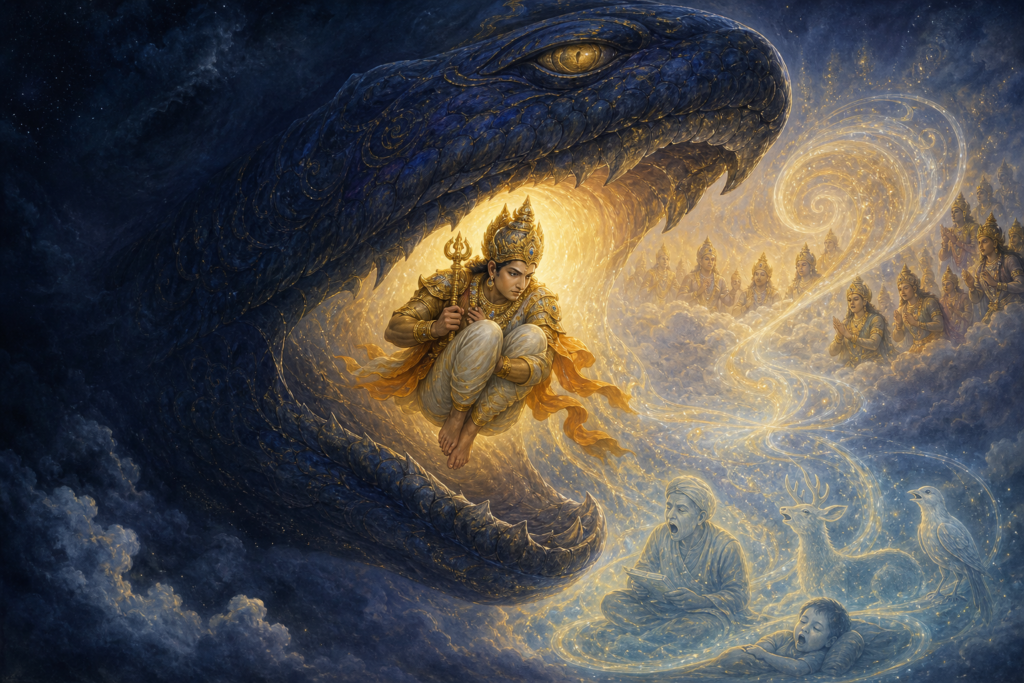
Tripura Rahasya preserves a striking narrative about King Susena’s royal horse and the rishi Gana’s ashram, where a brief sojourn within a mountain-world translates into millennia on earth. In the account, Mahasena witnesses a fully formed cosmos in a single day, only to return to a transformed landscape where twelve thousand years have elapsed. This literary moment captures a central Indic intuition: time can operate at multiple scales, and human perception touches only a narrow band of a much vaster rhythm.
This article examines how such expansive visions of time are not only textual or mythic themes but living ideas embedded in the Hindu way of life. The focus is the continuity between classical frameworksYuga, Mahayuga, Kalpa, and Brahma’s lifetimeand their presence in contemporary ritual through the Sankalpa Mantra. The perspective is inclusive across dharmic traditions, noting resonances with Jain cosmology and Buddhist texts, and emphasizing a shared civilizational comfort with very large numbers and cyclical time.
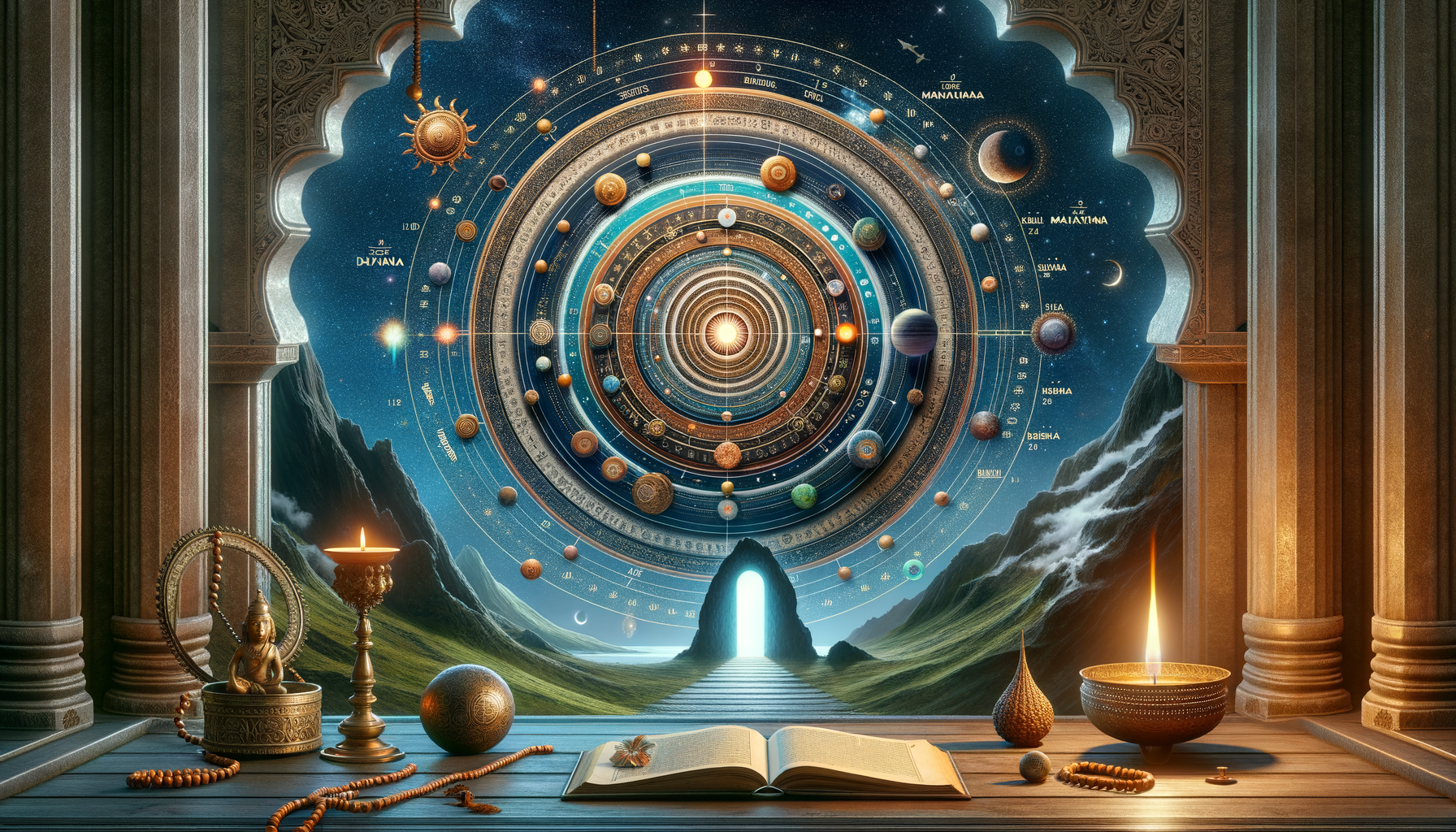
Yuga theory outlines four world agesSatya, Treta, Dvapara, and Kalicollectively known as chatur yuga. Their durations are traditionally given as 1,728,000 years for Satya, 1,296,000 for Treta, 864,000 for Dvapara, and 432,000 for Kali. One complete chatur yuga (Mahayuga) therefore totals 4,320,000 years.
A Mahayuga multiplied by 1,000 constitutes a Kalpa, the “day of Brahma,” corresponding to 4.32 billion years. An equal “night” follows, so a full day-night cycle of Brahma spans 8.64 billion years. Within each Kalpa, fourteen Manus preside over successive eras (Manvantaras), a structure that contextualizes cosmic governance across immense time.
Scaling further, 360 Brahma day-night cycles comprise a Brahma year, and 100 such years form Brahma’s lifetimeapproximately 311 trillion years. These magnitudes exceed ordinary human intuition, yet they are precisely the kind of numbers preserved and transmitted in Indic knowledge systems across millennia.
The dharmic world repeatedly demonstrates this numerical imagination. The Rig Veda refers to 100,000, while the Yajur Veda cites 10^12 (parardha). Jain cosmology involves timescales such as 2^588 and freely engages with the infinite; the Jaina Anuyogadvāra-sūtra references numbers beyond 10^250. The Buddhist Lalitavistara Sūtra names multiples of ten up to 10^145. Such examples underscore a shared civilizational ease with mathematical and temporal vastness without diminishing contributions from other cultures; rather, they highlight a distinctive and well-documented Indic emphasis on very large numbers and cyclical chronology.
In daily practice, these ideas surface vividly in the Sankalpa Mantra, recited at the beginning of puja, yajna, and other Hindu rituals. The sankalpa situates the act in space and time, setting intention with precision. The time-related portion begins: आद्य ब्राह्मण द्वितीय पारार्धे (Ādya brāhmaṇa dvitīya pārārdhe), indicating the present Brahma’s second half of life.
It then locates the ritual within the current Kalpa and Manvantara: श्रीश्वेतवाराहकल्पे (Shri Shwetavaraha Kalpe) and वैवस्वतमन्वन्तरे (Vaivasvata Manvantare). These phrases encapsulate a cosmological timestamp that reaches from the human sphere into the cosmic day of Brahma.
Next appears the explicit yuga marker: अष्टाविंशतितमे कलियुगे प्रथमे पादे (Ashtavimshatitame Kaliyuge, Prathame Pade), signifying the first quarter of the 28th Kali Yuga. Because yugas are cyclicalSatya follows at the end of Kalithis places present time within a running count of completed Mahayugas. For many practitioners, hearing or reciting these lines cultivates humility, continuity, and a grounded awareness that individual life unfolds within an intricately layered cosmic order.
Although this phrasing is specific to Hindu ritual, the broader sensibility it conveysreverence for cyclicality, respect for vast timescales, and an ethic of alignment with cosmic rhythmsresonates across dharmic traditions. In Jainism and Buddhism, textual engagements with enormous numbers and recurring temporal patterns contribute to a shared civilizational tapestry. Sikh wisdom, with its emphasis on truthful living, ethical action, and remembrance of the timeless Divine, complements this orientation by centering human conduct within the wider horizon of the Eternal.
Returning to the Tripura Rahasya episode, the rishi’s explanationhis wheel of time turning differentlyilluminates the purpose of such cosmological frameworks. They are not mere abstractions: they invite disciplined attention, ethical clarity, and experiential depth. When a practitioner intones the Sankalpa Mantra, the act of devotion is placed within Brahma’s day, Manu’s era, and the current yuga, transforming a single ritual moment into a conscious alignment with the cosmic clock.
References: Michel Danino, Indian Culture and India’s Future; Om Swami, Kundalini An Untold Story.
Inspired by this post on Varnam.