
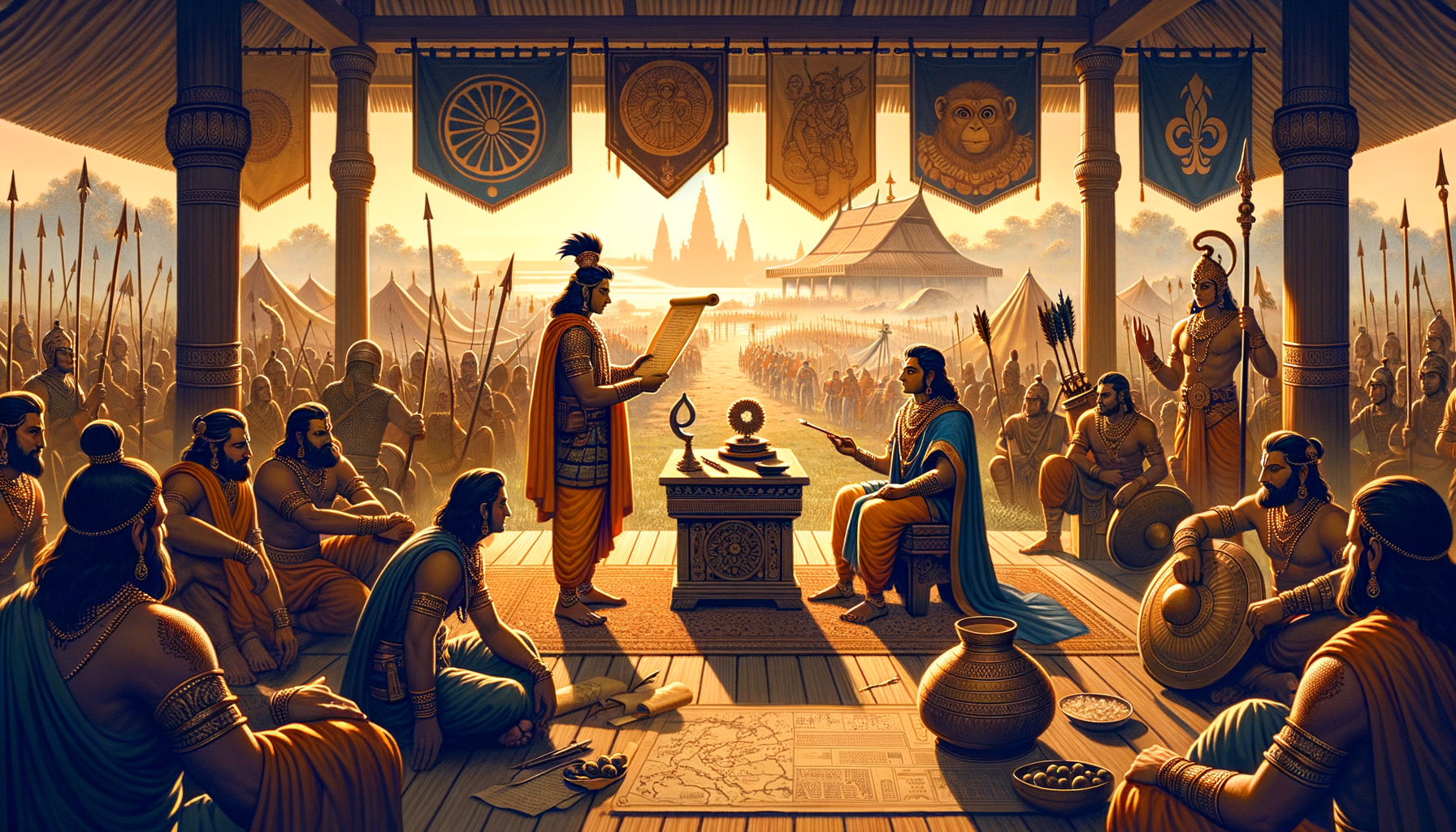
Dhritarashtra’s decision to dispatch Sanjaya as an emissary before the Kurukshetra War reveals far more than a perfunctory diplomatic gesture. In the Udyoga Parva of the Mahabharata, the journey of Sanjaya to the Pandava campwhere he speaks in the presence of Yudhisthira, Bhima, and notably Arjunaunfolds as a layered act of statecraft. It combines the outward observance of dharma with a clear intent to gather intelligence, test resolve, and influence the psychological terrain before any chariot rolled into battle. The episode underscores how the Mahabharata’s political narrative is inseparable from its ethical vision, where duty (dharma), restraint, and righteous conduct structure even the overtures of war.
Sanjaya’s embassy is most often summarized as a peace mission. Yet, when examined closely against the expectations of Kshatra Dharma and the immediate context of the impending conflict, it operates as a strategic probe. Arjunacentral to the Pandava military calculuswas not merely another listener in Upaplavya; he was the nerve center of their battlefield capability. Addressing him directly allowed Sanjaya to do what a skilled dūta (envoy) does best: gauge temperament, surface doubts, and relay nuanced assessments back to the Kuru court.
From the standpoint of royal legitimacy, Dhritarashtra needed to be seen fulfilling the dharmic imperative of pursuing peace before sanctioning war. This imperative resonates across dharmic traditions: the Jain emphasis on ahimsa, the Buddhist stress on right intention and non-harm, the Sikh insistence on justice alongside restraint, and the Hindu expectation that a ruler exhausts conciliatory paths before a Dharma-Yuddha. By sending Sanjaya, Dhritarashtra preserved the appearance of moral due process, demonstrating that negotiation was neither ignored nor rushed. Such signaling matteredto subjects, allies, and posterity.
The mission also served as an intelligence operation. Sanjaya’s proximity to Dhritarashtra and his proven discretion made him ideal for assessing the Pandavas’ readiness, morale, and internal cohesion. Observing Arjuna’s composure, the presence and counsel of Sri Krishna, and the tenor of Yudhisthira’s conditions for peace allowed the Kaurava court to calibrate strategy. Information about the Pandavas’ supply lines, alliances (not least with Panchala), and mobilization timelines could be inferred from camp activity and public declarationseven without intrusive questioning.
Targeting Arjuna specifically had psychological logic. Arjuna was renowned not only for martial excellence but also for a compassionate temperament susceptible to moral reflectiona trait the text later magnifies in the Bhagavad Gita. A carefully framed appeal to forbearance, seniority, and familial harmony could, in theory, encourage hesitation or foster internal debate among the Pandavas. Even slight doubt in a commander of Arjuna’s stature could translate into asymmetrical advantage for the Kauravas once battle formations tightened.
There was also a tactical consideration: time. Every day of delay strengthened the defensive preparations of Hastinapura while the Pandavas gathered their coalition across distances. A diplomatic mission, especially one that required a considered response, granted Duryodhana’s camp additional hours and days to refine dispositions, position reserves, and consolidate loyalties. Diplomacy, in this sense, doubled as strategic patience.
Another subtle aim was to assess and, if possible, circumvent the influence of Sri Krishna. By engaging the Pandavas through Sanjaya, Dhritarashtra could test whether a message that skirted Krishna’s mediation might find a different reception. The attempt was not merely to change terms, but to sample the decision-making ecology around Arjuna: who spoke, who concurred, and which principles were non-negotiable. The embassy tested whether any lateral path existed that Krishna’s own peace mission later could not bridge.
Crucially, Sanjaya’s visit reaffirmed the normative sequence that governs righteous conflict in the epic: counsel, conciliation, and, only upon failure, confrontation. The moral economy of the Mahabharata requires that a Dharma-Yuddha be preceded by sincere opportunities for peace. This structure is not uniquely “Hindu” in a sectarian sense; it reflects a wider dharmic ethos shared across Indic traditions, where restraint, dialogue, and proportionality are not signs of weakness but pillars of ethical power. The episode therefore provides a valuable precedent for inter-traditional dialogue today, suggesting that unity rooted in dharma stands above narrow factional triumphs.
The content of Sanjaya’s message, as captured in the Udyoga Parva, aligns with these layers. He conveys Dhritarashtra’s desire to avert catastrophe, highlights the ruinous consequences of fratricide, and asks what accommodation might sustain peace without erasing rightful claims. The Pandava reply, articulated through Yudhisthira and supported by Bhima and Arjuna, centers on justice: restoration of their due and a settlement that honors both law and honor. The standpoints are irreconcilable not because dialogue is superficial, but because the underlying commitmentsespecially Duryodhana’s refusal to part with even “five villages”are inelastic.
In the aftermath, Sanjaya’s role expands rather than concludes. Vyasa grants him divine sight (divya-drishti) to narrate the war’s progress to Dhritarashtra, turning him into the inner witness of both policy and consequence. The emissary who once measured intentions becomes the historian of outcomes, underscoring the epic’s insistence that power and accountability remain tethered. Dhritarashtra’s calculated outreach to Arjuna thus frames a complete arc: from diplomacy to duty, from intelligence to introspection, and from decision to reckoning.
Viewed through the lens of political theory, the embassy can be read as multi-vector diplomacy: legitimacy-building, intelligence gathering, deterrence testing, and psychological warfare combined under the canopy of dharma. For students of statecraft, the episode clarifies that ethical procedures are not mere ornament; they legitimize authority, structure choices, and often decide the social memory of conflict. For seekers of wisdom, it illuminates how great traditionsHindu, Buddhist, Jain, Sikhconverge on principles that protect dignity even amid unavoidable strife: speak truthfully, exhaust peaceable means, and fight only when righteous duty leaves no alternative.
Ultimately, the question “Why did Dhritarashtra send Sanjaya to Arjuna?” is best answered by acknowledging all these concurrent aims. It was an appeal to peace that satisfied dharma, a reconnaissance that informed strategy, a psychological probe aimed at the heart of Pandava strength, and a temporal cushion that benefited Kaurava logistics. The embassy did not prevent war, but it defined the ethical frame of what followedand in doing so, it preserved a lesson the Mahabharata continually teaches: power endures only when anchored to dharma, and without that anchor, victory itself is hollow.
Inspired by this post on Hindu Blog.
