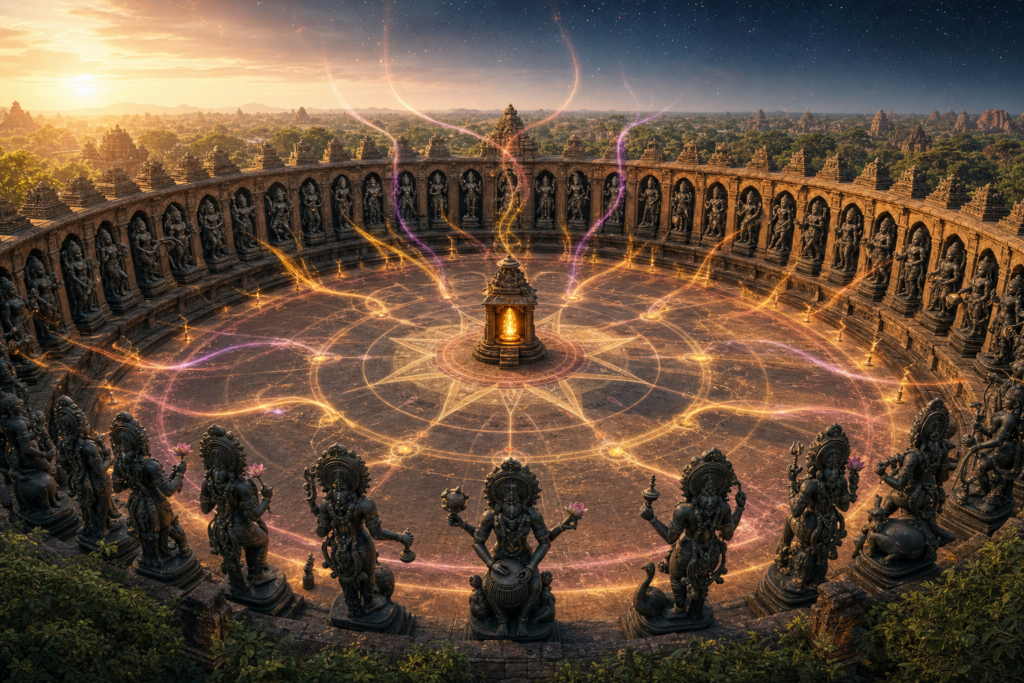
The Nrisimha Tapaniya Upanishad, a Vaishnava text affiliated with the Atharvaveda, holds a distinctive seat among the minor Upanishads for its synthesis of mantra, meditative discipline, and Vedantic insight. Within its twofold architecturePurva (earlier) and Uttara (later)the Fourth Khanda of the Purva section concentrates the work’s practical core, presenting the contemplative grammar through which devotion to Nṛsiṁha (Narasimha), the fiercely protective manifestation of Vishnu, is refined into luminous knowledge. Read as a compact manual, this Khanda outlines mantric revelation, the discipline of nyāsa (ritual placement), and the contemplative image (dhyāna) that situates the aspirant within an unshakable sense of inner fearlessness.
As with many Upanishads in the tāpanīya corpus, the text functions on two interlocking planes. First, it preserves liturgical detailsseed syllables (bīja), deified epithets, Gayatri formulations, and protective formulasthat invite a subtle, embodied practice. Second, it employs concise Vedantic hermeneutics to disclose Nṛsiṁha as the Supreme Reality (Brahman), guiding the contemplator from form to formlessness without devaluing the devotional form. The Fourth Khanda is best approached as a hinge between these planes, where practice (upāsanā) is not an end in itself but a means to insight (vidyā).
While recensional differences exist, most printed traditions of the Purva section agree that the Fourth Khanda gathers together three elements: a sanctified mantric core, a pattern of nyāsa that encodes those syllables in the subtle body, and a meditative visualization (dhyāna) culminating in a promise of protection and clarity (phala-śruti). This triad is the signature of a tāpanīya text: the mantras “heat” (tāpa) the mind through disciplined repetition, the nyāsa anchors awareness in the body, and the visualization harmonizes devotion with nondual discernment.
At the center stands the Nṛsiṁha Gāyatrī, widely received in the tradition as the Upanishad’s quintessential mantra: Om Nṛsiṁhāya vidmahe vajra-nakhāya dhīmahi tanno siṁhaḥ pracodayāt. The epithets crystallize the deity’s function as a source of unwavering refuge and discernment: “vajra-nakha” (adamantine nails) symbolizes the unassailable power that severs ignorance; “tanno siṁhaḥ pracodayāt” invokes the leonine impulse that urges the intellect (buddhi) toward luminous steadfastness. In the Fourth Khanda’s logic, this Gāyatrī is not merely protective; it is pedagogical, gradually reforming attention so that fear and agitation lose their foothold.
Traditions associated with the text also transmit the famed protective formula, often recited in parallel with the Gāyatrī: Ugraṁ vīraṁ mahā-viṣṇuṁ jvalantaṁ sarvato-mukham, nṛsiṁhaṁ bhīṣaṇaṁ bhadraṁ mṛtyor mṛtyuṁ namāmy aham. Each epithet is contemplative instruction. “Ugraṁ vīram” directs the mind to the energy that overcomes inner inertia; “jvalantaṁ” fixes attention on awareness as radiant; “sarvato-mukham” universalizes presence; “mṛtyor mṛtyum” dissolves the root-fear at the heart of reactivity. The Fourth Khanda’s pedagogy thus leverages language as a precise instrument of transformation.
In many recensions, the Khanda also emphasizes a bīja syllable associated with Nṛsiṁha, often given as kṣrauṁ. The single seed concentrates the mantra’s power into a compact acoustic form. In practice, the bīja is not an embellishment but the pivot of interiorization: as repetition grows subtler, attention moves from articulated verse to phonemic essence, from essence to unstruck resonance (anāhata), and from resonance to silent, steady witnessing.
Nyāsaritual placement of mantra limbs on the bodyis presented as a contemplative map rather than a mechanical rite. Karanyāsa (on the hands) and aṅganyāsa (on major limbs) serve two functions. Somatically, they attune proprioception, reducing mental drift. Philosophically, they enact the recognition that consciousness pervades the body; the practitioner no longer stands apart from sacred sound but realizes embodiment as a field of mantra. In this Fourth Khanda frame, nyāsa concretizes the Upanishadic axiom that the knower, the known, and the knowing converge.
The dhyāna supplied for Nṛsiṁha sharpens attention through vividly ethical imagery. The form is radiant (jvalantam), compassionate to the virtuous (bhadram), and fearsome to inner and outer harm (bhīṣaṇam). Contemplation of this paradoxfierce yet benevolenteducates the emotions: courage without aggression, care without complacency. Over time, practitioners report that the anxiety loops tied to uncertainty and threat begin to unwind, replaced by an unhurried steadiness in action.
Crucially, the Fourth Khanda situates mantra within Vedantic hermeneutics. Pranava (Om) functions as the meta-mantra, the ground-note into which all mantric streams return. Nṛsiṁha, encountered first as a form with attributes (saguṇa), is then understood as the very Brahman, the attributeless ground (nirguṇa) that supports and transcends all forms. The transition is not a dismissal of devotion but its fulfillment: the form discloses the formless by ripening the heart-mind for insight.
The Fourth Khanda also implies a practice architecture recognizable across Vedic tradition: a respectful intention (saṅkalpa), purification through breath or water, preliminary nyāsa, japa of the Gāyatrī and related mantras with a mālā (often 108 repetitions), and silent recollection. Ethical foundationstruthfulness, non-harm, and disciplined speechare assumed as prerequisites; without them, mantric practice lacks the stable base required for enduring transformation.
Beyond ritual exactitude, the Khanda’s deeper promise is psychological resilience. By training attention to returngently but firmlyto a clear acoustic and imaginal center, the practitioner learns to meet fear without collapse. Such training has contemporary relevance: in high-stress environments, these sequences provide a structured way to de-escalate physiological arousal, clarify priorities, and act with composure. The Upanishadic insight is practical: fear attenuates as the center of identity shifts from transient narratives to steadfast awareness.
Although dedicated to a Vishnu avatāra, the Fourth Khanda’s contemplative mechanics resonate across dharmic lineages. Mantra and dhāraṇī recitation in Buddhism, the Navakāra mantra and ajapa disciplines in Jainism, and Sikh nām-simran express allied commitments to attentive sound, ethical refinement, and insight. Read in this inclusive spirit, the Nrisimha Tapaniya Upanishad contributes to a shared civilizational vocabulary in which diverse forms guide seekers toward a common horizon of wisdom, compassion, and inner freedom.
From a textual-historical perspective, the Nrisimha Tapaniya Upanishad is generally placed in the medieval period, alongside other Vaishnava Upanishads. Its transmission includes minor variations in sequence and wording; the Fourth Khanda’s content, while consistent in theme, may present different mantric arrangements or nyāsa details across editions. Such fluidity is typical of liturgical literature and does not diminish the Khanda’s central thrust: to align breath, sound, image, and insight.
Care is also advised regarding initiation and guidance. Traditional lineages emphasize that mantrasespecially those taught with nyāsa and bījashould be received respectfully, with a commitment to harmlessness and beneficence. The Fourth Khanda presupposes that protective power is inseparable from ethical intention; the protection it promises matures with humility, service, and steadiness, not with domination or display.
A methodological approach to study can deepen engagement with the Fourth Khanda. First, read the Purva section continuously to appreciate how earlier khandas prepare the ground through pranava analysis and deity epithets. Second, practice close listening (śravaṇa) by reciting the Gāyatrī slowly until its cadence becomes intuitive. Third, pair mantric work with brief, eyes-closed visualization, allowing the affective tonefearlessness joined to benevolenceto become familiar. Finally, observe in daily life how speech, posture, and breath begin to reflect the mantra’s poise.
Seen as a compact sādhanā architecture, the Fourth Khanda of the Purva section distills the Upanishad’s purpose: to convert devotion into discernment, and fear into steadfast clarity. Its language is ancient, yet its pedagogy is timeless. Practiced with care, it offers a way of being that honors the fullness of dharmic plurality while leading seekersby the simple means of sound, breath, and attentiontoward a confident, compassionate center.
Inspired by this post on Hindu Blog.