
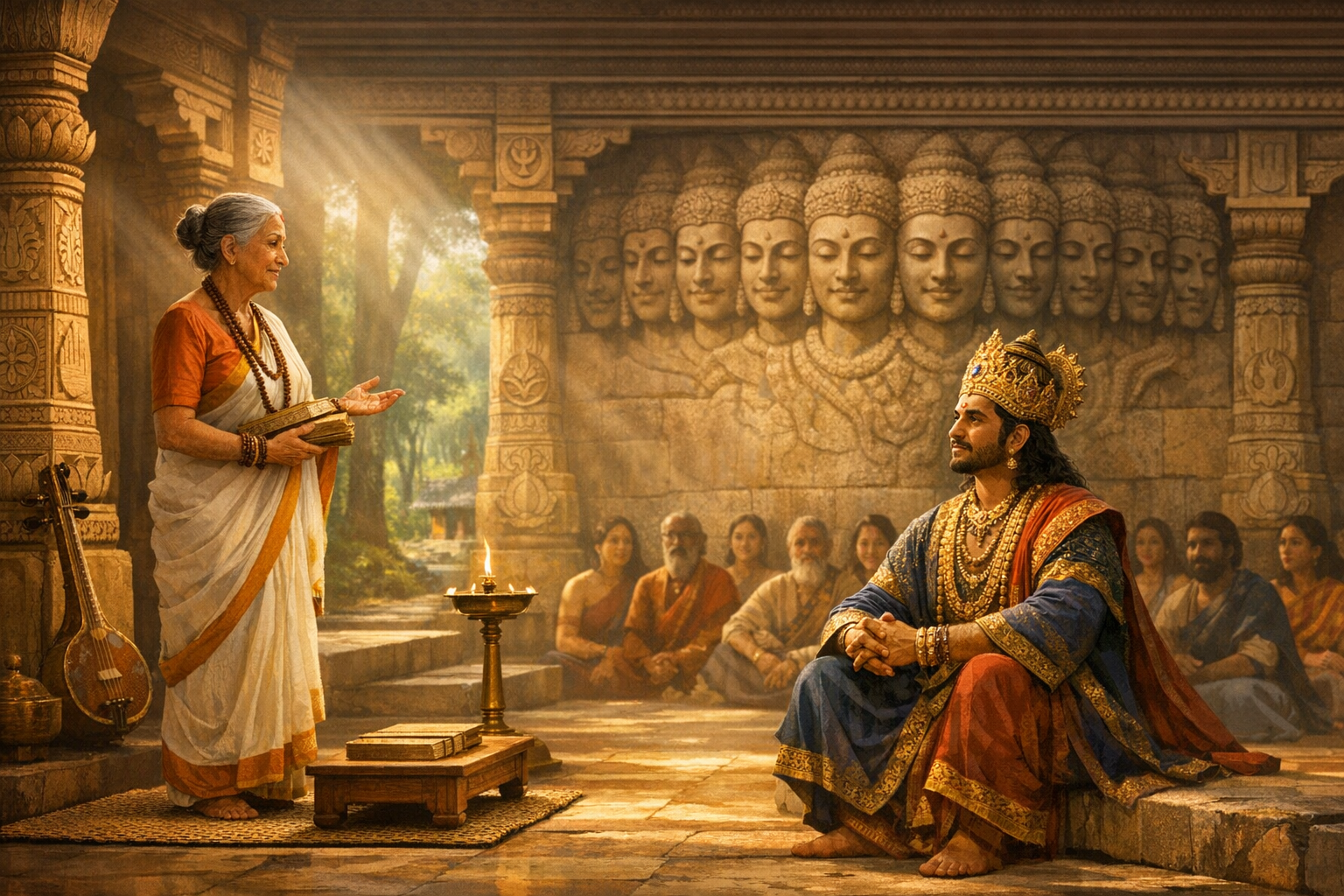
The evocative motif of Anasuya confronting Ravana continues to illuminate how Vedic wisdom frames knowledge, power, and ethical restraint, while also underscoring the honored status of women scholars in Ancient India. As a cultural memory threaded through Ramayana retellings and the wider katha parampara, the scene functions as a didactic lens: the tapas of a strī-ācāryā meets the formidable erudition of a scholar-king, bringing rājadharma and personal restraint into sharp relief.
In many narrations, a sacred assembly is imagineda sabhāwhere rigorous vāg-vāda (reasoned discourse) unfolds. Anasuya, the revered wife of Sage Atri, stands not merely as an exemplar of pativratā-dharma but as a teacher whose counsel shapes moral horizons. Ravana, a brilliant yet unbridled monarch of Lanka, personifies the paradox of vidyā without vinaya. The encounter is not spectacle; it is a meditation on the limits of unmoored ambition and the primacy of dharma-guided statecraft.
From a textual standpoint, critical editions of Vālmīki’s Ramayana do not preserve a formal, line-by-line debate between Anasuya and Ravana. What they do preserve with clarity is Anasuya’s authoritative presence in the forest exile, where she blesses Sita and expounds the ethics of marriage, self-mastery, and compassionate duty. The specific motif of her “correcting” Ravana thus belongs to later retellings and oral pedagogy, consistent with a broader Sanskritic pattern that features women sages delivering uncompromising ethical insight to powerful rulers.
This broader pattern is well attested. The Upanishadic discourse of Gargī Vācaknavī with Yājñavalkya, the philosophical reflections of Maitreyī, and the Mahābhārata’s portrayal of Sulabhā’s searching dialogue with Janaka reveal a civilizational norm: scholarly authority was rooted in pramāṇa (valid knowledge) and tapas (discipline), not in gender. Within this norm, Anasuya appears as a canonical beacon of Vedic wisdomher counsel to Sita in the Ramayana and her celebrated Puranic austerities (including the episode involving Brahmā, Viṣṇu, and Śiva) secure her status as a teacher whose speech carries śāstric weight.
Ravana himself is not a caricature but a complex figure. Lineage and learning place him in a venerable tradition: descended from Pulastya, master of Vedic and musical lore, and a noted devotee of Śiva. The narrative tradition uses his arc as a philosophical caution: vidyā without svādhyāya, and prowess without self-regulation, tend toward adharma. In this light, a scene of Anasuya challenging or correcting Ravana distills a central thesis of the Ramayanasovereignty is legitimate only when braided with restraint, compassion, and justice.
Even without a verbatim debate in the critical text, the themes that such a correction would encompass are clear from śruti–smṛti–purāṇa ethics and the epic’s narrative logic. First, rājadharma obligates a ruler to bind desire (kāma) and anger (krodha) to the welfare of subjects. Second, śāstra privileges humility (vinaya) as the soul of learning. Third, the sanctity of promise, hospitality, and non-injury (ahiṁsā) constrain royal assertion. Finally, the dignity and autonomy of women in household and public ethics is non-negotiable; violating that dignity corrodes the very foundations of order (ṛta) that kingship is sworn to uphold.
Anasuya’s authority draws strength from a long line of women who shaped Vedic and classical thought. The Ṛgveda remembers rishikās such as Vāk Ambhṛṇī (the Devi Sūkta), Lopāmudrā, Ghoṣā, Apālā, and Viśvavārā. The Upanishads honor the philosophical reach of Gargī and Maitreyī. The Mahābhārata and later śāstra literature continue this pattern, depicting women as interlocutors, teachers, and custodians of ethical insight. Situating Anasuya within this continuum clarifies why the motif of her correcting Ravana remains both resonant and plausible in the moral imagination of the tradition.
The Ramayana itself reinforces the authority of women’s counsel through multiple figures. Sita’s steadfast reasoning in Aśoka-vātikā, Mandodari’s sobering admonitions to Ravana, and the many moments where women’s voices articulate dharma together make a single point: the feminine voice in the epic is a source of clarity, restraint, and foresight. The Anasuya–Ravana motif harmonizes with this chorus, accentuating that the measure of knowledge is ethical fruit, not rhetorical force.
A cross-Dharmic lens further strengthens the insight. In Buddhism, the Therīgāthā preserves luminous verses of elder nuns, while Dhammadinnā’s dialogue in the Cūḷavedalla Sutta (MN 44) exemplifies technical precision in doctrinal debate. In Jainism, the Śvetāmbara remembrance of Mallinātha as a female Tīrthaṅkara, along with the leadership of learned sadhvīs, attests to the recognition of women’s spiritual scholarship within an Anekantavada (many-sided) epistemology. Sikh history honors Mata Khivi’s institutional foresight in sustaining the langar, Bibi Bhani’s stewardship in the Guruship lineage, and Mai Bhago’s resolute leadershipeach instance uniting erudition with service (seva).
Seen through this wider Dharmic aperture, the Anasuya–Ravana motif is not an isolated tale but a civilizational affirmation: authentic knowledge demands humility; power demands restraint; and women’s scholarly voices are indispensable in articulating both. The motif thus becomes a bridge for unity among Hinduism, Buddhism, Jainism, and Sikhismtraditions that, despite doctrinal distinctions, converge on compassion, self-mastery, and the ethical primacy of truth.
Cultural memory and pedagogy sustain the narrative’s vitality. Across households and study circles, grandparents’ kathā, temple discourses, and classroom readings often frame Anasuya’s example as a living template for ethical decision-making. Listeners commonly report a felt sense of steadiness when the story is told this way: a reminder that clarity and courage, expressed without rancor, can re-anchor communities in shared values even during moral turbulence.
Methodologically, approaching the motif with philological care strengthens understanding rather than diminishing it. Distinguishing between śruti, smṛti, itihāsa, purāṇa, and regional upākhyāna clarifies why episodes circulate with variations, and how they function pedagogically. Instead of pitting “historicity” against “meaning,” the Dharmic hermeneutic invites a both–and reading: the critical text situates Anasuya as a strī-ācāryā, while living traditions extend her authority to confront royal hubrisan extension fully consistent with epic ethics.
For contemporary readers of the Ramayana and Vedic literature, the practical takeaway is twofold. First, cultivate the habit of cross-referencing primary sources alongside regional narratives; this balances rigor with reverence. Second, recognize that inclusive scholarshipwelcoming women’s voices, honoring plurality, and privileging moral fruit over polemical victorymirrors the very dharma that the Anasuya–Ravana motif seeks to teach.
Ultimately, the enduring power of this story lies in its ethical architecture. By contrasting the serenity of tapas with the restlessness of conquest, and the clarity of wisdom with the fog of ego, the motif crystallizes what Vedic wisdom sets forth: knowledge is for liberation, leadership is for service, and the voice of a learned womanAnasuyacan steady even the proudest of kings. Read in unity across dharmic traditions, the lesson is shared and timeless.
Inspired by this post on Hindu Blog.







