
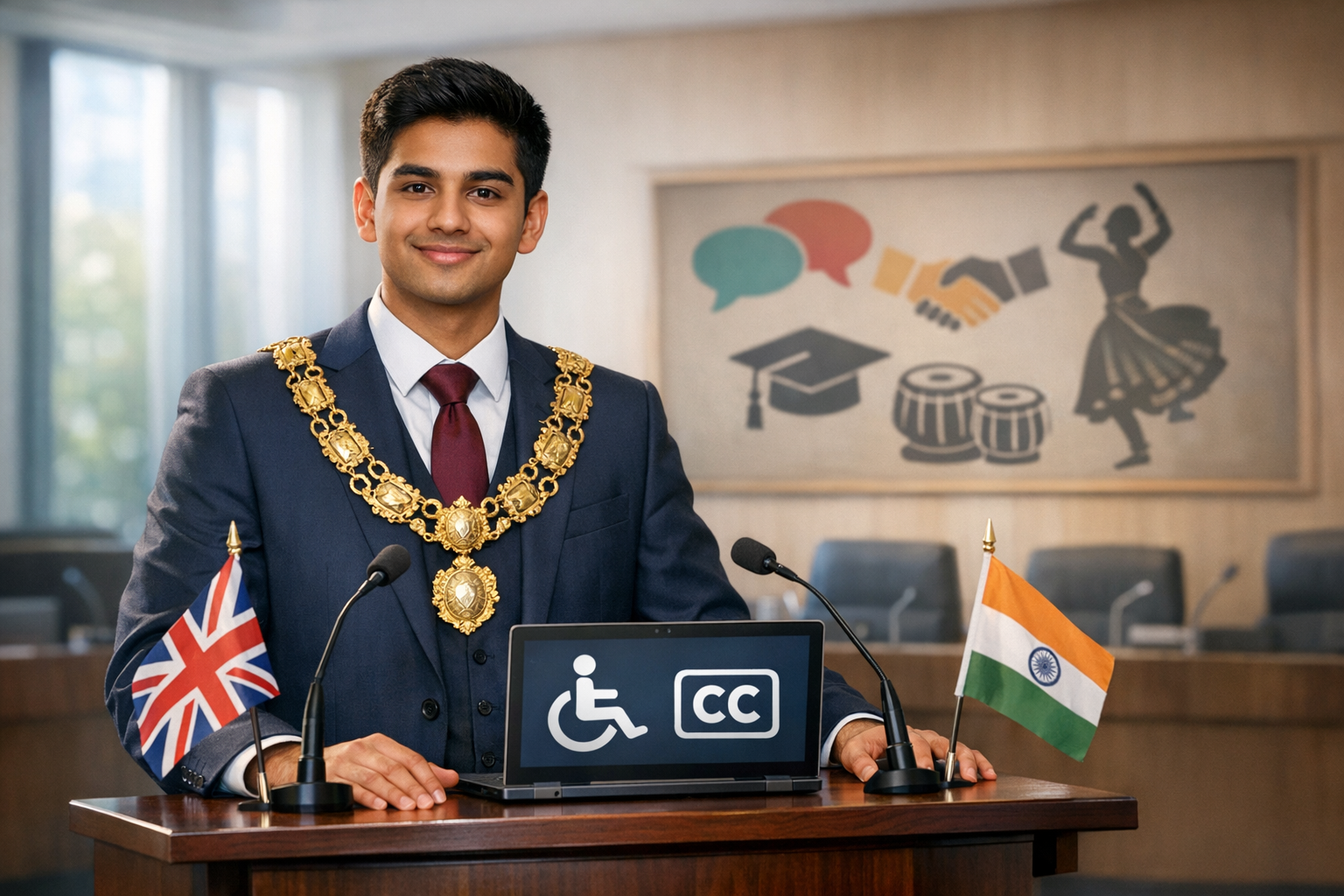
Tushar Kumar has become the youngest-ever Indian-origin mayor in the United Kingdom at 23, assuming the civic chair of Elstree and Borehamwood Town Council. The milestone carries symbolic and practical weight for British-Indian communities and for the wider UK public sphere, signaling generational renewal, diaspora representation, and a results-focused approach to local governance.
Elected as a Labour councillor at the age of 20 while studying at King’s College London, Kumar established an early track record in ward-level casework, committee participation, and cross-party collaboration. His academic training, combined with grassroots engagement, positioned him to connect policy intent with service delivery at street, school, and small-business level.
Before his mayoral year, Kumar served as Deputy Mayor under Dan Ozarow and worked as a policy adviser within the UK government. That blend of civic protocol, portfolio oversight, and Whitehall exposure is uncommon at his age and helps explain his emphasis on measurable impact, compliance, and stakeholder communication.
In England’s town and parish councils, the mayor is elected annually by fellow councillors to chair meetings, represent the community at civic functions, and serve as the council’s principal public figure. While the role is primarily civic and constitutional—distinct from an executive “metro mayor”—it meaningfully shapes agenda-setting, convening power, and the tempo of local initiatives. Kumar’s stated priorities—youth engagement, digital accessibility, and cultural preservation—are well suited to a mayoral year that depends on convening capacity and cross-sector partnerships.
Youth engagement, in this context, spans more than event programming. It typically includes establishing a youth advisory panel, co-designing activities with pupils and students, widening participation through schools and faith/community groups, and aligning opportunities with local employers. By focusing on this domain, Kumar is addressing both near-term participation (volunteering, civic literacy, public consultations) and longer-term pipelines (apprenticeships, mentorships, and early-career exposure to public service).
Digital accessibility is a statutory, technical, and ethical commitment. For UK public bodies, the Public Sector Bodies (Websites and Mobile Applications) Accessibility Regulations 2018 require conformance with Web Content Accessibility Guidelines (WCAG 2.1 AA). Priorities commonly include keyboard navigation, screen reader compatibility, adequate color contrast, captioned video, plain-language summaries, and accessible PDFs. At a town-council scale, improving accessibility also means transparent service information, simplified forms, and inclusive online consultations—making democratic processes easier to use for residents with diverse needs.
Kumar’s cultural agenda—preserving Indian culture among British-Indian communities through free Hindi classes and inclusive multicultural events—operates as a bridge rather than a barrier. Properly framed, language and heritage programs can welcome families from Hindu, Buddhist, Jain, and Sikh backgrounds, while inviting neighbors of all faiths and none. Such efforts strengthen social cohesion, reduce stereotyping, and embody the ethos of Vasudhaiva Kutumbakam, the idea that the world is one family.
Multicultural events curated with duty-of-care and neutrality guidelines can integrate classical arts with contemporary British culture, incorporate interfaith welcome remarks, and foreground shared civic values. When done well, they celebrate Indic languages and traditions alongside other local heritages, advancing unity-in-diversity and deepening place-based belonging in Elstree and Borehamwood.
From a delivery perspective, the combination of town-hall convening and prior policy-adviser experience supports a data-informed approach. Typical indicators might include youth-volunteering uptake, event participation by first-time attendees, accessibility statement compliance rates, satisfaction scores in post-event surveys, and the reach of multilingual communications. Publishing simple dashboards and post-project reviews strengthens trust, enables course correction, and models good governance.
At the party-political level, Kumar’s rise reflects a wider generational shift within the Labour Party and across UK local government, where younger councillors are increasingly visible in committee leadership and civic roles. Representation from British-Indian and broader South Asian communities continues to reshape local agendas—often focusing on small-business resilience, public health, green spaces, and inclusive public services—while remaining grounded in pragmatic town-level problem solving.
Recent media features and interviews provide additional context on Kumar’s priorities and style. For viewers seeking primary footage, see the overview video at this link and an interview segment at this link. Together, they underscore the thread that runs through his programme: open, youth-forward, and grounded in practical service delivery.
The impact of a young, visible mayor extends beyond any single initiative. Civic rituals—citizenship ceremonies, school visits, festival greetings—build social capital, especially for children who seldom see their languages or heritage reflected in public life. By locating Indian culture within the mainstream of borough and town identity, the mayoralty adds a layer of inclusive narrative that benefits all residents, not only the diaspora.
Good intentions require sound governance. Projects that engage minors and vulnerable adults must meet safeguarding standards; digital engagement must respect GDPR and data-minimization; event procurement should follow transparent value-for-money tests. Embedding equality impact assessments and accessibility reviews from the outset reduces risk and improves outcomes for the whole community.
For towns seeking to replicate this approach, a practical blueprint would include three strands: Youth Advisory Council with quarterly open forums; Digital Inclusion Clinics to help residents navigate online services and assist small charities with WCAG basics; and Language and Culture Saturdays offering free Hindi classes alongside sessions that spotlight dharmic harmony and intercultural understanding. Each strand is low-cost, partnership-ready, and measurable within a one-year mayoral term.
Kumar’s appointment as the youngest-ever Indian-origin mayor in the UK is both emblematic and operational. It symbolizes a confident, plural, and service-led Britain, and it operationalizes that vision through youth engagement, accessible digital services, and inclusive cultural programming. If sustained with transparency and community partnership, the Elstree and Borehamwood mayoralty can leave a durable legacy of participation and unity that outlasts a single civic year.
Inspired by this post on Hindu Human Rights Blog.










Leave a Reply
You must be logged in to post a comment.