Mumbai, March 6, 2026 The Maharashtra Cabinet, led by the BJP–Shiv Sena coalition, approved a draft law titled ‘Dharma Swatantrya Adhiniyam, 2026’, described as an anti-conversion bill intended to regulate religious conversions and strengthen safeguards against coercion, fraud, or undue inducement. The decision places Maharashtra alongside several Indian states that have enacted freedom of religion laws with the stated objective of protecting individual autonomy in matters of faith while remaining within the ambit of the Constitution of India.
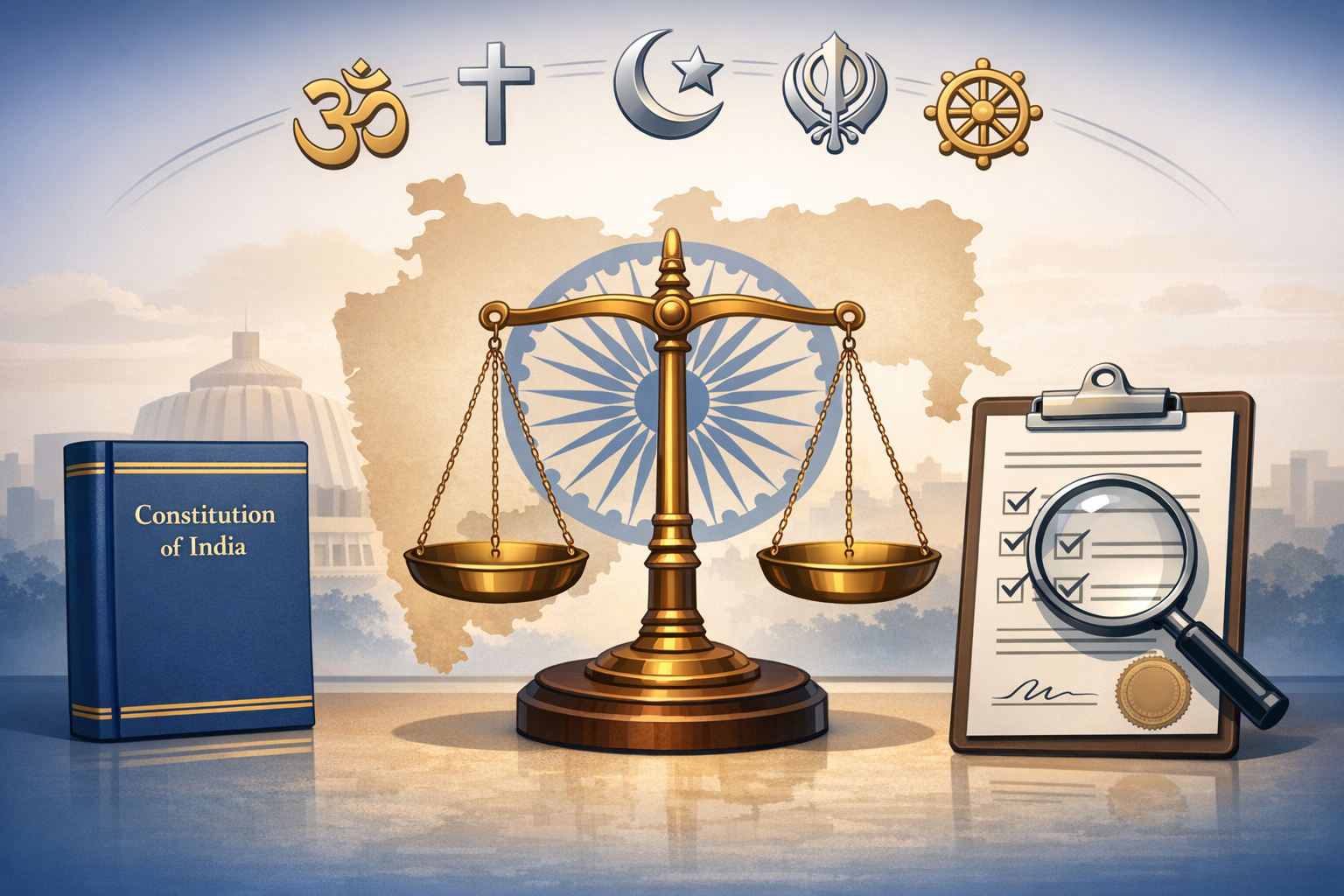
The framing of the proposal signals a dual policy aim: to deter conversion practices that compromise free consent, and to affirm the freedom of conscience guaranteed under Article 25. Importantly, the stated purpose is rights-protection rather than preference for any one religion; the bill’s language and rules will be expected to apply neutrally to all communities, including Hindu, Buddhist, Jain, Sikh, Muslim, Christian, and others.
The title itself ‘Dharma Swatantrya’ evokes a constitutional understanding of religious freedom as freedom of conscience and choice, not compulsion. Properly implemented, such a law must work to preserve pluralism, enable informed decision-making, and protect those most vulnerable to exploitation, consistent with India’s long-standing ethos of interfaith coexistence and the shared civilizational values of Hinduism, Buddhism, Jainism, and Sikhism.
Within India’s federal architecture, state-level anti-conversion frameworks already exist in Odisha (1967), Madhya Pradesh (1968; updated 2021), Chhattisgarh (1968 with subsequent rules), Arunachal Pradesh (1978, largely inoperative), Gujarat (2003; amended 2021), Himachal Pradesh (2006; 2019), Jharkhand (2017), Uttarakhand (2018), Uttar Pradesh (2020), and Karnataka (2021–2022). These laws typically target conversion by force, fraud, undue influence, or allurement while affirming voluntary, informed conversion as a protected liberty.
The constitutional baseline is well established. In Rev. Stanislaus v. State of Madhya Pradesh (1977), the Supreme Court upheld state competence to prohibit conversions effected by force, fraud, or allurement, clarifying that the right to “propagate” religion under Article 25 does not include a right to convert another person. At the same time, later jurisprudence including Justice K.S. Puttaswamy (2017) on privacy and Shafin Jahan v. Asokan K.M. (2018) on decisional autonomy in marriage underscores that adult individuals retain the liberty to make intimate choices, including matters of faith, free from arbitrary interference.
As the final text of ‘Dharma Swatantrya Adhiniyam, 2026’ is awaited in the legislature, the likely contours, inferred from other Indian state enactments and constitutional doctrine, can be anticipated. The bill will probably define conversion, force, fraud, allurement, and misrepresentation with precision; establish notice and verification procedures to protect consent; and prescribe graduated penalties for aggravated violations, particularly where minors or other protected classes are involved.
Clear definitions are pivotal. In comparable statutes, “force” often covers threats of harm or wrongful confinement; “fraud” encompasses deliberate concealment or misrepresentation of identity, intent, or material facts; “undue influence” refers to exploiting vulnerability or dependency relationships; and “allurement” is typically framed as offering material benefits to induce conversion. Narrow, carefully drafted definitions reduce ambiguity and the risk of over-breadth.
Procedurally, a notice-and-verification model is common. Converters, officiants, or the individual intending to convert may be required to file a pre-conversion declaration with the District Magistrate, followed by a post-conversion intimation. The civil administration then verifies voluntariness through a time-bound, non-intrusive process designed to protect privacy and dignity while documenting consent.
Institutional responsibility also tends to be emphasized. Organized conversion ceremonies, mass events, or programs run by associations often require additional permissions or record-keeping, ensuring traceability and transparency. These measures are typically neutral to religion, resting their legality on the state’s duty to prevent exploitation rather than to privilege or disadvantage any faith.
Penalty frameworks in peer jurisdictions usually distinguish between standard and aggravated cases. While specifics will depend on the final Maharashtra text, other states set lower sentencing bands for general violations and higher bands when the victim is a minor, a member of Scheduled Castes or Scheduled Tribes, or a person with disability. Tailored penalties seek to deter abuse without chilling lawful, voluntary religious activity.
Conversion and marriage are another design intersection. Some state laws address sham conversions timed solely to circumvent applicable marriage or inheritance rules. In doing so, legislatures must take care not to stigmatize interfaith marriages themselves, which are fully lawful under the Special Marriage Act, 1954. Any marriage-related clause should be drafted to target fraud or coercion, not legitimate interfaith unions or the lawful choice to change faith.
From a due-process perspective, robust safeguards are indispensable. Best practices include precise definitions, a presumption of innocence, clear evidentiary standards, time-bound inquiries, prohibitions on public disclosure of sensitive personal data, and avenues for legal aid. Provisions that inadvertently invert the burden of proof should be carefully calibrated to avoid chilling effects on legitimate religious activity or interfaith association.
Thoughtful implementation is equally vital. Training for district administrations and police on constitutional rights, religious diversity, and trauma-informed interviewing can substantially reduce error and bias. Multilingual forms, confidential hearings when required, and digital tracking of notices with audit logs improve both accessibility and accountability.
Civil liberties concerns raised in other states such as potential misuse to harass interfaith couples or religious workers underscore the need for strict internal oversight, penalties for false complaints, and periodic independent reviews. A narrowly tailored law, administered with integrity, should protect freedom of conscience rather than becoming a tool for social pressure or sectarian contestation.
For citizens, practical implications generally include documentary steps for those choosing to convert, and compliance responsibilities for organizations that facilitate conversions. Interfaith couples may prefer the Special Marriage Act route while ensuring that any change of faith, if chosen, is documented transparently and voluntarily. Communities and institutions across faiths can proactively adopt consent protocols and internal codes of conduct that mirror statutory standards.
For a state with rich civilizational pluralism, the promise of ‘Dharma Swatantrya Adhiniyam, 2026’ is best realized when it protects every person’s right to choose or not choose a religion a lodestar shared across dharmic traditions of Hinduism, Buddhism, Jainism, and Sikhism. When the law deters coercion and fraud without burdening sincere belief, it strengthens the social compact and advances unity in diversity.
Transparent monitoring promotes trust. Annual, anonymized reporting on notices filed, verifications completed, prosecutions launched, convictions secured, and complaints found to be false can help the public and legislature assess whether the act is functioning as intended. Regular legislative reviews allow recalibration where evidence reveals gaps or unintended consequences.
Key milestones ahead will include tabling of the bill, debate and committee scrutiny, rule-making that operationalizes procedures, and, potentially, judicial review testing definitions and safeguards. Each stage offers an opportunity to refine the balance between preventing coercion and preserving fundamental freedoms under Articles 14, 19, 21, and 25–28.
In sum, Maharashtra’s move to clear ‘Dharma Swatantrya Adhiniyam, 2026’ is a consequential step in India’s evolving regulatory landscape on religious conversion. Properly drafted and scrupulously administered, the law can unify the protective aims of anti-coercion policy with the constitutional promise of religious freedom, reinforcing a culture of consent, dignity, and mutual respect across all faith communities.
Inspired by this post on Struggle for Hindu Existence.