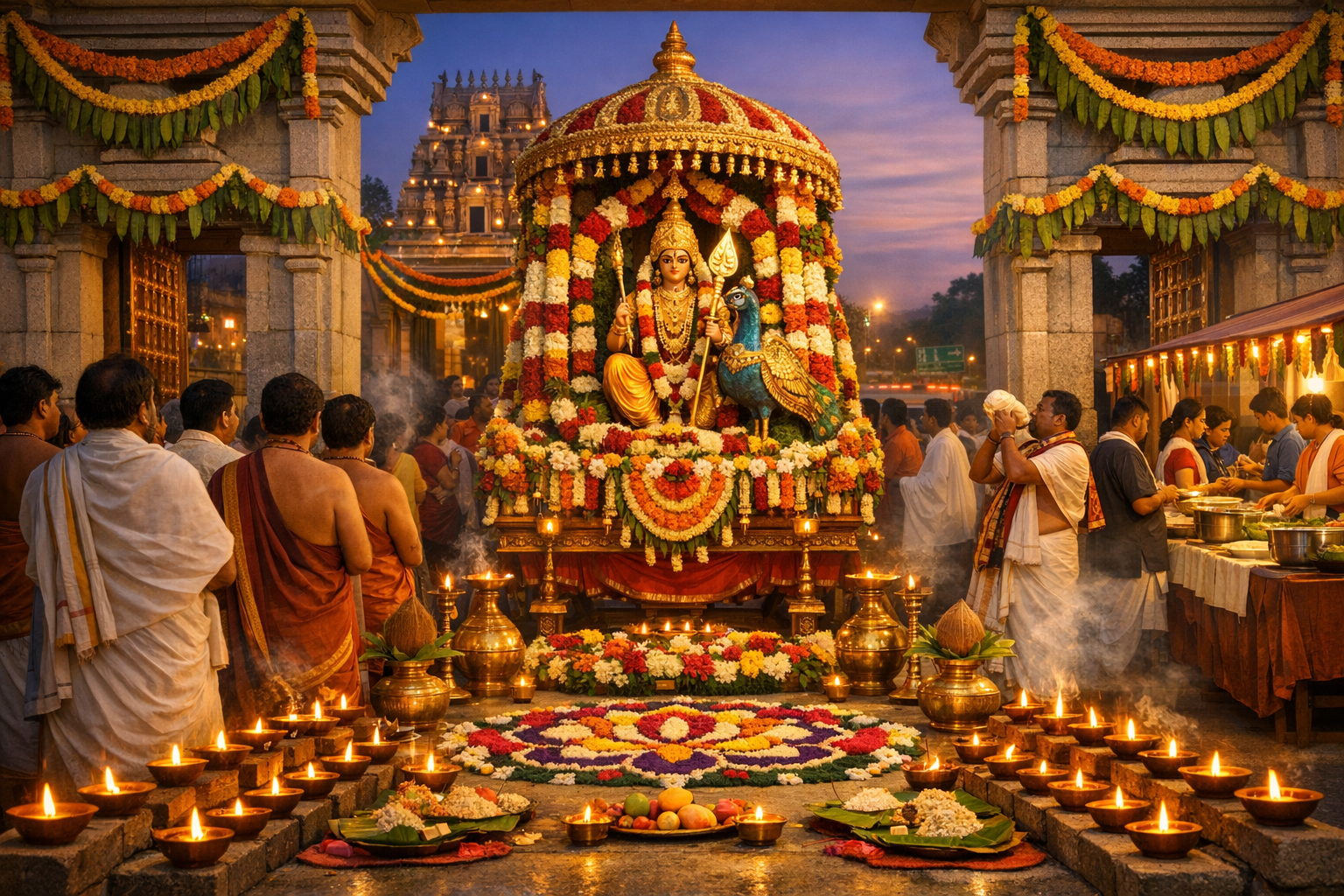
The Subramanya Shashti Jathra 2026 at Sri Subramanyeswara Swamy Temple, Siddalingapura, unfolded with palpable devotional intensity on the outskirts of Mysuru along the Mysuru–Bengaluru Highway (NH‑275). The jathra drew steady streams of devotees from Mysuru, Mandya, Chamarajanagar, and neighboring taluks throughout the day, affirming this temple’s standing as a vibrant regional shrine in Karnataka’s living temple network. The observance, held on Margashirsha Shukla Paksha Sashti (the sixth lunar day of the bright fortnight), emphasized disciplined worship, community cohesion, and the timeless ethos of dharmic service.
In the traditional panchanga, Subramanya Shashti aligns with Shukla Shashti of the Margashirsha month, a tithi selected for its auspicious resonance with Skandaalso known as Subrahmanya, Kartikeya, and Murugan. Temples in Karnataka typically follow udaya-tithi (tithi prevailing at sunrise) for festival scheduling; hence, the public program at Siddalingapura was organized around morning abhishekam, mid-day alankara, and evening procession when feasible, with mangalarati providing a luminous culmination to the collective worship.
The theological heart of the jathra centers on Subrahmanya as the embodiment of valor (śaurya), refined intellect (buddhi), and spiritual leadership (guru-tattva). Iconographically, the deity’s peacock vahana symbolizes the disciplined sublimation of pride and restlessness, while the śakti-āyudha (vel) signifies piercing clarity that dispels confusion. In many South Indian traditions attested by the Skanda Purana (and later vernacular retellings), Subrahmanya is also venerated as the guardian of serpents (nāgas), an association preserved in Karnataka’s devotional landscape from the coast to the Mysuru region.
Sri Subramanyeswara Swamy Temple at Siddalingapura serves as a vital dharmic node for villages and urban pilgrims alike, aided by its strategic location just off the Mysuru–Bengaluru Highway. The temple’s festival programming reflects the region’s liturgical cadence: precise mantra-recitation, careful ritual sequencing, and accessible darshan windows that accommodate elder devotees, families with children, and outstation visitors. The result is a balanced experience that honors both ritual rigor and congregational flow.
Rituals for Subramanya Shashti at this kshetra typically include abhishekam (ritual bathing) with jaladhara and pañcāmṛta (milk, curd, ghee, honey, and sugar), followed by vastra samarpana, vibhūti and chandan application, and detailed alankara. Archakas chant Subrahmanya Ashtottara and sections of Subrahmanya Sahasranama, while devotees often recite Subrahmanya Bhujangam. Naivedya commonly features sweet offerings and seasonal fruits, concluding with teertha-prasada distribution to the assembled devotees.
As evening approaches, the jathra dimension becomes prominent. Depending on local logistics and temple tradition, a pallakki (palanquin) or processional tour of the deity’s utsava murti is conducted within or around the temple precincts. Traditional instruments, conch-blowing, and nagara sankeertana accompany the procession, drawing together diverse age groups in rhythmic participation. The devotional ambience is heightened by collective chanting, with many reciting familiar Subrahmanya stotras, creating an immersive dharmic soundscape.
The community-service arc is integral to the Siddalingapura observance. Volunteers facilitate queue management, first aid, and water points, and they assist in annadana logistics so that prasada reaches the maximum number of pilgrims efficiently. This volunteerism exemplifies a characteristic strength of Karnataka’s temple culture: the alignment of personal devotion (bhakti) with community welfare (seva), conducted in a spirit of inclusivity and dignity.
From a calendrical perspective, Margashirsha Shukla Paksha Sashti generally falls in late November to December in the Gregorian calendar. Because lunar tithis can straddle two solar days, temples consult regional panchangas to fix the core ritual hours and manage high-footfall windows accordingly. The Siddalingapura temple’s adherence to udaya-tithi practice ensures that core rites are completed within the most scripturally consonant timeframe for Karnataka, enhancing both liturgical precision and devotional confidence.
Scholars often note that Kartikeya/Skanda worship expresses a synthesis of metaphorsyouthful leadership, disciplined energy, martial readiness in defense of dharma, and pedagogical guidance. These motifs resonate across India’s plural dharmic traditions. While rooted in Hindu temple practice, the ethical values foregroundedself-restraint, compassion, reverence for knowledge, and community solidarityare shared across Buddhism, Jainism, and Sikhism. The Siddalingapura jathra, therefore, not only celebrates a specific kshetra-deity but also affirms a broader, unifying dharmic ethos that honors diverse paths to spiritual refinement.
Field observations during the 2026 jathra highlighted several good-practice features that enhance the pilgrim experience: clear directional signage from the Mysuru–Bengaluru Highway into the village approach road; shaded holding areas to mitigate midday heat; and mindful use of eco-conscious materials for lamps, garlands, and packaging of prasada where feasible. These choices reduce strain on local infrastructure and preserve the sanctity and cleanliness of the precinct.
For visiting devotees planning future observances, key considerations include travel buffers to account for festival-day congestion near the highway exit, appropriate attire for extended standing or walking during processions, and carrying water for hydration while maintaining the decorum expected in temple premises. Families with elderly members may benefit from targeting darshan in the mid-morning or late-afternoon windows, when flows are steadier and temperatures milder. Such practical planning complements the spiritual focus of the vrata and deepens the overall religious experience.
At the liturgical core, the festival underscores a coherent soteriological message: resolve (sankalpa) refined by mantra, stabilized by disciplined conduct (niyama), and expressed as service (seva). This triad mirrors the theological arcs in the Skanda Purana and allied traditions where Subrahmanya consolidates communal strength through shared worship and educates through example. The jathra atmosphere at Siddalingapurarich in sound, color, and orderthus functions as both a devotional offering and a living pedagogy.
Comparatively, while grand Subrahmanya kshetras like Kukke Subramanya are renowned for specialized rites such as sarpa-related śāntis, the Siddalingapura temple’s jathra demonstrates how neighborhood and regional shrines sustain dharmic rhythms throughout the year. This distributed network of temples strengthens cultural continuity, ensures accessibility to core samskaras for households across socio-economic strata, and anchors the intangible heritage of Karnataka in daily practice rather than episodic spectacle.
Ultimately, the Subramanya Shashti Jathra 2026 at Sri Subramanyeswara Swamy Temple reinforced a simple, enduring truth: when ritual precision, communal seva, and environmental mindfulness align, temple festivals become powerful platforms for spiritual renewal and social harmony. The Siddalingapura observanceanchored in Margashirsha Shukla Paksha Sashti, illuminated by abhishekam and alankara, and crowned by a serene processionembodies the sacred splendor that continues to define Karnataka’s temple traditions.
Inspired by this post on Hindu Blog.