Samadhi in Hindu philosophy signifies the pinnacle of contemplative lifea state in which individual consciousness rests in profound stillness and clarity. Classical teachings distinguish two principal modalities of realization: savikalpaka samadhi and nirvikalpaka samadhi. Understanding their nuances illuminates how discernment (vikalpa) gradually quiets into non-dual awareness, offering a coherent map for seekers across dharmic traditions.
Savikalpaka samadhi, often aligned with Patanjali’s samprajnata samadhi in Raja Yoga, is characterized by lucid absorption that retains a subtle structure of subject, object, and the process of knowing. The mind remains steady and transparent, and meditative attention may rest on mantra, form, breath, or the luminous sense of I-awareness (asmita). Here, clarity is heightened rather than eclipsed; cognition becomes refined, devotional feeling deepens, and insight ripens without the turbulence of distraction.
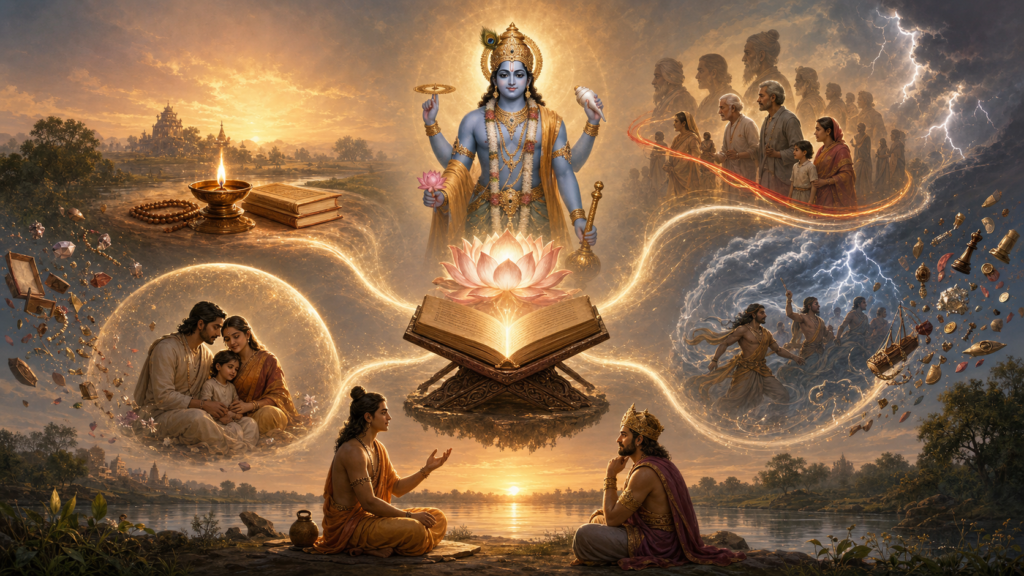
Nirvikalpaka samadhi, frequently compared with asamprajnata samadhi, describes absorption beyond all conceptual distinctions. In this unconditioned stillness, the knower-known division dissolves and non-dual awareness stands self-revealed. Advaita Vedanta frames this as recognition of Brahman as the sole realityneither an altered state to be possessed nor an idea to be affirmed, but a cessation of superimposition in which truth shines by itself.
Experienced practitioners often describe a natural continuity between these modes. Savikalpaka stabilizes attention and purifies perception; nirvikalpaka consummates that purification in contentless clarity. Rather than a rigid hierarchy, the relationship is complementary: disciplined engagement with an object (or sacred focus) matures into effortless objectless awareness. In daily life, this translates into greater equanimity, ethical sensitivity, and a steady joy not dependent on circumstance.
Within the broader dharmic landscape, resonances are evident. In Buddhism, samadhi and the jhāna scheme cultivate deep unification that can open into insight regarding impermanence and non-self. Jain thought speaks of shukla dhyana, the pure contemplation culminating in serene stillness and liberation. Sikh tradition emphasizes Naam Simran, an absorption in the Divine Name that quiets the mind and centers the heart. While doctrinal frameworks differ, these streams share a commitment to ethical living, disciplined attention, and compassionate actionfoundations without which samadhi remains incomplete.
Classical sources also agree that preparation matters. Patanjali’s yama and niyamaahimsa, satya, asteya, brahmacharya, aparigraha, and the disciplines of purity, contentment, tapas, svadhyaya, and Ishvara-pranidhanastabilize character and align intention. Such ethical grounding protects practice from spiritual bypass and ensures that deep concentration bears the fruit of wisdom and humility rather than pride or alienation.
In practical terms, savikalpaka samadhi is cultivated through focused dhyana: sustained attention to breath, mantra japa, visualizations of deities, or inquiry into the sense of “I.” Many find that devotion (bhakti) softens the heart and eases concentration, while discriminative inquiry (viveka) clarifies understanding. Over time, effort relaxes as attention learns to abide in its own luminosity.
Nirvikalpaka samadhi is not forced by will; it often unfolds as a natural easing of effort when conceptual elaboration grows silent. In Advaita, the neti-neti approachgently releasing identification with body, senses, and thoughtssupports this recognition. In meditative phenomenology, the transition may feel like the vanishing of the meditator at the very moment of most lucid presence. What remains is uncontrived awareness, limitless and self-known.
Common misconceptions are worth dispelling. First, nirvikalpaka is not escapism; it clarifies engagement rather than negates it. Second, savikalpaka is not “lesser”; it is a precise and indispensable refinement of attention. Third, samadhi does not negate ethics; it intensifies compassion and responsibility. Across Hinduism, Buddhism, Jainism, and Sikhism, genuine realization expresses itself as service (seva), non-harm, and reverence for life.
Integrating these insights into daily rhythms is straightforward yet profound. Short, regular meditation fosters one-pointedness; mindful pauses between tasks preserve clarity; contemplative reading of Upanishads, Yoga Sutra, or bhakti poetry nourishes aspiration; and acts of kindness sustain the heart’s openness. With consistent practice, savikalpaka’s steady light naturally reveals nirvikalpaka’s boundless sky.
For contemporary seekers, the proven path remains simple: ethical living, sincere practice, and humility in the face of mystery. Samadhi is less a rarefied peak than an ever-deepening intimacy with the real. The dharmic traditions agreeauthentic realization unites rather than divides, honors diversity while revealing a shared ground, and transforms insight into compassionate presence in the world.
In this comparative lens, savikalpaka and nirvikalpaka samadhi emerge not as competing endpoints but as harmonious movements of the same awakening. The first refines and illumines; the second completes and liberates. Together they offer a complete map for inner freedomrooted in Hinduism, resonant across Buddhism, Jainism, and Sikhism, and relevant to every sincere practitioner today.
Inspired by this post on Hindu Blog.