
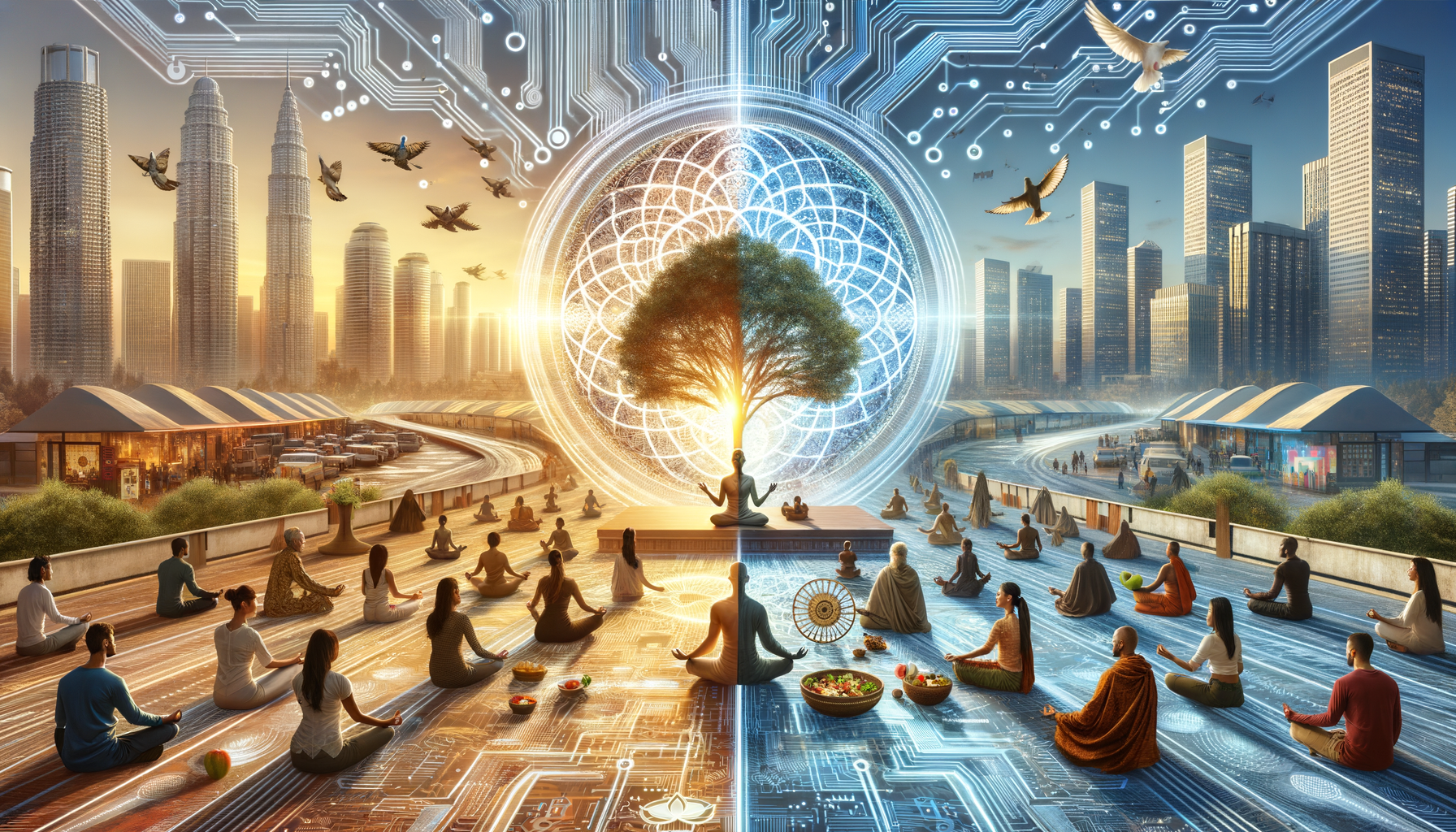
The modern world celebrates extraordinary scientific advancements and technological progress in medicine, engineering, and communication. Yet a paradox persists: discontentment, inner turmoil, and violence appear to be increasing. From a dharmic perspective, this divergence is not surprising. Material capability has accelerated faster than moral clarity and inner stability, creating a widening gap between what can be done and what should be done.
Through the lens of Hindu philosophy, this condition reflects avidyāmisapprehension about the self and the purpose of lifecombined with the agitation of rajas and the inertia of tamas. When attention is fragmented by relentless information flows and desires are continually amplified by consumerist incentives, the mind loses inner balance. The result is heightened anxiety, polarization, and the normalization of subtle and overt violence, even as external comforts multiply.
Dharmic traditions offer convergent insights for this crisis. Hinduism emphasizes dharma as the organizing principle for individual and social harmony, with the Bhagavad Gita pointing to inner mastery (yoga) as the basis for wise action (karma yoga) and social welfare (lokasaṅgraha). Buddhism underscores karuṇā and mindful awareness to transform dukkha. Jainism grounds ethics in ahiṁsā and anekāntavādacultivating non-violence and intellectual humility by acknowledging multiple viewpoints. Sikhism centers on sewa, courage, and inner remembrance (nāṃ simran) to anchor ethical action. Together, these paths articulate a shared civilizational insight: outer peace depends on inner order.
Practical disciplines make these insights tangible. Yogathrough āsana, prāṇāyāma, and dhyānasteadies attention and reduces reactivity. Mindful ethics in daily life curbs impulsive speech and action, while sewa and dāna reorient the self from consumption to contribution. Satsang and learning circles support community resilience. Anekāntavāda refines public discourse by encouraging multivocal reasoning instead of zero-sum certainty. These time-tested practices translate spiritual insight into measurable reductions in stress, aggression, and social distrust.
Applied at scale, dharmic values can inform institutions and policy. Education that integrates character formation with scientific literacy aligns capability with conscience. Media and technology design that favors responsibility over outrage reduces performative conflict. Justice models that embody the principle of minimum violence emphasize restoration, not escalation. In civic life, the Gita’s ideal of lokasaṅgraha inspires leadership that balances efficiency with empathy, aligning progress with the common good.
Many observers recognize a striking pattern: when individuals cultivate sattvaclarity, compassion, and steadinessrelationships heal, workplaces become more humane, and communities grow safer. Scientific triumphs then serve, rather than steer, human life. The dharmic synthesis across Hinduism, Buddhism, Jainism, and Sikhism does not erase differences; it harmonizes them into a shared ethic of inner discipline, non-violence, service, and pluralism. Such unity in spiritual diversity offers a credible path to reduce discontentment and violence without abandoning modernity’s gifts.
In sum, the paradox of progress is resolved by pairing outer innovation with inner transformation. When technological power is guided by dharma, ahiṁsā, karuṇā, and sewa, scientific advancements uplift rather than unmoor society. This integrated approachrooted in India’s civilizational wisdomoffers practical hope for inner peace and social harmony in an age of unprecedented change.
Inspired by this post on Hindu Blog.










