
Madhvacharya’s pathway to God begins with a deeply consoling idea: the Divine is the sanctuary of those who grow weary while walking through worldly existence. In this vision, spiritual life is not a cold intellectual exercise or a remote theological abstraction. It is the movement of a vulnerable human being toward a living refuge. The devotee may pass through fatigue, moral confusion, attachment, fear, and repeated disappointment, yet the path is not without protection. God is understood as the supreme shelter for those who seek Him through intense devotion, and this confidence gives the devotee strength to continue without despair.
This teaching is central to the devotional and philosophical world associated with Madhvacharya, the great Vaishnava acharya of the Dvaita Vedanta tradition. His approach gives theological depth to bhakti by insisting that the relationship between the individual soul and the Supreme is real, meaningful, and enduring. Human dependence on God is not treated as weakness; it is treated as spiritual clarity. The soul becomes stronger when it recognizes its dependence on the Divine, just as a traveler becomes more secure after finding a trustworthy guide across difficult terrain.
The original teaching emphasizes that God protects those who seek protection through sincere devotion. This does not imply that worldly life suddenly becomes free of hardship. Rather, it means that hardship is no longer interpreted as abandonment. The devotee’s journey through material existence becomes meaningful because it is held within a larger divine order. Under such confidence-inspiring circumstances, a devotee need not despair during the sojourn in this material world. The heart may still feel burdened, but it is not spiritually homeless.
In Madhvacharya’s Dvaita philosophy, God is not an impersonal principle absorbed into the individual self. The Supreme Lord, especially identified with Vishnu and Krishna in the Madhva tradition, remains eternally distinct from the individual soul. This distinction is not a barrier to intimacy; it is the condition that makes devotion possible. Love requires relation, and relation requires difference. The devotee worships, remembers, serves, and surrenders because the Lord is real, personal, independent, and infinitely compassionate.
The eradication of inner enemies such as passion and anger is described as essential to dedication to the Lord. This point gives Madhvacharya’s pathway a strong ethical foundation. Devotion is not merely emotional enthusiasm or ritual correctness. It requires inner purification. Anger, pride, greed, jealousy, and uncontrolled desire are not treated as minor psychological inconveniences; they are forces that cloud judgment and obstruct spiritual vision. A person may speak of devotion, but if the inner life remains dominated by hostility and ego, the movement toward God remains incomplete.
This emphasis is highly practical. In ordinary life, many people discover that spiritual practice becomes most difficult not during public worship but in private reactions: resentment after insult, impatience during frustration, pride after success, or despair after failure. Madhvacharya’s teaching directs attention to this inner battlefield. The pathway to God is walked through worship, scripture, and remembrance, but also through the disciplined transformation of emotion and conduct. Devotion matures when it reshapes character.
Moksha, or total liberation, is presented as a gift that only God can grant. This is a crucial feature of Madhva thought. Human effort matters, scriptural study matters, ethical conduct matters, and devotional practice matters; yet liberation is not reduced to a mechanical result produced by human achievement. Divine grace remains decisive. The soul does not conquer God through austerity or argument. It receives liberation through the Lord’s benign grace, which ends the painful cycle of repeated birth and death and brings redemption.
The idea of divine grace also prevents spiritual arrogance. A person may possess learning, ritual discipline, social standing, or philosophical skill, but none of these alone can replace surrender. In the Madhva tradition, knowledge and devotion are integrated, but knowledge must lead to reverence. The goal is not intellectual vanity; the goal is right understanding of reality, right orientation toward God, and right living within the cosmic order established by the Supreme.
Madhvacharya’s devotional poetry, especially the Dwadasastotra, occupies an important place in this spiritual world. The original account notes that the essence of his philosophy is contained in this hymn, which has traditionally been recited in Madhwa households during worship at the time of offering the “neivedya”. This detail is significant because it shows that philosophy was not confined to scholastic debate. It entered the home, the shrine, the voice, the meal offering, and the daily rhythm of devotion.
The Dwadasastotra is valued not only as poetry but also as theology in musical form. Composed in different metres and suited to devotional rendering, it demonstrates how Indian spiritual traditions often carry doctrine through beauty. A hymn can teach metaphysics; a melody can preserve philosophy; a household recitation can sustain a lineage of thought across generations. For devotees, such compositions are not ornamental additions to doctrine. They are living vehicles of remembrance.
The source tradition also mentions that in two chapters of the Dwadasastotra, Madhvacharya refers to the ten incarnations of the Lord, while in another he extols the divine Mother Sri Lakshmi. This devotional arrangement is meaningful because it places cosmic order, divine compassion, and sacred mediation within one theological frame. Vishnu’s incarnations reveal the Lord’s active concern for the world, while Sri Lakshmi is revered in the Madhva tradition as eternally associated with the Supreme and as a central presence in the devotional life of the community.
Madhvacharya’s assertion that the world of sentient beings is under the control of an intelligent Supreme Being reflects the realist foundation of Dvaita Vedanta. The world is not dismissed as a mere illusion without value. It is real, ordered, and morally significant. Human actions matter because the world is a field of responsibility. Devotion matters because the soul is real. Grace matters because bondage is real. Liberation matters because suffering within worldly existence is real.
This realism distinguishes Madhvacharya’s philosophy within the broader landscape of Vedanta. While different Vedantic traditions interpret the relation between God, soul, and world in distinct ways, Dvaita emphasizes an enduring difference between the Supreme, individual souls, and matter. For Madhvacharya, spiritual wisdom does not dissolve these distinctions into sameness. It understands them correctly. The soul’s fulfillment lies not in becoming identical with God but in realizing its dependent nature and serving the Supreme with devotion, knowledge, and humility.
The teaching also refers to an “unalterable settled hierarchy” governing ordinary existence. In Madhva theology, reality is structured, not chaotic. This hierarchy includes the Supreme Lord, Sri Lakshmi, liberated beings, divine personalities, individual souls, and material nature in ordered relation. Such hierarchy is not merely social or institutional; it is metaphysical. It points to a universe in which beings are distinct, capacities differ, and divine order gives meaning to spiritual aspiration.
Modern readers may find the language of hierarchy challenging, especially in a world sensitive to equality and dignity. A careful reading, however, shows that the spiritual purpose of this teaching is not contempt for others but recognition of dependence, order, and responsibility. Within a dharmic framework, humility before the Divine need not diminish compassion toward fellow beings. On the contrary, when the world is understood as governed by God, ethical conduct toward others becomes more serious, not less.
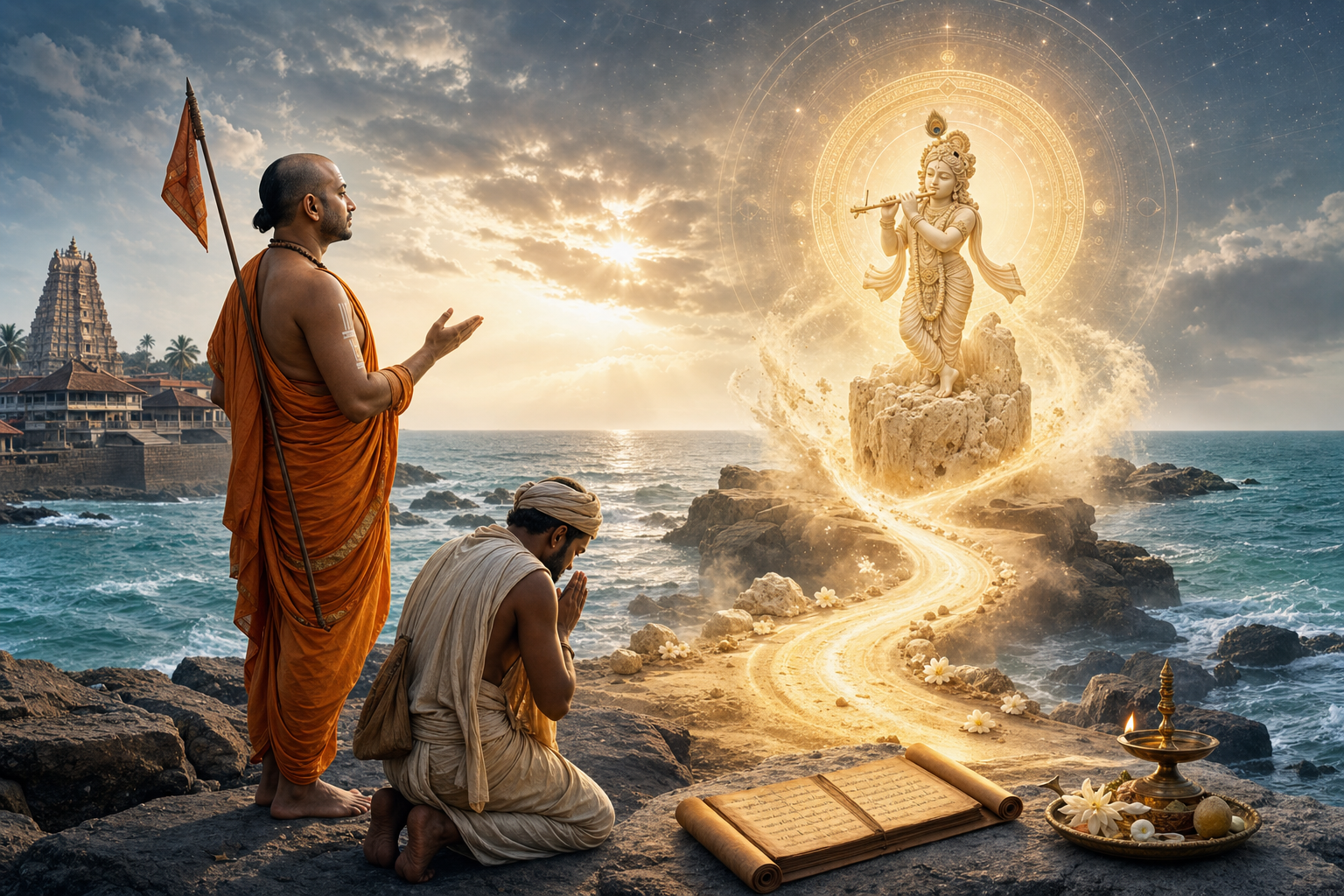
The well-known narrative of Madhvacharya and the Udupi Krishna idol gives this philosophy a memorable sacred geography. The account recalls that while Madhwa was performing his oblations on the western seashore, a merchant ship was caught in a storm. Through his prayers, the danger was quelled. When offered gifts in gratitude, he chose a block of “Gopichandana”. When it was split open, an idol of Lord Krishna emerged. Madhvacharya cleansed the idol and installed it at Udupi, where it became the focus of a major devotional tradition.
This story works at several levels. Historically and culturally, it connects Madhvacharya to the coastal devotional landscape of Karnataka. Theologically, it presents Krishna as hidden within a humble substance, revealed through grace, devotion, and discernment. Spiritually, it suggests that the Divine may be encountered where ordinary eyes see only clay, burden, or chance. The devotee’s task is to remain alert to sacred possibility even within the storms of worldly life.
The installation of Lord Krishna at Udupi also illustrates how philosophy becomes institution. The source account refers to the worship of this icon by eight Bala-sanyasis by turns, pointing toward the living ritual order associated with the Udupi Krishna tradition and the eight monastic institutions connected with Madhvacharya’s legacy. A philosophical insight survives more powerfully when it is embodied in temples, worship, teaching lineages, music, food offerings, pilgrimage, and disciplined community memory.
The pathway to God, as presented through Madhvacharya, therefore contains several interwoven elements: refuge in the Divine, destruction of inner enemies, disciplined devotion, scriptural understanding, reverence for Sri Lakshmi and Vishnu, recognition of the reality of the world, and dependence on divine grace for Moksha. No single element can be isolated from the rest. Bhakti without ethics becomes sentimentality. Knowledge without humility becomes pride. Ritual without surrender becomes habit. Grace without effort becomes presumption. Madhvacharya’s tradition holds these dimensions together.
This integrated approach also resonates with the wider family of dharmic traditions. Hinduism, Buddhism, Jainism, and Sikhism differ in theology, metaphysics, discipline, and vocabulary, yet all preserve serious concern for liberation, ethical purification, self-mastery, and freedom from ego-centered living. Madhvacharya’s path is specifically Vaishnava and Dvaita, but its call to humility, devotion, moral discipline, and transcendence can be appreciated in a broader dharmic conversation. Unity does not require flattening differences; it requires honoring them without hostility.
In contemporary life, Madhvacharya’s teaching remains relevant because spiritual exhaustion is not confined to any one era. People today may not describe their struggles in the classical language of samsara, but many recognize the same weariness: restless ambition, anxiety, moral distraction, fractured attention, and the feeling of being carried by forces one does not fully control. The image of God as sanctuary speaks directly to this condition. It offers not escapism, but orientation. It reminds the devotee that life’s burdens need not be carried in isolation.
The pathway also teaches that devotion is not passive. Seeking refuge in God does not mean abandoning responsibility. It means acting with clearer dependence, cleaner intention, and deeper remembrance. A devotee still studies, works, serves, worships, repents, and strives. The difference is that these actions are no longer performed as expressions of isolated ego. They become offerings within a sacred relationship.
Madhvacharya’s spiritual vision is therefore both comforting and demanding. It comforts because God is described as protector, sanctuary, and fulfiller of the devotee’s deepest aspiration. It demands because the devotee must confront anger, passion, pride, and ignorance. It comforts because Moksha depends on divine grace. It demands because grace is approached through sincerity, devotion, knowledge, and disciplined living. This balance gives the path its enduring force.
The hymn in praise of the Lord, as the original teaching observes, incorporates profound religious truths. Madhvacharya did not merely describe the goal of life; he also showed the way to reach it. That way is not a vague spirituality without form. It is a devotional discipline rooted in the reality of God, the reality of the soul, the reality of the world, and the saving power of grace. For the weary traveler in worldly existence, this remains a powerful message: the path may be difficult, but it is not abandoned by the Divine.
Inspired by this post on Hindu Pad.






Leave a Reply
You must be logged in to post a comment.