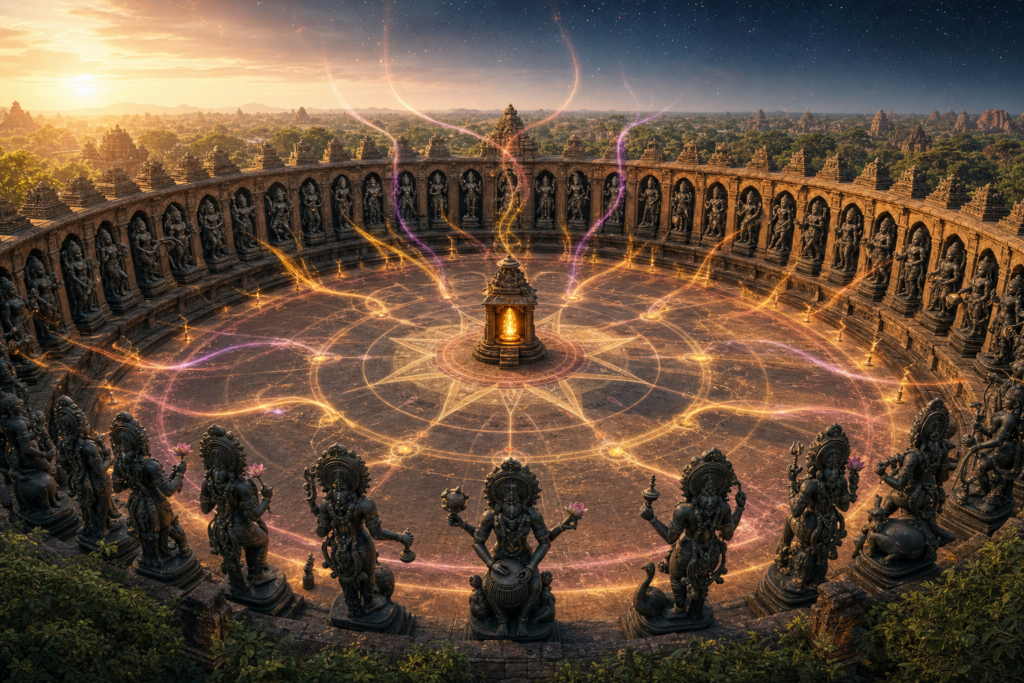
Jagadadhipati Siddhasunderstood as perfected beings aligned with the cosmic orderoccupy a distinctive place within Hindu spiritual traditions. The Sanskrit expression “Jagad Adhipati” means “lord of the universe,” an epithet traditionally applied to the Supreme (Vishnu, Shiva, or Devi). In many lineages, Siddhas are portrayed as those who, through realization of the universal Self, reflect that sovereignty inwardly and act outwardly as beneficent guardians of dharma.
Textual strands from the Purāṇas, Tantra, and Yoga-śāstra describe siddhas as beings who transcend ordinary limitations of time, space, and ego. While narratives often marvel at siddhis (extraordinary capacities), the deeper emphasis is on inner mastery: clarity (viveka), compassion (karuṇā), and steadfastness in truth (satya). In this sense, “Jagadadhipati Siddhas” are not merely miracle-workers; they embody sovereignty over the inner cosmos and serve the welfare of all beings.
Etymology and usage are instructive. “Jagad Adhipati” functions as a devotional title for the Supreme Reality and, by extension, for manifestations such as Jagannath. Siddhas appear throughout Hindu literature as witnesses, teachers, or protectors. The confluence of these ideas suggests a theological insight: when consciousness awakens to Brahman, the realized person reflects the cosmic rulership of the Divine through humility, service, and wisdom rather than domination.
Scriptural motifs further illuminate their role. The Purāṇas describe realms like Siddhaloka, while Yoga texts caution that siddhis are byproducts, not the goal. Upanishadic non-dualism (advaita) frames the highest attainment as abiding in the Self, which naturally flowers into universal goodwill. In practice, the mark of a Jagadadhipati Siddha is not spectacle but the quiet radiance of lokasangrahasustaining the world through wise action.
Across the Dharmic family, cognate ideas enrich this understanding. Jainism venerates Siddhas as liberated beings abiding in Siddha-śilā; Buddhism speaks of mahāsiddhas and bodhisattvas who work for universal liberation; Sikh tradition honors the Guru as a living guide who illumines the path of truth. While doctrines differ, a shared ethic of compassion, discipline, and inner freedom unites these visions, reinforcing the ideal of unity in spiritual diversity.
Multiple pathways converge toward such realization. In jñāna traditions, discernment reveals the Self as infinite awareness; in bhakti, loving surrender to one’s Ishta personalizes the cosmic; in yoga, integrated practice harmonizes body, breath, and mind; in tantra, sacred embodiment transforms perception. Hinduism’s acceptance of diverse methods reflects a confidence that truth can be approached from many angles without forsaking coherence.
For many practitioners, this teaching becomes tangible through lived moments: the expansive stillness felt after prāṇāyāma, the intimacy of mantra-japa, or the awe experienced before the murti of Jagannathvenerated as Jagad Adhipatiwhere personal devotion meets cosmic presence. Such experiences do not claim exclusive authority; rather, they inspire humility and a deeper commitment to ethical living.
Ethically, the Jagadadhipati Siddha ideal emphasizes responsibility over power. Mastery is measured by the capacity to alleviate suffering, uphold dharma, and honor the sanctity of all life. In contemporary terms, this translates into compassionate service, ecological reverence, social harmony, and a principled defense of pluralism among Hindu, Buddhist, Jain, and Sikh communities.
Historically, accounts of siddhas function as both inspiration and caution. They encourage disciplined practice while warning against attachment to phenomena. The focus returns again and again to the inner transformation that ripens into fearlessness, equanimity, and loving-kindnessthe true insignia of those who carry the mantle of cosmic stewardship.
In sum, the Jagadadhipati Siddhas exemplify a synthesis: transcendence without indifference, power without pride, and devotion without sectarianism. They remind seekers that the “lordship” of the universe is ultimately a call to serve the universehonoring the many paths within the Dharmic traditions while recognizing a shared horizon of wisdom and compassion.
Inspired by this post on Hindu Blog.