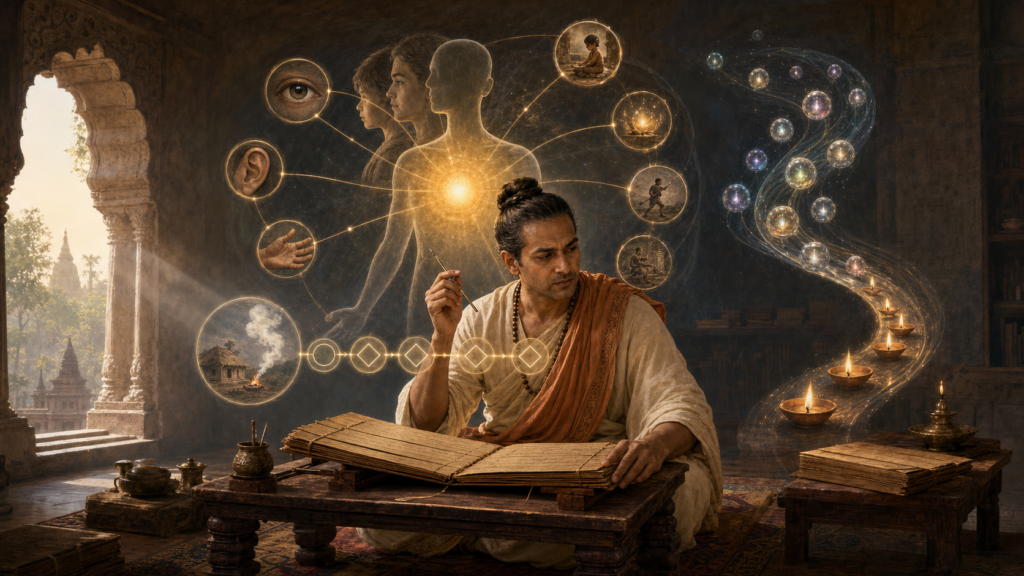
Iccha Mrityu, from the Sanskrit words “Iccha” (will or desire) and “Mrityu” (death), denotes the profound idea of death by will in Hinduism. It refers to the spiritual capacity to consciously choose the time and manner of one’s passing, grounded in mastery of mind, prana, and detachment. Within Hindu scriptures and philosophical discourse, this concept illuminates the intimate link between self-knowledge, ethical living, and liberation (moksha).
The Mahabharata presents the most celebrated illustration in Bhishma, who received the boon of Iccha Mrityu from King Shantanu. Struck on the battlefield and resting upon a bed of arrows, Bhishma deliberately awaited the auspicious turn of the sun toward Uttarayana before relinquishing the body. This narrative emphasizes sovereignty over the final transition as a fruit of unwavering dharma, tapas, and lifelong self-discipline.
Yogic literature and Hindu spiritual traditions describe related attainments where realized beings depart in a state of deep samadhi, sometimes termed “mahasamadhi” in later yogic lore. While textual sources vary in terminology and emphasis, the common thread is clear: conscious dying is portrayed not as escape, but as the culmination of inner mastery and clarity about the Atman’s immortality and the body’s transience.
Philosophically, Iccha Mrityu underscores that fearlessness at death arises from ethical conduct, steadfast meditation (dhyana), disciplined breath (pranayama), and a life aligned with dharma. It is never a license for self-harm; rather, it is depicted as a rare capability of the spiritually mature, consistent with ahimsa and responsibility toward community, family, and society.
Resonances appear across dharmic traditions, reinforcing unity rather than division. In Buddhist sources, the Buddha’s parinirvana is portrayed with foreknowledge of the time of passing, signifying serene mastery. Jain practice includes Sallekhana, a rigorously ethical vow of mindful fasting near the natural end of life, undertaken with equanimity and under strict guidance. Sikh teachings emphasize fearless acceptance of Hukam and describe the Gurus’ passing as joti jotlanguage that conveys serene union with the Divine. While each tradition maintains its own framework and safeguards, all affirm a dignified, conscious relationship with mortality.
Contemplating Iccha Mrityu can be ethically and emotionally transformative in contemporary life. Many find that honest reflection on mortality nurtures compassion, reduces anxiety, and deepens gratitude for each moment. Those who accompany loved ones at the end of life often observe that a calm presence, prayer, and mindful breath foster serenityan echo of the scriptural ideal of conscious transition.
Spiritual disciplines that cultivate claritysuch as meditation, scriptural study, selfless service (seva), and thoughtful breath practicesare presented as pathways to inner steadiness rather than techniques to “achieve” death by will. The goal is not power, but wisdom: to live so ethically and attentively that dying becomes an extension of conscious living, aligned with Sanatana Dharma’s vision of liberation.
Ultimately, Iccha Mrityu invites a humane and unifying outlook: life is to be cherished, relationships to be honored, and the last breath to be faced without fear. Read through the lens of dharmic unity, the concept encourages mutual respect among Hinduism, Buddhism, Jainism, and Sikhism, affirming that mindful, ethical living prepares one to meet death with gracetransforming an ending into a conscious passage toward spiritual freedom.
Inspired by this post on Hindu Blog.