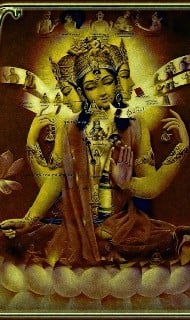
Beholding the unlimited opulence of Krishna and the manifestation of many other Brahmas, the Brahma of this universe felt as small as a rabbit among elephants. Reflecting on this vision, the following confession of limitation offers timeless guidance: ‘There are people who say, ‘I know everything about Krishna.’ Let them think in that way. As far as I am concerned, I do not wish to say very much about this matter. O my Lord, let me say this much. As far your opulences are concerned, they are all beyond the reach of my mind, body and words.’ [SB 10.14.38]
This recognition of one’s smallness illustrates the ‘Law of Contrast’: contemplating those greater than oneself clarifies true position and proportion. Though every person carries a measure of ‘Isha’—a modest capacity to influence or control—such power is negligible when compared first to the devas and ultimately to the Supreme Isvara, Lord Shri Krishna. This sober comparison refines Hindu spirituality and bhakti by aligning perception with reality rather than with egoistic self-appraisal.
Within classical bhakti understanding, the living being is never the independent doer; one must be empowered even to accomplish the simplest task—what to speak of great achievements. Any influence, intelligence, devotion, wealth, learning, or beauty that appears in a life is best understood as entrusted opulence, meant for service rather than self-display. This orientation shifts the axis from entitlement to gratitude, from acquisition to seva, and from ownership to responsibility under dharma.
Such humility is not only a Vaishnava virtue; it resonates across dharmic traditions. In Buddhism, the contemplation of impermanence and śūnyatā softens possessiveness; in Jainism, anekantavada and aparigraha invite restraint and multidimensional understanding; in Sikhism, hukam and seva cultivate surrender and service. Across these streams, ego is disciplined, compassion is expanded, and action is purified.
Practically, this perspective reframes personal success: recognition, capability, and even Krishna consciousness itself function as opportunities to serve. As this matures, the identity that matters most is that of a contributor. The question, then, is not how much one controls, but how faithfully one engages received gifts for the benefit of others in a spirit of devotion.
The reflection culminates in a simple ethic with profound reach across bhakti and wider Vedic philosophy: whatever has been given is given for service. In that light, the perennial aspiration becomes clear—givers and servants, not takers or masters—redirecting life toward humility, responsibility, and love-centered action under the shelter of Lord Shri Krishna.
Inspired by this post on Dandavats.