The contemporary fascination with longevity often conceals a deeper intuition: human awareness senses that it is not exhausted by a single bodily lifespan. Within dharmic knowledge systems—Hinduism, Buddhism, Jainism, and Sikhism—this intuition is articulated through distinct yet converging frameworks. Hindu philosophy identifies the imperishable conscious principle as atman, apparently journeying through saṁsāra under the law of karma; Buddhist analyses trace the aggregates that produce the sense of self and emphasize freedom from suffering; Jain thought affirms the beginningless jīva enmeshed in karmic matter; Sikh teachings direct the mind toward remembrance of the Divine Name (Naam) and selfless service (seva). Across these traditions, the shared question beneath the search for “more years” is clear: how can a finite life align with what is abiding?
Biological longevity by itself does not fulfill that aspiration. Consider the emblematic giant Sequoia—vast, long-lived, and biologically astonishing—yet fixed in place and mute to relational meaning. Dharmic philosophies consistently suggest that the human telos is not mere duration but rightly directed consciousness, ethical clarity, and loving service. What is sought is not the permanence of stasis, but the continuity of living wisdom: a luminous steadiness of awareness and action that neither bodily change nor external upheaval can sever.
Classical Hindu sources frame this insight with technical precision. The Upanishadic corpus states that the conscious principle is unborn and undying, while the Bhagavad-Gita teaches that weapons do not cut it, fire does not burn it, and time does not diminish it. The cycle of birth and death—saṁsāra—arises as conditioned experience propelled by karma, and liberation (moksha) consists in freeing awareness from ignorance (avidyā) and misidentification with the transient. This framework does not deny change in the material field; rather, it clarifies that the witness-consciousness remains irreducible and that knowledge aligned with dharma can end the compulsion to transmigrate.
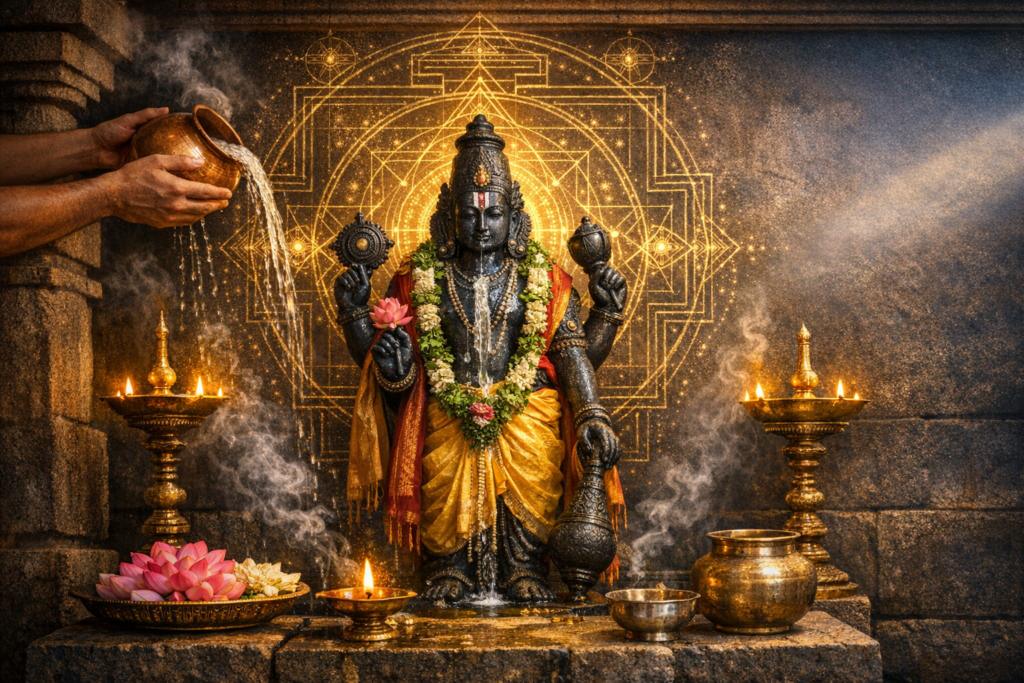
Within Vaishnava thought, the teleology of consciousness is expressed as devotional service (bhakti) to Krishna that is unmotivated and uninterrupted—ahaituky apratihata—culminating in an eternal, blissful relationship with the Divine. Eternity here is not a static backdrop but a living reciprocity: conscious persons engaging in dynamic service in an eternal realm, with an eternal spiritual body characterized by knowledge and joy. In this reading, “touching eternity” is not an abstract metaphysical state; it is relational, affective, and ethical—service-centered awareness that endures.
Yet the lived condition frequently falls short of that ideal. Service becomes episodic, fragmented by distraction, and motivated by personal gain—precisely the opposite of ahaituky apratihata. Classical psychology in the dharmic traditions identifies how rajas (restless passion) and tamas (inertia and confusion) obscure sattva (clarity and harmony), interrupting practice and re-entrenching habit patterns that bind one to repeated birth and death. The recognition of this gap is not defeatist; it is diagnostic. It reveals exactly where refinement is needed.
A relatable illustration clarifies the psychology of resistance. A determined toddler’s reflexive “no”—to dinner, to shoes, to any reasonable redirection—mirrors an adult mind’s status quo bias. Even when a better course of action is evident, ingrained preference for the current activity resists transition. Dharmic disciplines name this akarmaṇya-pravṛtti (a tendency toward inaction or misdirected action) and propose graduated training of attention and intention to soften that reflexive resistance. The analogy is simple but exact: inner growth requires learning to say “yes” to what truly nourishes awareness.
Bhakti-yoga presents a structured pathway from motivated, inconsistent practice to steady, intrinsic devotion. Foundational engagements—śravaṇa (attentive hearing of sacred knowledge), kīrtana (vocal remembrance, including the Hare Krishna mantra), smaraṇa (contemplative recollection), and seva (service)—steadily reshape the inner landscape. As habits of remembrance replace habits of distraction, anarthas (unhelpful tendencies) diminish; attraction (ruci) matures into deep attachment (āsakti), which matures into compassionate, causeless loving disposition (bhāva), and ultimately love (prema). The progression is technical, time-tested, and empirically verifiable through its effects on conduct, equanimity, and relationships.
The same architecture of transformation appears—adapted to respective metaphysics—across the dharmic spectrum. In Buddhism, carefully cultivated mindfulness (sati), insight (vipassanā), and loving-kindness (mettā) recondition perception, attenuate craving, and dissolve suffering. In Jainism, vows (vrata), curbing of inflows (saṁvara), and shedding of karmic accretions (nirjarā), anchored in ahiṁsā and aparigraha, refine consciousness toward liberation. In Sikhism, Naam Simran, kirtan, and seva reorient identity around the Divine and community. The shared ethic is striking: disciplined remembrance and compassionate service cultivate a continuity of awareness far more consequential than biological longevity alone.
Philosophical nuances remain. Hindu discourse affirms an eternal atman; Buddhist analyses deconstruct a permanent self to relieve attachment; Jain philosophy describes the liberated jīva; Sikh teachings emphasize devotion to the Timeless (Akal) and the transformative power of the Name. Rather than contradiction, these can be read as complementary emphases, each reducing egocentrism and enhancing compassionate clarity. All align on the practical necessity of training attention, purifying intention, and embodying seva in daily life—an inter-traditional unity that this reflection affirms.
Translating this into practice benefits from a concrete, sustainable design. A daily anchor of contemplative discipline—such as morning śravaṇa, Nama-japa, or reflective reading (svādhyāya)—stabilizes the mind before the day’s complexity unfolds. Brief midday resets preserve clarity, while evening gratitude or kīrtana consolidates learning. Intentionally chosen acts of seva—family care offered as worship, professional integrity under dharma, and community support—convert ordinary contexts into continuous practice. The measure of progress is simple and rigorous: is attention steadier, motivation purer, speech kinder, and service less self-referential?
This reframing also clarifies the role of health and lifespan. Dharmic teachings do not reject longevity; they simply deny it pride of place. Health becomes the support, not the purpose, of spiritual work. Instead of chasing extreme biohacking, the aspiration turns toward a livable rhythm that optimizes clarity, compassion, and service. When duration aligns with devotion, years amplify meaning; when it does not, added years may only prolong confusion.
In this light, “touching eternity” ceases to mean prolonging the body or escaping the world and comes to mean inhabiting the world from an eternal orientation. In Hindu vocabulary, it is aligning atman with Sanatana Dharma and, in the bhakti tradition, cultivating ahaituky apratihata devotion to Krishna. In cognate terms across Buddhism, Jainism, and Sikhism, it is abiding in an unbroken ethic of remembrance and compassionate action that loosens the knot of self-centeredness. The outward forms vary; the inner continuity is one.
Such continuity matures as emotional resilience. Interruptions—inevitable in ordinary life—no longer sever the thread of practice. The toddler-like “no” that once blocked beneficial redirection is gradually replaced by a measured “yes” to what nourishes awareness. Over time, this resolves the original paradox: the longing for permanence is fulfilled not by standing immobile like a Sequoia, but by moving through life as a conduit of service. What endures is the quality of consciousness—lucid, compassionate, relationally alive—through which every moment is offered.
The dharmic synthesis is therefore both analytically precise and experientially generous. It distinguishes the imperishable from the perishable, critiques the obsession with mere duration, and offers a skillful path—bhakti, mindfulness, vows, and seva—through which the finite touches the timeless. Seen this way, the quest for longevity transforms into a wiser project: to cultivate an unbroken current of devotion and service that, by its very nature, partakes of eternity.
Inspired by this post on Dandavats.