The Bhagavad Gita presents a clear principle: the state of mind at the time of death shapes the next destination. Allowing an untrained mind to determine that moment’s direction is risky, given how quickly attention oscillates between calm and turbulence. A deliberate inner discipline becomes essential, one that steadily orients thought and affection toward the Divine—Hare Krishna—so that remembrance arises naturally when it matters most.
Such training is the work of Bhakti, a practice that refines attention through love-infused remembrance (nama-smaraṇa) and service (seva). Within the broader dharmic family, kindred methods cultivate the same steadiness of heart and mind: mindfulness and maitri-karuṇā in Buddhism, anupreksha in Jainism, and simran in Sikhism. Although the language and symbols vary, these paths harmonize around a shared insight: disciplined affection for the Highest becomes the mind’s refuge in life’s most critical threshold.
Love proves to be a powerful regulator of attention. Where the heart rests, the mind follows. When affection for Krishna matures through daily practice, the reflex at a crisis point is to call out to Krishna and seek shelter there. The Bhagavad Gita’s guidance is thus practical rather than abstract: by aligning feeling and focus now, the end-of-life mind-state becomes a predictable extension of daily habit.
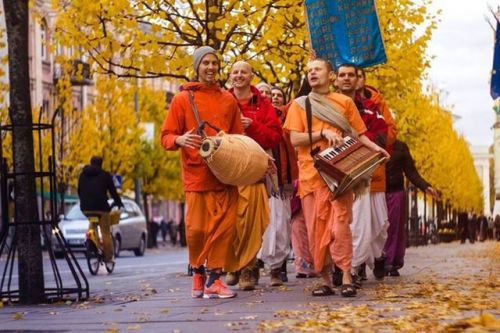
Daily application preserves this teaching. Japa, kirtan, contemplative reading of sacred texts, ethical living rooted in dharma, and moments of breath-aligned remembrance during ordinary tasks form a reliable training ground. Over time, these micro-rituals condition the mind to return to its chosen Ishta without strain, much like a well-rehearsed pathway that the mind traverses almost automatically.
Many practitioners observe that in moments of fear, grief, or uncertainty, the tongue spontaneously utters the Divine Name and the heart settles. This is not sentimentality; it is the fruit of consistent sadhana. Across dharmic traditions, similar testimonies arise: simran softens distress, maitri-bhavana steadies the breath, and anupreksha clarifies perception. Each method refines the same capacity—to return to what is most deeply loved and trusted.
Unity emerges naturally from this insight. Whether the Name remembered is Krishna, Rama, the Tirthankaras, or the Guru, the orientation is toward the Supreme Truth. The practices of Bhakti, mindfulness, simran, and reflective contemplation all cultivate inner peace, ethical clarity, and readiness for the final transition. This shared commitment strengthens cohesion among Hinduism, Buddhism, Jainism, and Sikhism without diminishing the distinctiveness of each path.
Ultimately, the counsel is compassionate and precise: train the mind through love and disciplined remembrance now, so that at the final moment there is no struggle—only shelter. With a heart anchored in Krishna, or in one’s chosen Ishta, the destination follows the affection. In this way, love does not merely soothe the mind; it guides it—at the time of death and beyond.
Inspired by this post on Dandavats.