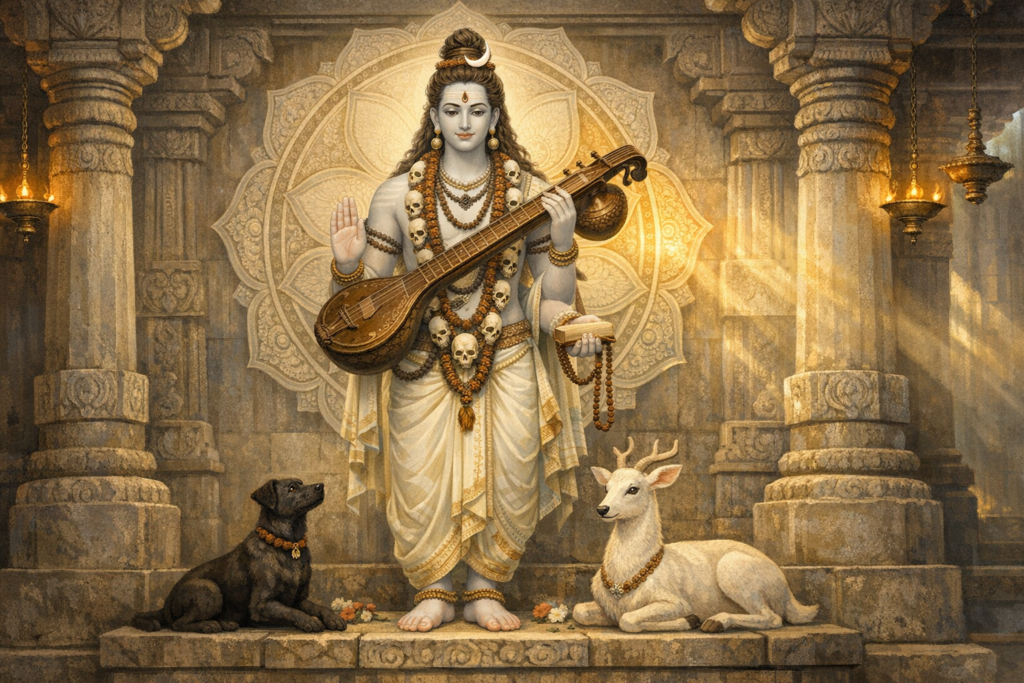
The unaffected witness, often expressed as sakshi-bhava, stands at the heart of Hinduism’s contemplative disciplines. It describes a steady awareness that observes thoughts, emotions, and impulses without attachment, judgment, or interference. Far from being abstract, this practice is deeply practical and accessible, guiding everyday decisions toward clarity and composure while remaining anchored in the rich insights of the Upanishads, the Bhagavad Gita, and Yoga philosophy.
Within Vedanta, the witness is identified with the luminous Atman, the ever-present consciousness that knows mental movements yet remains untouched by them. In the Bhagavad Gita, the cultivation of equanimity (samatva) and the recognition of the inner seer (drashta) point toward this stance of spacious awareness. Classical Yoga frames the same ideal through pratyahara and dhyana, where attention is gently withdrawn from distractions and settled into steady, non-reactive observation.
The significance of sakshi-bhava becomes evident amid contemporary pressures—notifications, rapid news cycles, and demanding timelines. Observing the mind as it reacts allows a moment of freedom between stimulus and response. In that space, ethical discernment (viveka) matures, emotional balance stabilizes, and action aligns more closely with dharma. Readers often notice that even brief moments of witnessing reduce reactivity and restore calm.
Simple, consistent methods build this capacity. Breath awareness through pranayama centers attention and signals safety to the nervous system. A short daily period of dhyana—beginning with ten minutes—makes the witnessing stance familiar. Japa steadies attention with sound and rhythm, while informal mindfulness throughout the day—labeling experiences such as “thinking,” “planning,” or “worrying”—keeps awareness clear and kind. When strong emotions arise, pausing to notice body sensations and thoughts, without suppressing or indulging them, nurtures compassionate clarity.
This orientation to the mind unifies the shared ethos of the dharmic traditions. Buddhism’s vipassana refines careful, non-judgmental observation of mental phenomena. Jainism’s samayik cultivates equanimity and ethical attentiveness in the present moment. Sikh practice emphasizes simran and a stable sehaj (natural ease) that softens reactivity and centers awareness in the Divine. Together, these pathways affirm a common vision: clarity without harshness, steadiness without indifference, and unity in spiritual diversity.
Scriptural themes reinforce that witnessing does not imply passivity. While one remains inwardly undisturbed, outward engagement remains skillful through Karma Yoga—acting without clinging to outcomes. The Upanishadic insight into the Atman as sakshi, the Gita’s guidance on samatva, and Yoga’s emphasis on steady attention together describe a mind capable of compassionate action precisely because it is not driven by unexamined impulses.
Everyday moments become opportunities to practice. During a crowded commute, attention can rest with the breath while observing irritation come and go. In a difficult conversation, noticing tightening in the chest or rapid thoughts creates room for a measured response. While scanning news or social media, seeing the pull of distraction allows conscious choice. Over time, these small acts of witnessing accumulate into notable stability and clarity.
Common misunderstandings deserve care. Witnessing is not suppression; it welcomes the full range of experience and lets it pass naturally. Nor is it detachment in the sense of cold indifference; rather, it is warm, attentive presence that enables appropriate boundaries and empathy. This balance supports emotional resilience, thoughtful communication, and ethical decision-making in work, family, and community life.
With sustained practice, the mind grows lighter, more sattvic, and less compelled by momentary urges. Discernment (viveka) strengthens, reaction cycles shorten, and actions increasingly reflect wisdom rather than habit. In this way, the silent witness becomes both a path to inner freedom (moksha) and a foundation for harmony in society—honoring the unity of Hinduism, Buddhism, Jainism, and Sikhism while celebrating the diverse methods each tradition offers.
By returning to sakshi-bhava throughout the day—through pranayama, dhyana, japa, and moment-to-moment mindfulness—readers can master the mind with gentleness and precision. The result is a life lived with calm clarity, guided by enduring dharmic wisdom and enriched by a shared spiritual heritage that values many paths, one purpose.
Inspired by this post on Hindu Blog.