Accounts preserved in Srila Prabhupada Lilamrita and remembered across the early Krishna consciousness movement consistently portray Srila Prabhupada as profoundly personal in his dealings with devotees. The defining impression is not of a leader issuing demands, but of a spiritual guide who relished reciprocating love; this reciprocity, in turn, animated service, study, and community life. Such a relational ethos became one of the most attractive features of the movement’s formative years.
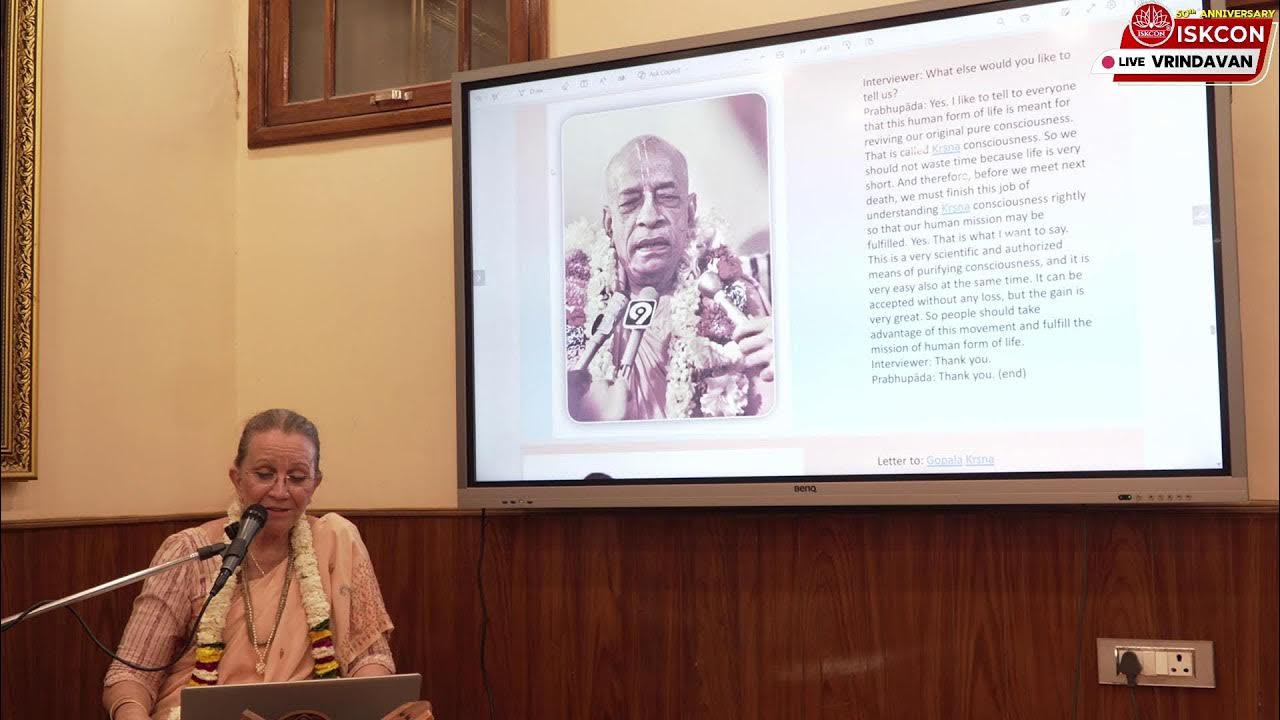
Recollections associated with senior Vaishnavas, including narratives linked with HG Kusha Mataji (29.03-2026), align strongly with this portrait. The emphasis falls on careful listening, tailored guidance, and the unwavering sense that each person’s spiritual journey mattered. Rather than a unidirectional expectation of service, Srila Prabhupada modeled a cycle of giving and receivingdevotees offered seva, and he returned profound care, clarity, and encouragement.
This personalism is anchored in Gaudiya Vaishnavism’s theological core. Bhakti-yoga is understood as a relationship with the Supreme Person, where love is inherently mutual and dynamic. The concept of acintya-bheda-abheda (inconceivable simultaneous oneness and difference) frames all interactions, including those between guru and shishya, as real and relational, not merely symbolic. Within this framework, the guru’s love does not abstract the disciple’s individuality; it illumines it.
From a practical leadership perspective, the early expansion of ISKCON (International Society For Krishna Consciousness) was inseparable from Srila Prabhupada’s ability to meet individuals where they wereculturally, emotionally, and intellectuallywhile steadily inviting them to deepen sadhana. Oral histories and letters from the 1960s–1970s frequently attest to a leader who remembered faces, circumstances, health concerns, and personal strengths, and who matched instruction to aptitude. This pastoral sensibility made demanding disciplinesjapa, seva, scriptural study, and sankirtanafeel humane and achievable.
The movement’s early appeal, particularly in multicultural urban environments, therefore cannot be fully explained by philosophy alone. The embodiment of that philosophy through reciprocal love created belonging. Many devotees describe how honest appreciation for their efforts, combined with firm but compassionate correction, sustained their enthusiasm through long days of service and rigorous daily schedules. In this, Srila Prabhupada translated complex theology into lived experience.
Srila Prabhupada’s interpersonal method can be analyzed as a multi-layered pedagogy. At the foundational layer (sambandha), he clarified identityjiva, Ishvara, and their eternal relationship. At the practice layer (abhidheya), he enacted bhakti-yoga through routines, mentorship, and community standards. At the goal layer (prayojana), he kept the telos of pure love of Krishna visible and emotionally resonant. Each layer was reinforced not only by instruction, but by gestures of personal attention that dignified the practitioner’s journey.
In organizational terms, this approach amounted to a culture of devotee care long before that vocabulary became common in institutional life. Governance-by-heart, combined with governance-by-scripture, created a balanced system where discipline did not feel distant or punitive. Devotees repeatedly report that being seen and knownby name, by service, by strugglemade sacrifice feel meaningful and sustainable. That emotional ecology was decisive in transforming a small devotional community into a global movement.
Comparatively, this personalist mode of bhakti resonates broadly with other dharmic traditions. The emphasis on compassionate guidance recalls the value of the sangha in Buddhism, where personal mentorship and community practice reinforce the path. In Jainism, the discipline of ahiṁsa and the teacher-disciple bond align with the ethic that spiritual progress is nurtured through attentive, individualized counsel. Sikhism’s ideals of seva and sangat similarly highlight how mutual care and shared remembrance ground spiritual endeavor in lived fraternity. Srila Prabhupada’s practice thus harmonizes with a wider dharmic ethos: disciplined paths flourish when shaped by reciprocal love and community support.
From a sociological vantage, personalism had measurable effects on retention, morale, and cross-cultural adaptation. In the early centers of ISKCON, devotees from diverse backgrounds found that rigorous commitmentsmorning programs, dietary vows, and public kirtanwere humanized by encouragement that felt immediate and sincere. Reciprocity mitigated culture shock, bridged generational gaps, and translated Sanskritic concepts into shared habits of care.
Theologically, reciprocal love is not sentimentalism; it is the grammar of bhakti. When devotees offered their limited time and energy, Srila Prabhupada returned transformative value in the form of clear purpose, scriptural grounding, and empowering trust. Such reciprocity constitutes a spiritual economy: the more love circulates, the more the collective capacity to serve expands. In Gaudiya Vaishnavism, this is consonant with the notion that Krishna’s mercy is both causeless and catalyzed by sincere endeavorthe devotee’s effort is met, multiplied, and made auspicious.
Leadership science provides another lens. Contemporary studies of high-reliability organizations and mission-driven nonprofits emphasize that psychological safety, role clarity, and recognition are critical to sustained performance. Srila Prabhupada’s methodpublicly appreciating devotees’ services, privately correcting when necessary, and consistently linking tasks to transcendental purposeanticipated these findings. The result was a robust volunteer culture aligned to a clear telos, with personal attention as the medium that kept that alignment intact.
The early history of the Krishna consciousness movement also suggests that personalism accelerates knowledge transfer. Complex practices such as deity worship, Sanskrit chanting, or editorial standards for publishing were learned faster and retained longer when teachings were conveyed through close mentorship. Devotees remember not only prescriptions but also the compassion with which those prescriptions were deliveredcompassion that made correction feel like care rather than censure.
There is a further philosophical nuance in Srila Prabhupada’s approach: truth transmission was dialogical. He invited questions, engaged doubts, and addressed real-life constraints without diluting principles. This dialogical stanceneither authoritarian nor permissiveallowed ideals to be internalized. Devotees were not merely following rules; they were learning to love the rules because they disclosed a relationship.
Importantly, this mode of engagement did not marginalize discipline. On the contrary, it enhanced it. Clear standards for chanting, diet, study, and service were consistently upheld, but their observance was infused with meaning by the affection that accompanied them. The paradox of personalism is that love makes austerity light and therefore more reliable over time.
These insights continue to be relevant to spiritual communities today. As institutions grow, scale can inadvertently distance leaders from practitioners. Srila Prabhupada’s example suggests structural remedies: decentralized mentorship, routine personal check-ins, cultures that celebrate small wins, and leadership training that prizes listening as a core competency. Such measures operationalize love so that it survives and even thrives at scale.
At the level of public theology, Srila Prabhupada’s personalism also offers a bridge to interfaith and intrafaith harmony within the broader dharmic family. Shared virtuescompassion, discipline, humility, truthfulness, and serviceprovide common ground across Hinduism, Buddhism, Jainism, and Sikhism. Emphasizing these convergences neither erases theological distinctiveness nor collapses meaningful differences; rather, it situates dialogue in a field of mutual reverence where personal care is the lingua franca.
From an educational standpoint, curricula that feature Srila Prabhupada Lilamrita alongside dharmic exemplars from other traditions can cultivate this integrative vision. Students discover how doctrines become durable when carried by love, and how institutions endure when animated by care. In such learning environments, philosophical depth and pastoral sensitivity reinforce each other.
There is also a communication lesson in these histories. Many early seekers were drawn not only by metaphysics but by the feeling of being welcomed and known. For contemporary outreachwhether through kirtan, cultural programs, or digital platformsthe same principle applies: let rigor be felt as kindness. When an invitation to practice arrives through evident concern for a person’s well-being, the mind opens; when respect accompanies instruction, the heart follows.
The narratives surrounding Srila Prabhupada repeatedly circle back to simple, human moments: a remembered name, a gentle word during illness, encouragement after failure, a smile that made a crowded temple feel like home. These gestures, small in isolation, aggregated into trust. Trust, in turn, allowed stricter disciplines to take root without resentment. This is the durable calculus of bhakti: relationship breeds responsibility; responsibility magnifies realization.
Strategically, personalism also mitigated burnout. Communities that reward effort with appreciation and practical support experience lower attrition and higher resilience. Devotees often testify that recognitionspiritual and socialmade demanding service joyful. When love is reciprocated, duty becomes delight.
Even at the level of textual engagement, reciprocation matters. Scripture study under compassionate guidance becomes a living dialogue rather than an abstract exercise. Learners not only parse commentary; they absorb the teacher’s mood. In Gaudiya Vaishnava terms, this is transmission of bhava, where emotion and understanding mature together.
The early movement’s public facekirtan, prasada distribution, and open-door temple culturewas thus the outward expression of an inward ethic: love given, love returned. That ethic resonates powerfully across dharmic traditions and offers a practical template for unity without uniformity. Communities flourish when they are both principled and personal.
In sum, the recollections preserved in Srila Prabhupada Lilamrita and echoed by early associates, including narratives connected with HG Kusha Mataji, converge on a single insight: Srila Prabhupada led by loving reciprocation. He did not merely ask for service; he dignified servers. He did not only defend doctrine; he humanized it. In doing so, he forged a culture within ISKCON whose enduring strength lies not simply in ideas, but in the way those ideas became care.
For contemporary seekers and leaders alike, the lesson is clear and actionable. Anchor teaching in relationship, pair clarity with compassion, and let standards be carried by affection. When love is reciprocal and duties are personalized, spiritual organizations do more than expandthey endure, inspire, and unite. This is the enduring promise of personalism: a path where devotion deepens as hearts meet.
Inspired by this post on Dandavats.