
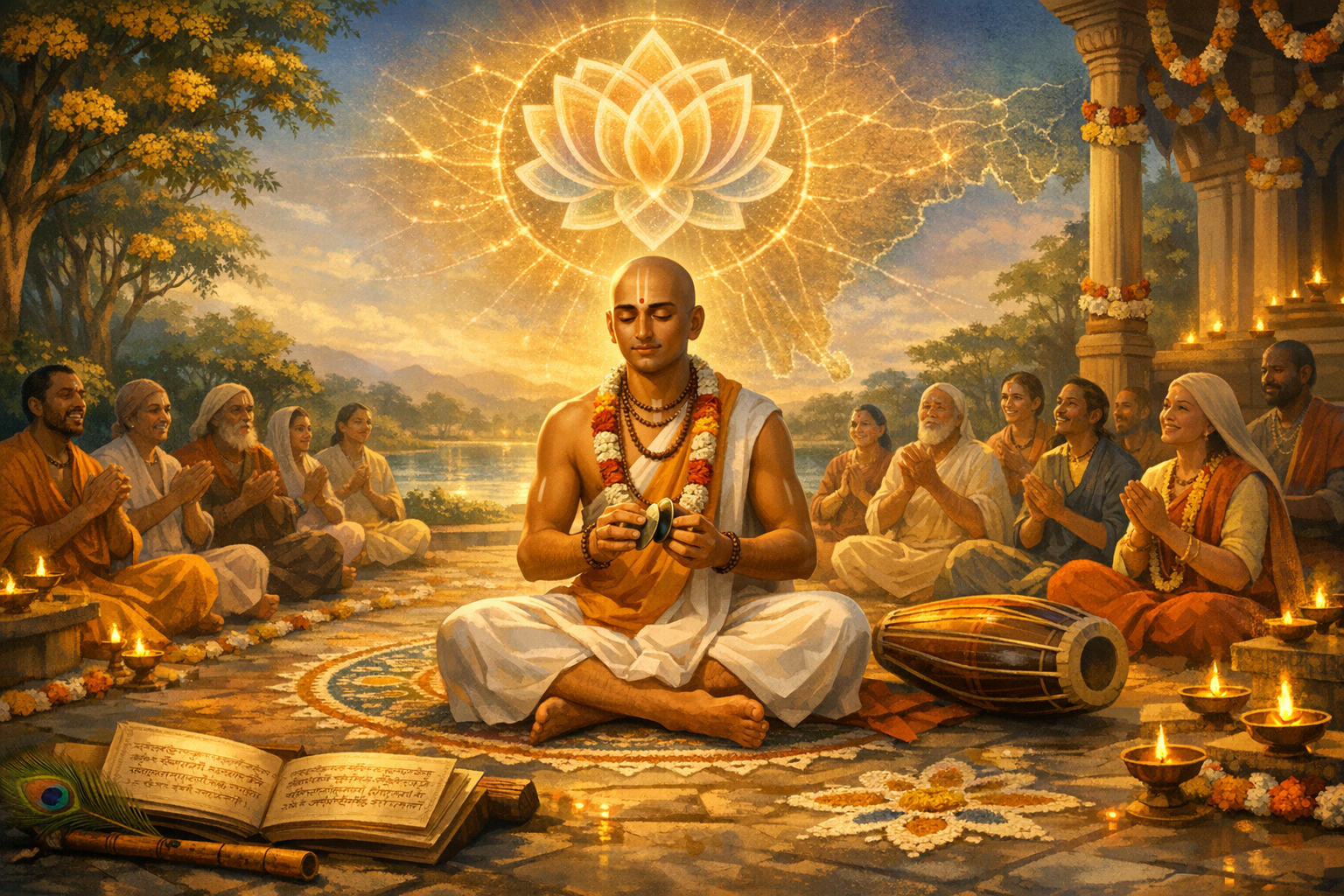
Narottama Dasa Thakura (c. 1534–early 17th century) is recognized as one of the principal architects of the Gaudiya bhakti tradition, the devotional current associated with Shri Chaitanya. Born in Kheturi of present-day Bangladesh, he translated the ecstatic love of Krishna into durable institutions of song, scholarship, and pilgrimage that reshaped Bengal and much of eastern India.
Born to Raja Krishnananda Datta, a local zamindar, Narottama Dasa Thakura received a classical education in grammar, poetics, and music and remained a lifelong bachelor (brahmachari). From childhood he felt a deep attraction to Shri Chaitanya, a devotion that, according to Gaudiya accounts, matured into a clear vocational calling to serve the bhakti movement.
Gaudiya hagiographies record formative spiritual experiences in which divine grace beckoned him toward Vrindavan, the sacred landscape of Krishna. Such narratives emphasize a spontaneous awakening of prema (divine love) as the driving force behind his later organizational and literary achievements, situating his life within a theology of grace, surrender, and service.
In Vrindavan he sought initiation from Lokanatha Goswami and pursued advanced study under Jiva Goswami. This training grounded him in achintya-bhedabhedasimultaneous difference-and-non-differenceand in raganuga-bhakti, the refined path of devotion modeled on the moods of Krishna’s eternal associates. Through rigorous practice and close mentorship, he internalized the Goswamis’ synthesis of scriptural hermeneutics, aesthetic theology (rasa), and disciplined sadhana.
Commissioned to carry the Gaudiya canon eastward, Narottama Dasa Thakura joined Srinivasa Acharya and Shyamananda Pandit in transporting the writings of Rupa, Sanatana, Jiva, and other Goswamis to Bengal and adjoining regions. Although the manuscript caravan was famously waylaid en route, the episode catalyzed far-reaching dialogues and conversions, embedding Vaishnava literature at the heart of devotional life and study circles across Gauda-Desha.
Returning to Kheturi, he convened the landmark Kheturi Mahotsava on Gaura Purnima, widely remembered as the first formal festival celebrating Shri Chaitanya’s appearance. The festival standardized kirtana melodies and sequences, affirmed Vaishnava etiquette, energized pilgrimage circuits, and forged a shared devotional calendaruniting dispersed communities that had previously functioned in relative isolation.
As a composer and singer, he codified a living repertoire that remains foundational to Gaudiya practice. His collectionsPrarthana and Prema-bhakti-candrikafunction as a sadhana manual in song, guiding practitioners through guru-tattva, nama-tattva, humility, repentance, remembrance, and longing for Krishna. These lyrical teachings became portable theology, carried in memory and melody from village akharas to urban congregations.
Technically, these compositions reveal a precise pedagogy: progressive engagement with the holy name, calibrated through regulative practice (vaidhi-sadhana) and deepened by cultivated inner remembrance (smarana). Structurally, they trace a path from śraddhā (initial faith) to prema (consummate love), aligning lyrical content with the sequential stages of bhakti articulated by the Goswamis and making the journey intelligible to householders and renunciants alike.
Musically, Narottama Dasa Thakura’s sankirtana emphasized congregational call-and-response, mridanga and kartala accompaniment, and raga selections suitable to time, mood, and festival. This integration of theology, poetics, and performance produced an accessible yet exacting culture of devotion that continues to train communities from Bengal to the global diaspora, evidencing how shared song can transmit sophisticated metaphysics without sacrificing emotional immediacy.
His social vision was equally decisive. By prioritizing the transforming power of the holy name over birth or status, he welcomed seekers from diverse backgrounds into disciplined devotional life, softening rigidities of caste and custom. In doing so, he aligned Gaudiya Vaishnavism with an ethic of compassion and inclusivity, expanding participation while maintaining rigorous standards of conduct and practice.
Geographically, the network he helped animate reached Bengal, Odisha, Assam, and Manipur, threading local idioms of devotion into a broader Gaudiya vocabulary. In each region, sankirtana served as a participatory bridgelinking householders and renunciants, scholars and artisansunder a shared commitment to Krishna-bhakti, communal service (seva), and congregational remembrance.
Throughout, Narottama Dasa Thakura remained a bachelor devoted to austere personal practice, rigorous teaching, and institution-building. Accounts of his final years situate his passing in the early 17th century, with memorial traditions preserved in and around Kheturi, where his organizational genius and devotional intensity are still commemorated.
From an intellectual standpoint, his synthesis demonstrates how achintya-bhedabheda informs praxis: the inconceivable unity-in-difference of the divine simultaneously authorizes intimate love and reverent service. This balance is voiced in lyrical humility, meticulous ritual standards, and the insistence that the holy name is both the means (sadhana) and the goal (sadhya) of spiritual life.
For contemporary readers, the relevance is practical. Prarthana reads like a field guide to emotional and ethical refinementcultivating patience, honesty, gratitude, and steadinesswhile Prema-bhakti-candrika offers stepwise alignment of daily life with remembrance of Krishna through japa, kirtana, seva, and satsanga. Many find that these songs translate profound theology into daily disciplines that sustain devotion amid modern pressures.
In a plural Dharmic landscape, this legacy naturally harmonizes with shared civilizational valuesnon-violence, self-discipline, truthfulness, and compassionate serviceresonant in Hindu, Buddhist, Jain, and Sikh traditions. Sankirtana’s open, participatory form models how devotion can nurture unity without erasing diversity, offering a practical template for social cohesion anchored in spiritual practice.
Narottama Dasa Thakura’s enduring influence is visible wherever Gaudiya Vaishnavism flourishes todayin village akharas, urban temples, and global congregations that carry his songs as living scripture. By wedding scholarship to song and festival, he ensured that love of Krishna would be both deeply personal and robustly communal, a vision whose clarity and compassion continue to inspire seekers across generations.
Inspired by this post on Hindu Pad.










