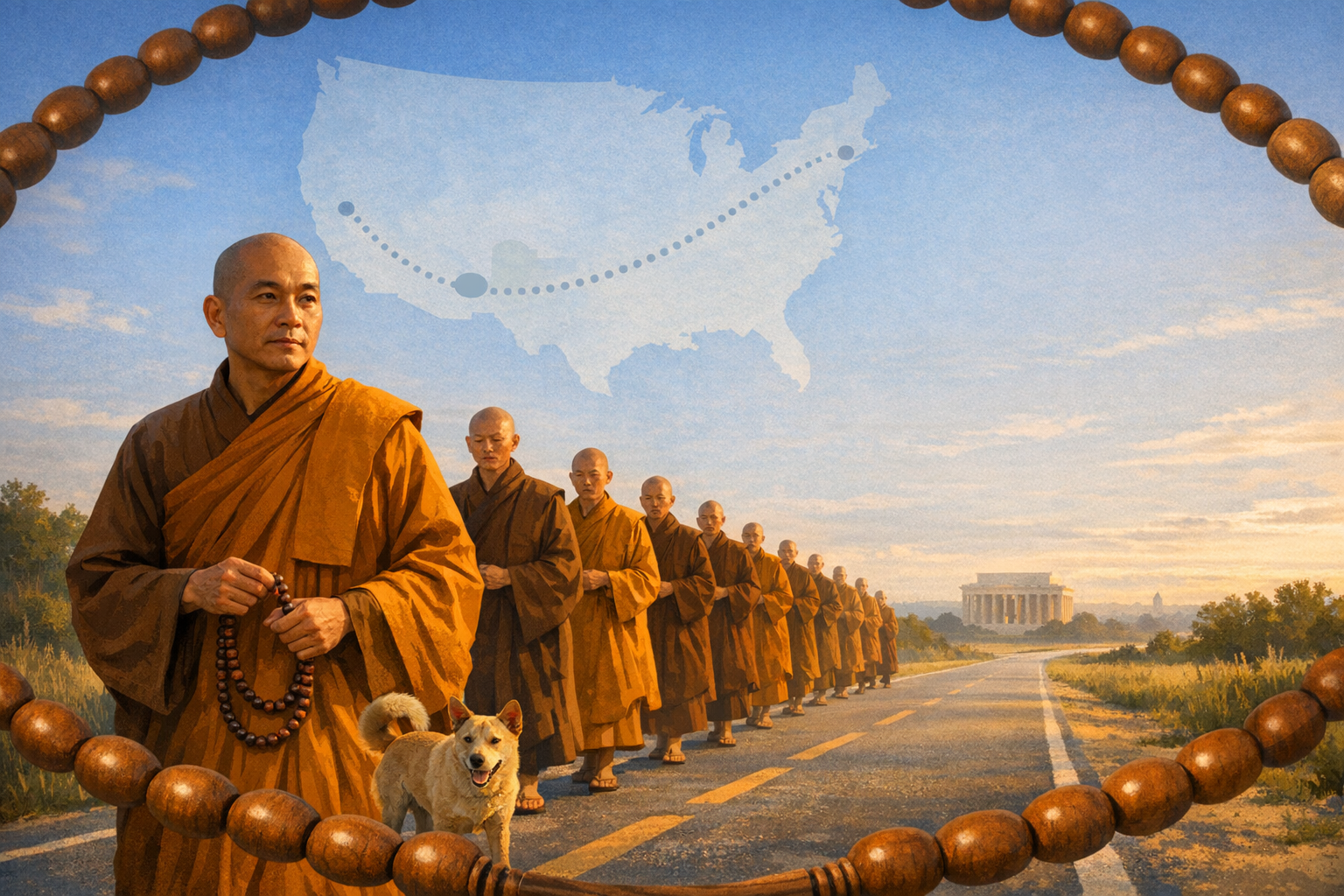
Nineteen Vietnamese Buddhist monks from the Huong Dao Vipassana Bhavana Center in Fort Worth, Texas, completed a 108-day, approximately 2,300-mile Walk for Peace from Fort Worth to Washington, D.C., traversing nine U.S. states to model compassion, nonviolence, and mindful presence in public life. Their quiet processionfree of slogans, speeches, or political messagingdrew sustained national attention, culminating at the Lincoln Memorial before the group returned to Fort Worth for the closing ceremony. Along the way, a stray dog named Aloka became an emblematic companion, embodying trust, loyalty, and the unforced bonds that can arise through kindness.
The choice of 108 days is not incidental. The number 108 holds deep significance across dharmic traditionsBuddhism, Hinduism, Jainism, and Sikhismas a symbol of completeness and disciplined practice. In Buddhist practice, a 108-bead mala supports continuous recollection and purification; in broader dharmic philosophy, 108 indexes fullness, auspicious cycles, and the integration of body, breath, and mind. By walking for precisely 108 days, the monks aligned their public journey with a pan-dharmic grammar of practice, signaling a shared civilizational inheritance grounded in ahimsa (nonviolence), karuna (compassion), and inner steadiness.
The organizing monastery follows the Vipassana tradition, emphasizing insight (vipassanā), mindfulness (sati), and equanimity (upekkhā) cultivated in daily life. This orientation shaped the method of the walk: measured pace, attentive breathing, and a pervasive ethic of metta (loving-kindness). The approach resonates with parallel principles in other dharmic pathsHinduism’s tapas and ahimsa, Jainism’s vows of non-harm, and Sikhism’s seva (selfless service)offering a unifying frame rather than sectarian assertion. Throughout the journey, the monks reiterated that the Walk for Peace was non-political and non-proselytizing, inviting participation through presence rather than argument.
Logistically, the scale is notable. Covering roughly 2,300 miles in 108 days implies a daily average near 21 milesdemanding consistency, recovery discipline, and careful route planning. The group navigated changing terrains and climates, from open highways to narrow shoulders and town centers. Local hosts occasionally provided hospitality, while volunteers assisted with coordination, safety briefings, and basic needs. As a mobile contemplative practice, the walk required harmonizing bodily exertion with meditative steadiness, a hallmark of the Vipassana discipline.
Public response remained strikingly consistent and simple: “Thanks” and “Compassion” were the words most often offered by people on sidewalks and porches. Residents paused to watch in silence; some joined for a few minutes of walking; others bowed or placed hands over their hearts. Live tracking and social media amplified the experience, enabling distant observers to witness how mindful presence altered the tone of everyday spaces. Many noted that traffic quieted, conversations softened, and strangers acknowledged one another as the procession passedan observable, local modulation of civic atmosphere.
Multiple moments signaled institutional respect. A brief, courteous exchange with a police officerwidely shared onlinecaptured the emerging reciprocity: uniformed service meeting contemplative service with mutual regard. Such gestures mattered because they modeled how civic and spiritual commitments can coexist without friction, each reinforcing the other’s dedication to public order, dignity, and safety.
There were also isolated instances of hostility. A small number of demonstrators voiced opposition as the walk passed through certain areas, reflecting anxieties that sometimes surface when visible religious practices enter public space. Yet interfaith hospitality frequently counterbalanced such episodes; church elders and lay Christians in various towns greeted the monks warmly, emphasizing shared values of love, humility, and neighborliness. The broader pattern that emerged was one of pluralism in actiondifferences acknowledged, dignity maintained, and common ethical ground affirmed.
Aloka, the Indian stray who chose to accompany the group, became an unexpected mirror for the journey’s themes. Without training or compulsion, the dog tracked the procession day after day, guided by routine, relationship, and a palpable sense of safety. In community psychology and animal behavior studies, such affiliative bonding often arises from predictable cues and reliable care. In the public imagination, Aloka came to symbolize how trust grows when fear recedes, and how compassion can forge belonging across species.
The emotional charge surrounding the walkoften captured in videos of onlookers in tearswarrants careful reflection. One compelling hypothesis, echoed by commentators, is that these are “tears of recognition,” a softening that occurs when people feel seen and safe. Contemporary affective science provides plausible mechanisms. According to polyvagal theory, cues of calm and non-threat from one group can promote nervous system down-regulation in observers, shifting them from hypervigilance toward social engagement. Mirror neuron research further suggests that witnessing deliberate, gentle movement can invite similar internal states, while social baseline theory proposes that co-presence reduces perceived effort and alarm. In plain terms, silent, kind attention is contagious.
Several vignettes illustrate these dynamics. A former Marine reportedly waited hours in freezing conditions simply to witness the procession, later describing an emotional release he had not expected. In another documented encounter, a woman shared how a brief interaction and a simple guided breathing practice helped her reframe persistent distress. These accounts, while personal, align with clinical evidence that paced breathing and focused attention can reduce sympathetic arousal and improve moment-to-moment regulation.
Pragmatic lessons for daily life emerged along the route. A universally accessible micro-practice involves three steps: pause to feel the contact of the feet with the ground; take three slow breaths emphasizing a longer exhalation; and soften the gaze or gently lower the eyes for a few moments. This brief resetrooted in ancient contemplative methods and supported by modern psychophysiologyoften restores clarity in difficult interactions. The monks’ walk functioned as a living classroom for such skills, translating monastic discipline into everyday tools.
Within a wider dharmic context, the Walk for Peace became a moving demonstration of unity across traditions. Buddhist metta and karuna sit naturally alongside Hindu ahimsa and the yogic cultivation of steadiness (sthira-sukha), Jain reverence for life in thought, word, and deed, and Sikh seva expressed through humble service. These streams converge in a single current: the refusal to harm coupled with the commitment to help. Framed this way, the journey did not present Buddhism in isolation; it illuminated a shared ethical vocabulary that has long animated South Asian wisdom traditions.
The choice of finishing at the Lincoln Memorial also carried civic symbolism. In that storied spaceoften associated with national self-examinationthe presence of a silent, multi-week dharmic practice invited reflection on how peace is built: not by erasing difficulty, but by cultivating grace within it. As one commentator observed, the peace modeled by the monks was not the absence of trouble; it was the presence of steadiness inside trouble, practiced step by deliberate step.
After reaching Washington, D.C., the monks completed their cycle by returning to Fort Worth for an ending ceremony. The full arcdeparture, sustained practice, national encounter, and returnmirrored classical pilgrimage patterns in which outward travel catalyzes inward integration. Across fifteen weeks, the United States served as both landscape and interlocutor, responding with countless small acts of recognition: smiles, bowed heads, folded hands, and the words “Thanks” and “Compassion.”
For civil society, several implications stand out. First, disciplined nonviolence, embodied rather than proclaimed, measurably influences public tone. Second, interfaith respect is most persuasive when expressed through service and humility. Third, trauma-informed public culture can be advanced by normalizing simple regulatory practicessuch as mindful walking or paced breathingwithin schools, workplaces, and community events. Finally, shared dharmic values offer a robust, non-sectarian foundation for unity: they belong to no single group yet can strengthen all.
In sum, the 2026 Walk for Peace was a large-scale experiment in applied compassion. Its participants crossed a continent-sized civic classroom and left a residue of calm wherever they went. The lesson was precise and portable: cultivate attention, embody nonviolence, and allow kindness to do its quiet work. Whether in Fort Worth, Washington, or anywhere in between, those three moves remain availableone mindful step, one gentle breath, and one act of regard at a time.
Inspired by this post on Hindu Human Rights Blog.