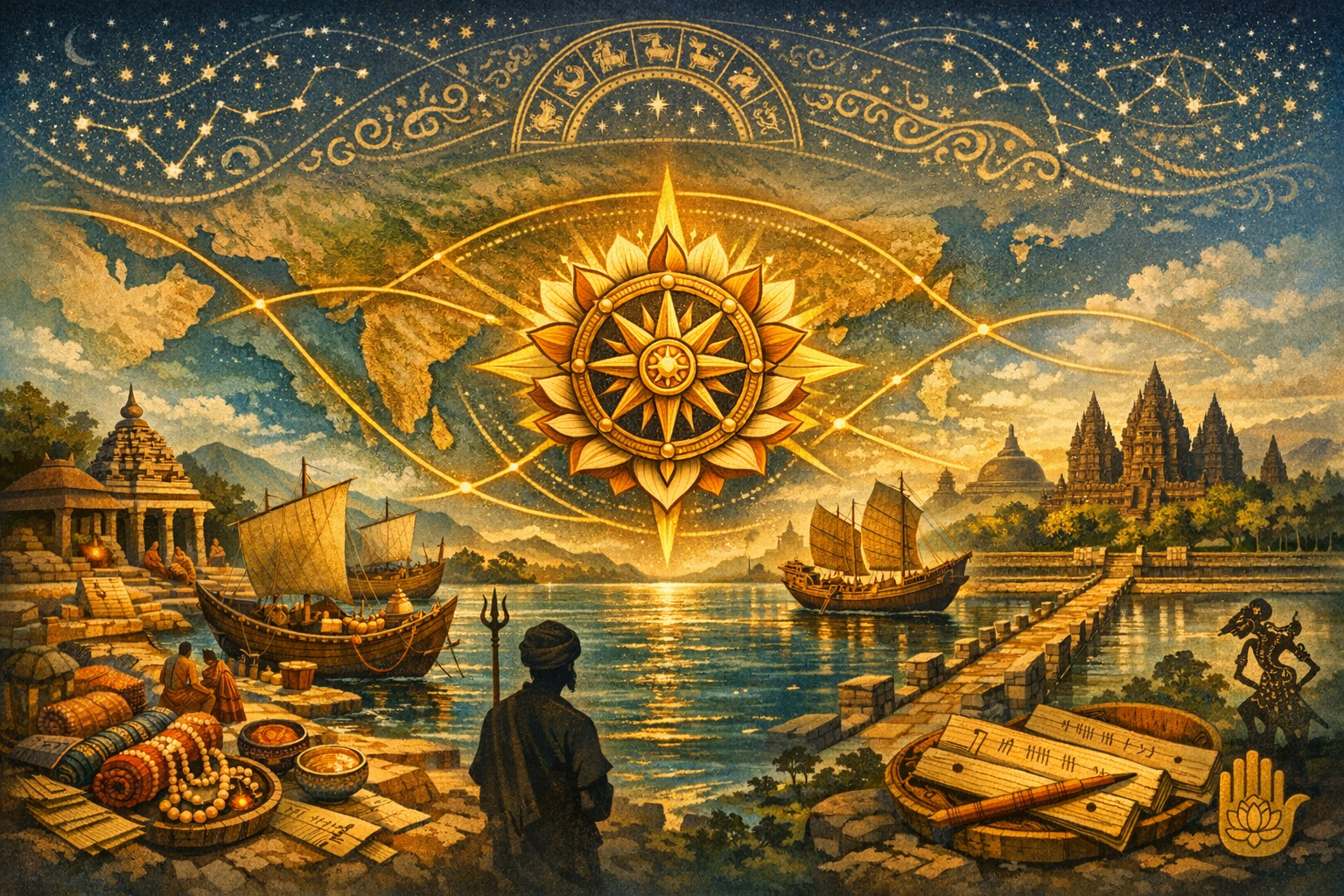
Across Asia’s vast littorals and riverine corridors, the enduring imprint of Vedic culture and broader dharmic traditions took shape primarily through peaceful trade, scholarly exchange, and religious teaching rather than conquest. In the longue durée of Bharatavarsha’s history, this steady diffusionanchored in commerce, monastic networks, and royal patronageproved more resilient than changes imposed by force. The result was a shared civilizational grammar across the Orient in which Hinduism, Buddhism, Jainism, and later Sikhism contributed complementary ideas of dharma, ethics, knowledge, and social organization.
Evidence from archaeology, epigraphy, linguistics, art history, and historical texts converges on a single conclusion: ancient India’s principal influence in the East was structured by Indian Ocean trade and sustained by institutions of learning and devotion. From the earliest references to monsoon navigation in Graeco-Roman sources to inscriptions in Sanskrit and Old Javanese, the data trail explains how religious thought, scripts, administrative idioms, and ritual technologies traveled with merchants, monks, and artisans. The emphasis was less on domination and more on interdependencea pattern that aligns with the dharmic ethic of coexistence.
Maritime connectivity provided the formative infrastructure. Mastery of the monsoons by at least the first century BCE enabled direct voyages between western Indian ports and Southeast Asian entrepôts. Littoral hubs such as Tamralipti on the Bay of Bengal, Kaveripattinam (Puhar), Arikamedu, and Sopara interfaced with Berenike and Aden to the west and with Oc Eo (Funan), Kedah’s Bujang Valley, Takuapa in peninsular Thailand, and Kedurang and Barus in Sumatra to the east. Indian Rouletted Ware, carnelian and agate beads, and South Asian coinage turn up in these locales, registering the depth and regularity of the Indian Ocean trade system.
Merchant corporations such as the Ayyavole 500 (Ainnurruvar) and Manigramam are attested in Southeast Asian inscriptions, including the Tamil inscription at Lobu Tua (Barus, Sumatra) and the ninth-century record near Takuapa. These guilds carried more than commodities; they transmitted languages of contract, ethical norms of fair dealing, ritual patronage models, and techniques of accounting that reflected the decimal place-value system. Their temples and rest-houses functioned as social infrastructure along the maritime silk routes.
Buddhist scholastic networks knitted the region together with equal vigor. Chinese pilgrims Faxian, Xuanzang, and particularly Yijing documented a two-way current linking Nalanda University and other Indian centers to Srivijaya, Java, and the Khmer realm. Yijing’s maritime itinerary in the seventh century CEstudying Sanskrit grammar and Vinaya in Srivijaya en route to the Ganges plaincaptures the pedagogy of circulation: monks learned texts and languages in one hub, received ordination or advanced training in another, and then taught across the network.
Language and script provide some of the most measurable markers of exchange. Sanskrit and Pali served as linguae sacrae and administrative idioms across the region. The Vo Canh inscription (near Nha Trang, Vietnam) is among the earliest Sanskrit epigraphs in Southeast Asia. Over time, Pallava-Grantha and related South Asian scripts informed the development of Khmer, Mon, Thai (via Old Khmer), and the Kawi script of Java and Bali. Farther northeast, the Siddham script was preserved in Japan’s Shingon and Tendai traditions for writing bīja mantras, attesting to the prestige of Indic philology well beyond the subcontinent.
Calendrical science and astronomy traveled alongside script and philology. Variants of the Saka era (78 CE) and the Chulasakarat era (638 CE), lunar-solar calendrical reckoning, nakshatra lists, and computational methods associated with the Sūrya Siddhānta influenced time-reckoning, ritual scheduling, and royal chronicles. In mainland Southeast Asia and the Indonesian archipelago, Indic month names, zodiacal vocabulary, and auspicious-moment selection (muhurat) entered courtly and temple practice, aligning agricultural, mercantile, and ceremonial life with shared cosmological frameworks.
Architecture and sacred geography reveal a further layer of synthesis. Angkor Wat and Angkor Thom in Cambodia, Prambanan in Java, and My Son in Champa translate Vedic and Agamic ideasmandala planning, Mount Meru cosmology, axial alignments, and consecration ritesinto locally resonant forms. In the Khmer realm, the devarāja institution under Jayavarman II ritualized kingship through Śaiva idioms, while Mahayana and later Theravada Buddhism remained integral to royal and popular piety. The region’s temple-cities thus became palimpsests where Shaiva, Vaiṣṇava, and Buddhist symbols coexisted with local ancestor and nature cults.
Law, statecraft, and civic ethics also absorbed Indic templates, then adapted them. Old Javanese legal digests and the Kutaramanawadharmasastra drew selectively on Dharmasastras such as the Manusmṛti and Yājñavalkya Smṛti, while court ceremonials and guild bylaws reflected the dharmic preference for layered dutyfamily, guild, temple, and state. Rather than replacing local customs, these frameworks offered a generalized method for adjudication and ritualized authority, leaving room for regional jurisprudence.
Literary and performative arts secured this synthesis in public memory. The Ramayana and Mahabharata circulated in numerous retellings: the Reamker (Khmer), Ramakien (Thai), Phra Lak Phra Lam (Lao), Hikayat Seri Rama (Malay), and the Old Javanese Kakawin Ramayana. Wayang kulit (shadow theatre) in Java and Bali, classical dance in Cambodia and Thailand, and epic murals across the region embedded dharmic ethicsdharma, artha, kama, moksha, and the primacy of right actioninto popular aesthetics.
Material culture corroborates these textual and artistic arcs. Bronze icons and stone images in Khmer and Cham contexts display South Indian stylistic lineages while innovating for local patronage. Ritual paraphernalia, yantras, and water-management structures tied to temple complexes illustrate how sacred engineeringan Indic synthesis of architecture, ritual, and hydraulicscould serve agrarian productivity and civic life.
Commerce remained the enabling ecosystem from the start. Pepper, aromatics, and forest products moved west; textiles, beads, and metalwork traveled east; ideas, skilled labor, and liturgical specialists moved both ways. The Indian Ocean trade fostered cosmopolitan harbors where Hindu, Buddhist, and Jain merchants co-financed shrines, schools, and rest-houses. Jain mercantile ethics and the principle of ahimsa influenced business norms in several ports, while Buddhist dāna (generosity) and Hindu dakṣiṇā (honoraria) underwrote monastic and temple economies.
Education anchored the long-term durability of exchange. Institutions like Nalanda University provided curricular models for grammar, logic, medicine, and metaphysics that traveling monks and scholars adapted abroad. Srivijaya, documented by Yijing as a major center for Buddhist learning, functioned as an academy and transit hub linking Sumatra, Java, the Malay Peninsula, and the Ganga plain. Through these nodes, Sanskrit and Pali grammatical methods, meditation disciplines, and scholastic debate (vāda) permeated the intellectual life of the region.
Scientific knowledge followed similar channels. The decimal place-value system and the concept of zero matured in Ancient India and traveled westward through the Islamic world; in Southeast Asia, astronomical tables, planetary deities (grahas), and auspicious-timing algorithms permeated court almanacs and temple calendars. Elements of Ayurveda informed medical compendia in Java (Usada literature) and facets of Thai traditional medicine, while yoga and breath-based disciplines interlaced with monastic practice.
Case studies illustrate the composite nature of this process. At Angkor Wat, a Vaishnava cosmogram frames a royal funerary temple later integrated into Theravada practice, demonstrating religious continuity through transformation. At Prambanan, a monumental Shaiva complex coexisted with nearby Buddhist sanctuaries like Borobudur and Sewu, embodying the dharmic norm of plural sacred spaces. In Cham territories, Śaiva and Vaiṣṇava temples at My Son present a lineage of Sanskrit inscriptions that map ritual life, law, and regional identities.
The Chola moment (for example, Rajendra I’s campaign against Srivijaya in 1025 CE) is a notable exception to the rule of peaceful diffusion. Yet even here, transient military activity did not overturn the prevailing architecture of exchange. Over centuries, the sturdier and more consequential vector remained mercantile networks and scholastic-religious tiesforms of soft power grounded in mutual advantage and shared values.
Buddhism’s spread via both land (Silk Roads) and sea linked China, Korea, and Japan to South and Southeast Asia. Monastic translations of Sanskrit and Prakrit texts into Chinese, the preservation of Siddham in Japan, and the ritual repertoire of esoteric Buddhism testify to a genuinely pan-Asian intellectual commons. Within this shared commons, Hindu and Buddhist philosophical vocabulariesdharma, karma, samsara, and moksha/nirvanacirculated freely, generating dialogue rather than dogma.
Jain influences, while more modest geographically, surfaced through merchant communities and the ethical prestige of ahimsa. Over time, Sikh mercantile and maritime communitiesespecially in the early modern and modern periods across the Malacca Straits, the Malay Peninsula, Singapore, and Thailandadded seva (service), community kitchens, and charitable trusts to the region’s dharmic mosaic. The cumulative effect, across centuries, has been the reinforcement of a civilizational ethos captured in the maxim Vasudhaiva Kutumbakamthe world is one family.
Methodologically, this narrative rests on an interdisciplinary foundation: port archaeology (Oc Eo, Bujang Valley, Arikamedu), ceramic and bead typologies, numismatics, Sanskrit and Old Javanese epigraphy, temple plans and iconography, and travelogues by pilgrims like Faxian, Xuanzang, and Yijing. Read together, these sources resolve apparent contradictionssuch as isolated military episodesinto a coherent picture of long-term cultural exchange without imperial annexation.
For the study of History and Cultural Heritage, the lesson is twofold. First, durable influence tends to arise from consent, utility, and shared meaning rather than coercion. Second, Asia’s civilizational development is best explained not as cultural replacement but as complex layeringlocal agency shaping imported forms, and imported frameworks expanding local horizons. This balance of continuity and change underpins the unity-in-diversity that characterizes dharmic traditions across the region.
In contemporary terms, acknowledging Vedic and broader dharmic contributions to the Orient does not diminish the originality of Southeast Asian or East Asian cultures; it clarifies the matrix in which they evolved. Recognizing Hindu, Buddhist, Jain, and Sikh strands in this matrix strengthens interfaith respect and scholarly rigor alike. It also encourages fresh partnerships in education, cultural preservation, and sustainable heritage tourism that honor the very mechanismstrade, teaching, and shared ethical vocabulariesby which these connections first took root.
Ultimately, the story of Vedic contributions in the Orient is a case study in how soft power, when carried by merchants, monks, and makers, can shape civilizations. Through Indian Ocean trade, Nalanda-linked scholastic circuits, temple and monastic institutions, and inclusive philosophies of dharma, a living bridge formed between Bharatavarsha and the wider East. Its foundationspluralism, reciprocity, and learningremain instructive for any endeavor seeking unity among Hinduism, Buddhism, Jainism, and Sikhism in today’s interconnected world.
Inspired by this post on Dandavats.