
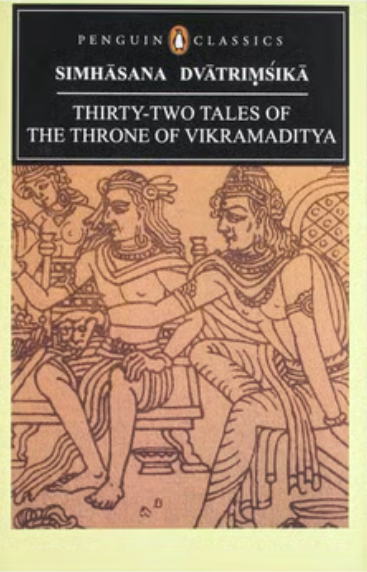
Simhasana Dvatrimsika, widely remembered in north Indian storytelling as Singhasan Battisi or the “Thirty-Two Tales of Vikramaditya’s Throne,” occupies a distinctive place in Sanskrit literature, Indian folklore, and the study of Rajadharma. It is not merely a cycle of entertaining courtly tales. It is a layered work of political ethics, literary memory, and civilizational pedagogy, built around the enduring figure of Emperor Vikramaditya and the moral standard associated with his throne.
The narrative premise is elegant and memorable. King Bhoja, the celebrated Paramara ruler of Dhara, discovers or approaches the legendary throne of Vikramaditya. Before he can ascend it, thirty-two statuettes connected with the throne speak one by one. Each recounts an episode from Vikramaditya’s life and asks whether Bhoja possesses the same courage, discrimination, generosity, justice, and self-command. The throne therefore becomes more than a royal seat. It becomes a test of sovereignty.
This literary structure gives the text its continuing force. Royal authority is not treated as inheritance alone, nor as power alone. It is treated as a discipline. A ruler must be brave, but bravery without discernment becomes recklessness. A ruler must know śāstra, but learning without practice becomes vanity. A ruler must protect the realm, but protection without fairness becomes oppression. In this way, Simhasana Dvatrimsika transforms Vikramaditya into a model through whom questions of statecraft, ethics, charity, duty, and judgment can be examined.
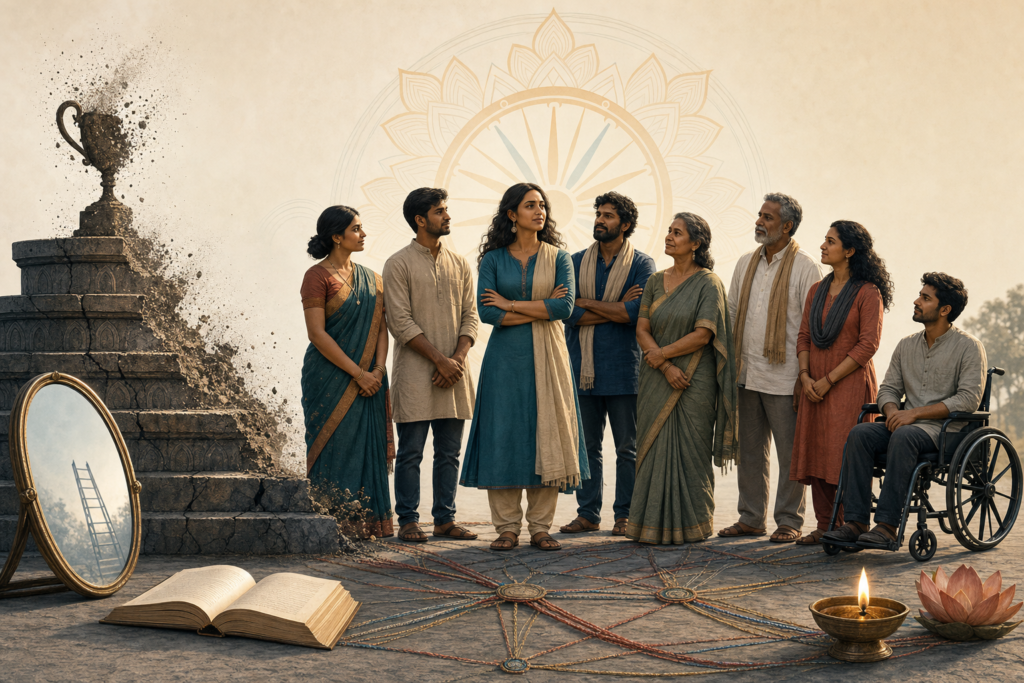
The work is also important because it links two great names in the Paramara imagination: Vikramaditya and Bhoja. Vikramaditya represents the archetype of the ideal king whose fame expands across regions, languages, and centuries. Bhoja represents the learned ruler who must measure himself against that inherited standard. The text therefore dramatizes an important civilizational idea: tradition is not a decorative memory but a demanding mirror. Greatness in the past does not excuse mediocrity in the present; it raises the bar for conduct.
The title itself deserves attention. Simhasana means throne, and Dvatrimsika refers to a set of thirty-two. The text is known through several related titles, including forms that refer to Vikramaditya, the throne, the statues, and the number thirty-two. Franklin Edgerton, whose manuscript work remains important for modern scholarship, noted the variety of manuscript titles and worked with a large set of witnesses from different regions. This manuscript diversity shows that the text lived not as a single frozen artifact but as a mobile narrative tradition.
The authorship of the original work remains uncertain. Some Jain recension manuscripts associate the Sanskrit rendering with Kshemaankara Muni, a Śvetāmbara Jain teacher. Other manuscripts have been associated with names such as Siddhasena Divaakara or Ramachandra Suri. Traditional attributions have also connected the work with figures such as Kalidasa, Vararuchi, and Nandisvara, although such claims cannot be treated as settled historical fact. The more cautious conclusion is that Simhasana Dvatrimsika emerged through a complex process of composition, redaction, translation, and regional adaptation.
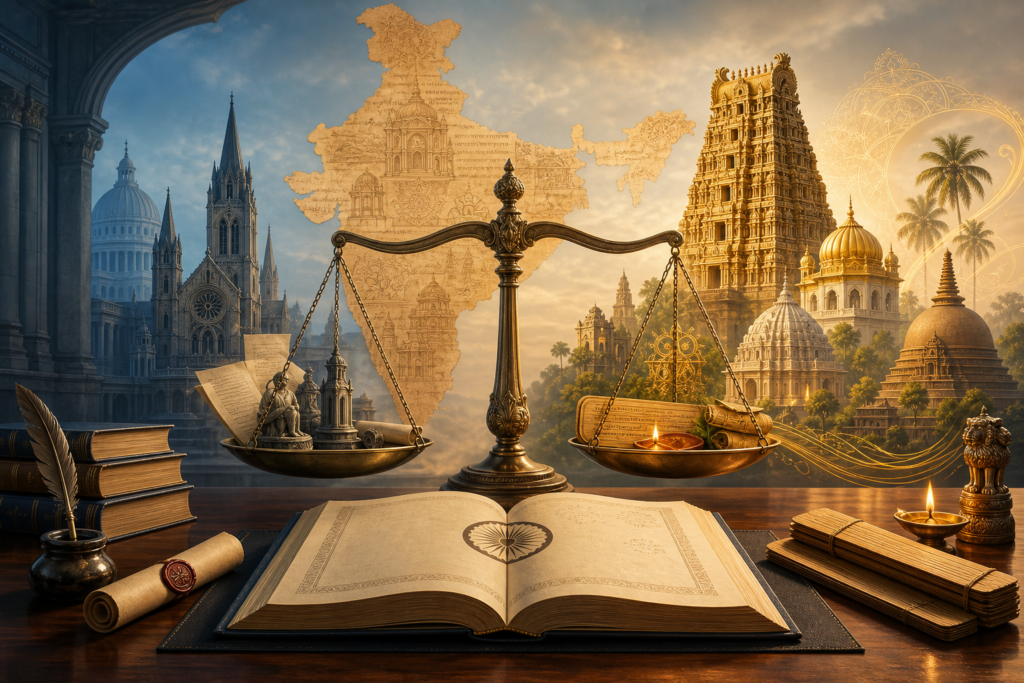
This textual history is especially valuable for understanding the unity of Dharmic traditions. The Vikramaditya cycle circulated through Sanskrit, Prakrit, Jain literary environments, and many regional languages. It belongs to a shared world of moral instruction in which Hindu, Jain, Buddhist, and broader Indic storytelling habits often interacted. Rather than treating these traditions as sealed compartments, the evidence of transmission suggests a civilizational ecosystem where ideas, forms, and exempla moved across communities while retaining their distinct voices.
Three major recensional streams are often discussed: the Jain Recension, the Bengali Recension, and the Southern Recension. These recensions differ in details, but they preserve the central frame of the throne and the moral testing of Bhoja. Such variation is not a weakness. It is one of the signs of a living literary tradition. A tale that could travel through Bengal, the South, Jain scholastic settings, Sanskrit courts, and later vernacular retellings had already become part of India’s shared memory.
The text also stands beside other didactic Indian classics such as the Panchatantra, Hitopadesha, and Vetala Panchavimsathi. Like those works, it uses story as a vehicle for instruction. It does not preach through abstraction alone. It stages dilemmas. It places kings, ascetics, petitioners, supernatural beings, householders, and moral failures in situations where judgment must be exercised. This is why the text remains useful for students of Sanskrit literature, Indian political thought, and ethical education.
Vetala Panchavimsathi, the “Twenty-Five Tales of the Vetala,” is especially close in spirit to the Vikramaditya tradition. Both works test intelligence under pressure. Both rely on paradox, moral tension, and the king’s ability to answer without losing composure. Yet Simhasana Dvatrimsika differs in emphasis. Its thirty-two stories do not merely test cleverness; they test worthiness. The question is not only whether a ruler can solve a problem, but whether he has earned the right to sit in judgment over others.
A key theme of the work is Rajadharma, the duty of rulership. The ideal king is expected to punish wrongdoing, honor the virtuous, protect the realm, maintain fairness among petitioners, and acquire resources justly. These principles are not presented as bureaucratic procedure alone. They are treated as acts of worship, because governance in the Dharmic imagination is tied to moral order. Power becomes legitimate only when it serves protection, justice, and social balance.
This view of kingship has technical significance. In many Dharmashastra and Niti traditions, the ruler is the final arbiter in matters of law and order, but that role requires self-restraint. The king must avoid becoming a captive of anger, pleasure, flattery, or faction. The tales repeatedly warn that learning can become arrogance, courage can become cruelty, and authority can become negligence if not governed by viveka, discrimination. Vikramaditya’s greatness lies in the integration of strength and discernment.
The portrayal of Vikramaditya is therefore not merely heroic. It is pedagogical. He is brave in battle, but he is also attentive to individual suffering. He moves among his subjects, listens to hidden griefs, tests appearances, and acts when justice requires intervention. This image of the ruler moving beyond palace walls carries a deeply human appeal. Many readers still recognize the longing behind such stories: the hope that authority should be alert, accessible, and morally awake.
At the same time, the text should not be reduced to nostalgia. Its value lies in the disciplined questions it asks. What makes a person fit to govern? How should a leader balance law and compassion? When does generosity become imprudence? When does punishment become necessary? How should inherited prestige be tested by present conduct? These are not medieval questions only. They remain relevant in public life, institutional leadership, family responsibility, and personal ethics.
The narrative also warns against the misuse of education. One memorable strand concerns learned people whose learning becomes a source of arrogance or harm. In this moral universe, knowledge is not automatically purifying. It must be joined to humility, service, and restraint. This is a recurring insight across Dharmic literature: vidya is elevated when it produces clarity and compassion; it is degraded when it produces vanity.
Several tales also address the destructive power of vice. Gambling, intoxication, uncontrolled desire, cruelty, theft, and betrayal appear not as isolated moral lapses but as forces that corrode judgment. The text’s method is practical. It shows how a single unchecked weakness can overwhelm status, intelligence, and prior merit. In this respect, Simhasana Dvatrimsika belongs to the broader Niti tradition, where ethical instruction is tied to consequences rather than sentiment alone.
The work’s literary texture is enriched by allusions to the Ramayana, Mahabharata, Puranic literature, Kalidasa’s works, and Niti poetry. The Southern Recension also shows connections with materials such as the Arthashastra tradition and other narrative collections. This intertextuality matters because it reveals the education expected of its audience. A listener or reader was invited to recognize patterns, compare precedents, and understand that each tale stood inside a larger world of Sanskrit learning.
Yet the appeal of the text was never confined to Sanskrit specialists. Its stories entered Bengali, Gujarati, Hindi, Tamil, Telugu, and other Indian language traditions. They were also translated or adapted beyond India, including Persian, Siamese, Newari, Tibetan, and Mongolian contexts. A Persian translation was prepared in the Mughal period under Akbar’s patronage, and later European access came through translation routes shaped by Persian and French mediation. This long journey shows the wide attraction of Vikramaditya’s narrative persona.
The manuscript history contains one striking modern detail: Edgerton used thirty-three manuscripts in his study, while another group of manuscripts sent from Bombay was reportedly lost in the Titanic shipwreck. That episode is a reminder of how fragile literary transmission can be. Manuscripts survive through copying, care, climate, patronage, travel, and sometimes sheer accident. Every preserved recension of Simhasana Dvatrimsika is therefore part of a larger story of cultural preservation.
The frame of thirty-two statuettes is especially powerful as symbolism. A throne normally suggests elevation, but here it becomes a place of interrogation. The statuettes do not flatter Bhoja. They interrupt him. They narrate, compare, and demand introspection. In literary terms, this device turns the act of ascension into a moral examination. In social terms, it suggests that institutions carry memory, and that memory can restrain ambition.
This is one reason the text continues to resonate in discussions of Indian civilization. It refuses to separate power from character. Modern political language often measures leadership by efficiency, popularity, strategy, or victory. Simhasana Dvatrimsika adds older criteria: generosity, truthfulness, courage, fairness, learned judgment, protection of the vulnerable, and the ability to sacrifice personal comfort for public duty. These qualities are difficult to quantify, yet the text insists that they are central.
The text also handles diversity within the Dharmic world with notable breadth. Jain teachers, Sanskrit redactors, regional poets, royal courts, and popular storytellers all participated in the evolution of Vikramaditya’s legend. This makes the work an important case study in shared heritage. Hindu, Jain, Buddhist, and Sikh readers may approach such literature through different theological and philosophical lenses, but the common ethical concerns of duty, restraint, compassion, courage, and wisdom create a meaningful field of dialogue.
For contemporary readers, the emotional power of Singhasan Battisi often lies in its childhood familiarity. Many first encounter the tales not through academic editions but through oral retellings, illustrated books, television adaptations, or family narration. Later study reveals that behind the accessible stories stands a sophisticated literary tradition. That transition from wonder to analysis is one of the pleasures of Indian literature: the tale that once delighted the imagination later becomes a guide to ethics, polity, and cultural memory.
A careful reading also helps avoid two common mistakes. The first is to treat Vikramaditya only as a historical puzzle and ignore the literary force of the tradition. The second is to treat him only as legend and ignore the way such legends shaped political and social ideals. Whether one approaches the figure through history, folklore, Sanskrit studies, or civilizational memory, the Vikramaditya cycle demands a layered method. Its truth is not only documentary; it is also ethical and cultural.
The role of Bhoja in the narrative intensifies this layered meaning. Bhoja is not portrayed as insignificant. On the contrary, he is himself remembered as a scholar-king and patron of learning. Precisely because he is great, the comparison with Vikramaditya becomes meaningful. The text does not humiliate Bhoja; it educates him. It shows that even a celebrated ruler must submit to a standard higher than self-regard.
This lesson has enduring application beyond monarchy. In any institution, a person may inherit a respected office, a prestigious title, or a revered tradition. Simhasana Dvatrimsika asks whether the person has internalized the discipline required by that inheritance. The true question is never only “Who occupies the seat?” It is “What qualities make the occupant worthy of the seat?”
The technical classification of the work as didactic narrative or exemplum, sometimes described through the idea of nidarshana katha, is therefore apt. It teaches through examples rather than commandments. Each story places a value into action. Charity is shown in sacrifice. Courage is shown under danger. Justice is shown under ambiguity. Discernment is shown when appearances deceive. This method is one of the great strengths of Sanskrit and Indic narrative traditions.
The work’s use of supernatural elements should also be read carefully. Celestial statuettes, extraordinary thrones, divine settings, and wondrous episodes do not make the text escapist. In classical narrative, marvel often creates distance from ordinary life so that moral perception becomes sharper. The unusual setting allows familiar weaknesses and virtues to be seen with clarity. Wonder becomes a vehicle for instruction.
In that sense, Simhasana Dvatrimsika remains a serious text for the study of Indian ethics. It explores the relationship between dharma and practical decision-making. It recognizes that no ruler, scholar, or householder lives in a world of perfectly simple choices. The person of judgment must interpret context, precedent, motive, consequence, and duty. This is why Vikramaditya’s wisdom is not presented as mechanical rule-following. It is presented as applied discernment.
The text’s portrayal of duty toward parents, spouse, children, subjects, petitioners, ascetics, and the vulnerable reflects the relational structure of Dharmic ethics. Individual excellence is not isolated self-perfection. It is measured through conduct toward others. A life lived only for appetite or status is treated as incomplete; a life lived for the welfare of others is praised. This principle aligns with broad currents across Hindu, Jain, Buddhist, and Sikh ethical thought, even where doctrinal details differ.
Because of this shared ethical ground, the text can be read today as a bridge rather than a boundary. Its world is rooted in Sanskritic kingship and Hindu civilizational imagination, yet its transmission through Jain recensions and multiple regional traditions demonstrates an openness characteristic of India’s literary history. The healthiest modern reading honors both specificity and shared inheritance. Unity does not require flattening difference; it requires recognizing the larger dharmic conversation in which difference can coexist with mutual respect.
The academic study of Simhasana Dvatrimsika also benefits from attention to translation. A.N.D. Haksar’s English rendering made the text more accessible to modern readers, while Edgerton’s earlier work remains important for manuscript comparison and textual history. Translation, however, always involves choices. Terms such as dharma, Rajadharma, śāstra, viveka, and niti carry layered meanings that cannot be fully replaced by single English equivalents. Readers gain most when they treat translation as an entry point rather than the final boundary of understanding.
As literature, the work succeeds because it joins moral instruction with narrative suspense. Each statuette’s tale delays Bhoja’s ascent and deepens the reader’s expectation. The repeated structure could have become monotonous, but the variation of dilemmas sustains interest. The frame creates rhythm; the individual stories create surprise. This combination explains why the work survived not only in manuscripts but in popular memory.
As cultural history, it preserves the image of Ujjayini and the royal imagination associated with Vikramaditya. Ujjayini appears not simply as a city but as a center of abundance, learning, political authority, and sacred geography. The association of Vikramaditya with Ujjain, the Vikrama era, and the broader Paramara memory has made the figure central to many discussions of Indian kingship, chronology, and regional identity.
As ethical literature, it offers a demanding view of leadership. A ruler who delegates everything and abandons responsibility is criticized. A learned person who uses learning destructively is condemned. A powerful person without self-control becomes dangerous. A generous person without discernment may fail to protect what must be protected. The text’s realism lies in its awareness that virtues must be integrated, not merely possessed in isolation.
For modern readers, this integrated standard may be the most valuable lesson. Public life often rewards narrow excellence: the clever speaker, the decisive administrator, the successful strategist, the charismatic personality. Simhasana Dvatrimsika asks for something harder: a whole person capable of courage, restraint, learning, compassion, and justice. That ideal is demanding, but its very difficulty explains why Vikramaditya’s throne remains such a powerful symbol.
The legacy of Simhasana Dvatrimsika therefore lies not only in its thirty-two tales but in the question repeated beneath them: what does worthiness require? The answer is never reduced to birth, office, wealth, or fame. Worthiness requires dharma in action. It requires the ability to serve before ruling, to listen before judging, to distinguish before acting, and to place the welfare of others above personal vanity.
That is why the work deserves continued study in Indian literature, Sanskrit literature, folklore, Rajadharma, and Dharmic philosophy. It is a story-cycle, a mirror for leadership, a bridge across traditions, and a reminder that civilizational memory carries ethical obligations. Vikramaditya’s throne is legendary, but the test it represents remains contemporary.
Reference basis: the discussion draws on the Indic Civilizational Portal article “Literature: Simhasana Dvatrimsika” and its cited reference to A.N.D. Haksar’s Simhasana Dvatrimsika, published by Penguin in 1998, along with the article’s summary of Franklin Edgerton’s manuscript work and the major recensional traditions.
Inspired by this post on Indic Portal.



Leave a Reply
You must be logged in to post a comment.