Hindi cinema’s musical language has evolved through a complex interplay of art, economics, and society. Over time, a pronounced preference for Urdu/Hindustani diction, the ghazal idiom, and certain aesthetic choices became prominent, while chaste Hindi lyrics, overtly Sanatana imagery, and devotional registers appeared less frequently in mainstream releases. Understanding how this shift emerged helps strengthen a unifying, dharmic appreciation of India’s plural cultural heritage rather than framing it as a zero-sum contest.
Listeners often recall earlier compositions that foregrounded a geet sensibility and classical ragas. A touchstone is the Mukesh-rendered “hari bhari vasundhara me neela neela ye gagan” (Boond Jo Ban Gaye Moti, 1967; Producer: V. Shantaram; Music: Satish Bhatia; Lyrics: Bharat Vyas), which exemplifies a lyrical, nature-centric Hindi register. The present-day predominance of Hindustani-Urdu vocabulary, however, reflects a historical layering rather than a simple replacement, signaling how audience tastes were shaped and reshaped by the industry’s ecosystem.
In the emergent Bombay film world of the 1930s, party politics, market forces, and patterns of urban consumption intersected to cultivate audience preferences. Popularity rarely arises in isolation; it is nurtured through distribution networks, critical discourse, and repeated exposure. In such a milieu, strategic narrativesartistic, ideological, or commercialgain traction to the extent that tastemakers and institutions amplify them consistently.
When distribution channels and cultural gatekeepers favor certain idioms, visibility follows. Thus, the numerical rise of ghazals relative to geets can be read as the outcome of market dynamics and institutional enthusiasm for particular forms. Rather than indicting any single strand, this perspective highlights how sustained curation and critical acclaim can normalize one register as the mainstream, even when multiple traditions coexist.
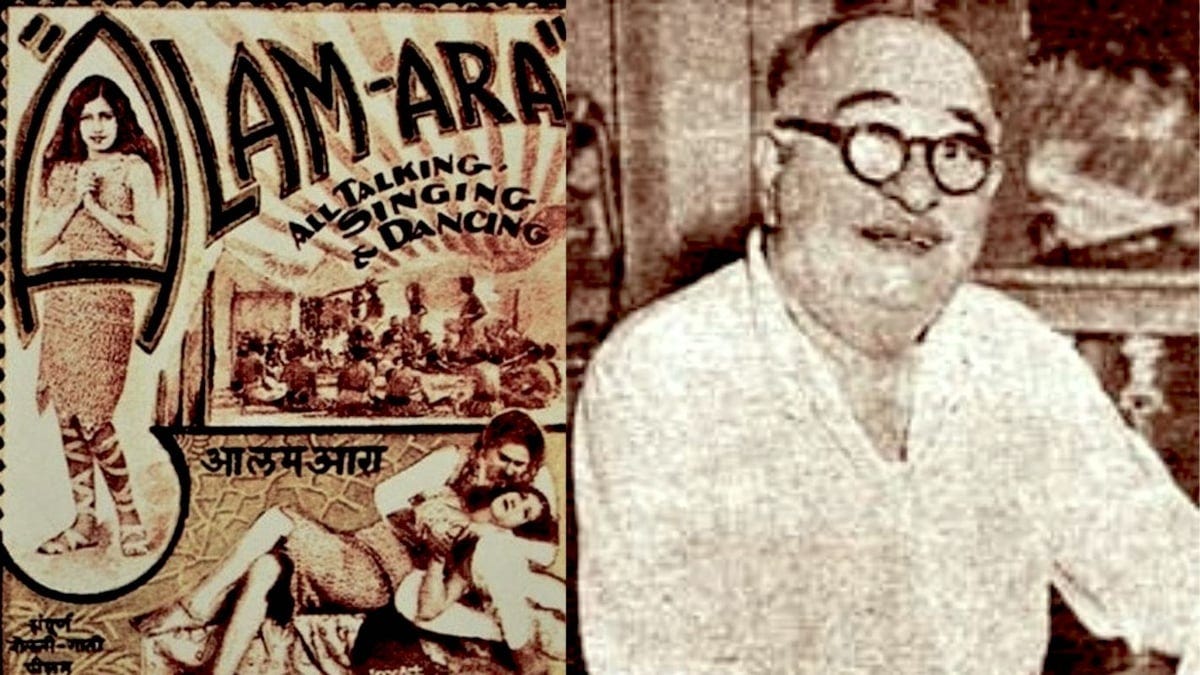
The landmark talkie Alam Ara (March 1931) provides an instructive early case. Produced by the Pune-born Ardeshir Iraniwhose family migrated to India from Iranand set on a Parsi stage play, the film inaugurated synchronized dialogue and song on Indian screens. The title is often interpreted in contemporary sources as an indirect Quranic-derived name, reflecting the cosmopolitan currents within Bombay’s theater and film circles of the time. The film’s choices can also be viewed as an effort to engage socially relevant themes, including portrayals of women, within a broader, urban audience.
Alam Ara’s musical architecture leaned toward the Urdu ghazal tradition, with the widely noted exception of “darasa bina tarse hain naina.” Contemporary accounts attribute the score to Firozeshah M. Mistry and B. Irani and describe the production’s technical ingenuitylarge microphones were reportedly concealed in costumes to capture diegetic sound, a significant innovation in Indian cinema’s sonic storytelling. While detailed musicological analysis is constrained by the film’s loss (it is not available for study in the National Film Archives of India), surviving documentation continues to shape historical understanding of its repertoire.
The earliest song associated with Alam Ara, “De De Khuda Ke Naam,” rendered by Wazir Mohammed Khan, is in Urdu and carries an explicit charitable exhortation, reflecting the period’s social-moral didacticism commonly embedded in early talkies. The lyrics remain emblematic of that era’s direct, audience-facing appeal:
De de kuda ke naam pe pyaare,taakat ho gar dene ki.kuch chaahe agar, to mang le mujhsehimmat ho gar lene ki.
Give in the name of God my dear,if you have the guts to give.if you need anything, ask meif you have the courage to accept it.
Zubeida’s ghazal in the film is sometimes associated by scholars with Raga Kankan or the more probable Mishra Khamaj, underscoring how classical and semi-classical frameworks anchored early cinematic music. Such choices would resonate with an audience accustomed to theater traditions and the then-vibrant urban mehfil culture.
The 1931 Census of India provides context on Bombay’s socioeconomics, showing differentiated housing conditions across communities and shifts in population shares between 1921 and 1931. Producers seeking financial viability naturally engaged the city’s wealthier patrons and cultural circuits. In this light, Alam Ara’s linguistic and musical palette appears commercially attuned to Bombay’s cosmopolitan audiences rather than a repudiation of other Indian traditions.
Subsequent milestones broadened the medium’s sonic range. India’s first recognized playback song, “mere ghar mohan ayo,” arrived with Dhoop Chhaon (1935), scored by R. C. Boral and Pankaj Mullick and sung by Harimati, Supra Sarkar, Parul Ghosh, and K. C. Dey. This challenging composition showcased the emerging grammar of playback and remained aesthetically rooted in devotional and philosophical motifs. The blind vocalist-actor K. C. Deyuncle of Manna Deybecame a sensation in the mid-1930s, emblematic of a period when cinema’s musical soul still drew deeply from bhakti, reflective poetry, and classical idioms.
Throughout the 1930s and 1940s, so-called “mythological” films and other non-ideological narratives were produced alongside new progressive, socially engaged cinema. Music proved central to messaging across all these strands, whether devotional, romantic, reformist, or realist. Rather than treating these as oppositional, it is more accurateand more unifyingto recognize them as interwoven threads in a shared cultural tapestry that includes Hindu, Buddhist, Jain, and Sikh sensibilities.
Parallel intellectual movements influenced cinematic narratives. The Indian Progressive Writers’ Association (London, 1935; Kolkata and Lucknow, 1936) and the Indian People’s Theatre Association (IPTA) convened writers and artistsamong them Faiz Ahmad Faiz, Saadat Hasan Manto, Ismat Chughtai, and later, influential filmmakers and critics such as K. A. Abbaswho helped popularize socially conscious storytelling. As noted by later commentators, the Nehruvian moment and the IPTA’s cultural activism often converged to shape post-independence cinematic idioms and themes.
These developments laid a strong foundation for the composite musical-linguistic style often associated with “Bollywood.” The result was a Hindustani register that integrated Urdu poetics, Hindi vocabulary, and classical ragas, all while reflecting changing audience expectations. From a dharmic-unity perspective, this multiplicity is not a dilution but an inheritancean opportunity to uphold timeless Indic values of pluralism, compassion, and beauty through many idioms.
A constructive path forward acknowledges history while revitalizing balance. Curating new works that foreground Sanskritized Hindi geets, bhajans, and shabads alongside ghazals; commissioning lyrics that draw from Hindu, Buddhist, Jain, and Sikh philosophical themes; and programming concerts and restorations that celebrate raga-based film music can all deepen unity. Equally, continued preservation efforts for early films and songsirrespective of linguistic registerwill enrich collective understanding of how Hindi cinema matured within India’s broader civilizational arc.
References (selected):
• Indo-Asian News Service & Khanna, P. “Bollywood’s never-ending fascination with Mughal era.” Hindustan Times. Feb 5, 2008.• QuranicNames: “Alamara/Alam Ara” (interpretive entry).• Live History India, Aditi Shah (2018): “Alam AraRemembering a Pioneer.”• MasterClass: Diegetic vs. non-diegetic sound (overview article).• Film Heritage Foundation: Documentation on Alam Ara (1931).• Muvyz.com: Song note ascribed to Zubeida’s later recollection.• Doraiswamy, R. (2018). “New Narratives for the New Age: The Cinema of K. A. Abbas” (Sahapedia)on the IPTA/PWA milieu and its cultural influence.