When I first typed “Eksar” into Google, I was greeted by a neat, modern description of a residential pocket in Borivali West, Mumbai“excellent infrastructure,” a Metro station, high-rises lined up like clones. But as I read, I felt a tug of disquiet. To me, Eksar isn’t just another urban cluster; it is a lapsed heritage site, a place where India’s maritime past still whispers through stone.
As a student of history and culture, I see Eksar as a casualty of mindless urbanisationone more ancient civilisational waypoint erased by concrete. Its antiquity stretches back at least to the second century C.E., yet today, its primacy survives in only two traces: a small Eksar Gaon Devi Temple (Grama Devata) hemmed in by skyscrapers, and six remarkable Viragalshero stonesnow tucked inside the compound of the posh Club Aquaria, owned by the Wadhwa Group.
This isn’t a full history of Eksar. It’s my attempt to recover an important chapter: Eksar’s singular role as a thriving naval hub and strategic conduit to the great port of Sopara. In fact, Eksar commands a substantial place in the neglected maritime history of Bharatavarsha.
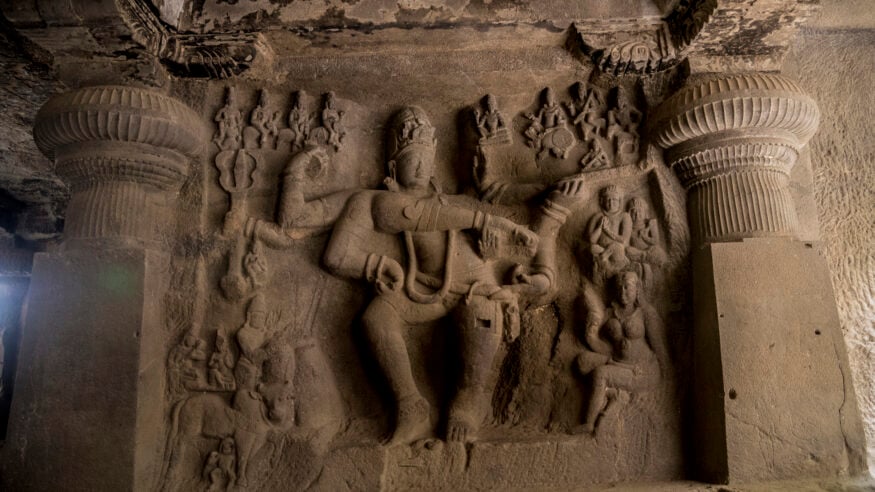
Drawing from the work of Moti Chandraone of India’s foremost cultural historiansI learned that these Viragals date to the eleventh century. Interestingly, the word Viragal (Vira + Kal) is not native to Marathi; Dagada is the common word for stone. Viragal came in from Kannada and is used similarly in Marathi. These stones were memorialsraised to honor a singular act of valor, usually by a warrior, soldier, or saviour. Across Southern India and Maharashtra, they appear in abundance. But the Eksar set is rare: they depict naval warfareships, flotillas, and sea battles in stone.
Reading the stones alongside scholars like Moti Chandra, Braz Fernandes, and A.S. Altekar, I pieced together a chronology of maritime conflicts in and around Eksar, especially over control of Sopara (about 38 kilometres away):
1) In 1019, the fabled Paramara Bhoja Raja conquered Konkan after defeating the Shilahara king, Arikesari, in what inscriptions attest was a fierce naval engagement. To commemorate the victory, Bhoja made land grants near Banaswada (Rajasthan) and Behama near Indore.
2) In the twelfth century, a sea battle raged between the Kadambas of Gopakapattana (Goa) and the Shilaharas of North Konkan near Sopara. References survive, but details are sparse.
3) In 1265, Someshvara, the last Shilahara king, fought his final battle here against the Sevuna monarch, Mahadeva. It was a dogged sea-war; Someshvara drowned himself in the sea rather than face capture. Hemadri or Hemadpant writes, “Someshvara preferred to drown himself and face the submarine fire (Baḍabāgni) rather than the fire of Mahadeva’s anger.”
The goal in every case was the same: control the prized port of Sopara. With that in mind, I read the six Eksar Viragals as a single, visual epic of maritime courage. Here is my walk-through of each, guided by Sri Moti Chandra’s descriptions.
Viragal 1
This tall hero stone (10′ X 3′ X 6″) unfolds across four panels. In the bottom panel, two horsemen with swords strike down an archer; on the right, the fallen hero and his comrades float on clouds toward Indraloka. The second panel shows two horsemen fleeing, leaving the archer to face six horsemen. In the third, a foot soldier pierces an archer with his lance while elephants bearing archers loom behind; below them, three swordsmen with shields advance. On the right, the dead are borne heavenward in an aerial car, guided by Apsaras toward Sivaloka. The fourth panel depicts Sivaloka: to the left, a man and woman worship the Sivalinga; to the right, music resounds. Above, Apsaras carry a bone-relic casket.
Viragal 2
The second stone (10′ X 3′ X 6″) also has four panels. At the bottom, corpses lie on the ground as Apsaras shower flowers. On the right, a king, general, and minister ride elephants under an umbrella-shaded howdah. One elephant flings a man with its trunk and tramples him. In the next panel, a ruler sits as one attendant holds an umbrella and another a rose-water sprinkler; to the right, a horseman fights the king amid surrounding battle scenes. The third panel shows three elephants in line; two bearded men duel in the foreground; a raja on an elephant fights in the middle. Soldiers’ perforated ears and large round earrings suggest a Konkan originsomething the Arab traveller Sulayman also noted. The fourth panel ascends to Kailasa: the dead warrior appears to the left amid Apsaras’ garlands; on the right, women sing and dance, and above, flying gods carry garlands around a bone-relic casket.
Viragal 3
The third stone (10′ X 3′ X 6″) brings the sea to life in four panels. At the bottom, five mast-fitted ships row forward; soldiers crowd the decks, oars slice the water, and the last shipperhaps the king’sshows women at its bow. The second panel tightens into action: four ships attack a much larger vessel; sailors topple into the sea. Above it, an eleventh-century inscription, now undecipherable, once spoke. In the third panel, three people worship the Sivalinga on the left while the Gandharvas gather on the right. The fourth panel crowns the scene with Siva-Parvati on Kailasa amid the Himalayas, with the bone-relic casket above.
Viragal 4
This expansive stone (10′ X 3′ X 6″) runs across eight panels like a storyboard of a campaign. Bottom: eleven armed ships attack another ship. Second: five ships from the left assail a boat from the right as wounded soldiers plunge into the sea. An eleventh-century inscription below is now unreadable. Third: nine ships return in victory. Fourth: soldiers disembark and retreat. Fifth: an army marches; an eminent person with four attendants welcomes it. Sixth: eight persons worship the Sivalinga on the left while Apsaras and Gandharvas sing and dance on the right. Seventh: perhaps Siva himself is shown; Apsaras stand with warriors on the left while horns, conch-shells, and clappers sound on the right. Eighth: the temple of Lord Siva in heaven comes into view.
Viragal 5
The fifth stone (6′ X 3′ X 6″) returns to the sea across four panels. Bottom: six mast-and-oar ships surge forward; in one, the king sits beneath a canopy. Second: three ships from each side collide in a naval battle; soldiers fall wounded or dead into the sea; Apsaras shower garlands upon the fallen. Third: heaven opens with a Sivalinga; a seated man worships as standing women bring offerings; Gandharvas and Apsaras make music and dance to the right. Top: the king holds Durbar as Apsaras greet him.
Viragal 6
The sixth stone (4′ X 15″ X 6″) is concise, with two panels: a sea battle rages below, and above, a warrior sits in heavenvalor transmuted into immortality.
Eksar retained its prominence well into the colonial perioduntil the British remapped Bharatavarsha to fit economic imperatives. The creation of contemporary Mumbai stands as one of their most ambitious undertakings. The Bombay Presidency alienated 701 acres in Eksar to drive a railway through Borivali on the Baroda route. By the 1880s, British official James Campbell recorded what he saw in prose that still conjures the scene:
“Eksar…has in a mango orchard, on the west bank of a fine pond, a row of six slabs of trap, four of them about ten feet high by three broad, the fifth about six feet high by three broad, and the sixth about four feet high by one broad. All, except one which is broken, have their tops carved into large funeral urns, with long heavy ears and hanging bows of ribbon, and above, floating figures bringing chaplets and wreaths. The faces of the slabs are richly cut in from two to eight level belts of carving, the figures in bold relief chiselled with much skill. They are palias or memorial stones and seem to have been set in front of a temple which stood on the top of the pond bank, a site afterwards taken by a Portuguese granary. Each stone records the prowess of some warrior either by land or by sea.”
Reading that, I can almost see the mango orchard and the “fine pond”both long gone, victims of unrestrained development. The temple on the pond bank was demolished by Portuguese Christian bigots and replaced with a granary. Layer by layer, Eksar’s landscapeand memorywas remade.
So where does that leave us? For me, these six Viragals are not just stones; they are India’s maritime memory carved into rockKonkan warriors, Sopara’s sea lanes, and the naval history of India told without words. Before unchecked urbanisation deepens our civilisational amnesia, we should relocate these precious, endangered stones from Club Aquaria to a museum that truly venerates our heritage and protects it for future generations.
If you care about India’s ancient and medieval maritime history, Eksar offers a complete, visual chroniclean essential reminder that our story is as much ocean as it is earth.