Chittorgarhrevered as a Vira-Bhoomistands today as a somber sanctum where memory, duty, and Kshatra Dharma converge. Approached as a Tirtha-Kshetra rather than a mere destination, the fort-city compels reflection on resilience, sacrifice, and ethical leadership across the dharmic traditions of Hinduism, Buddhism, Jainism, and Sikhism. In this setting, a deliberate pilgrimage illuminates how places of collective pain can become sources of inner strength, restraint, and steadfast responsibility.
Padmasimha, in his youth, underwent a rigorous education prescribed for a Kshatriya and deliberately embraced it as a disciplined path to purpose. Beyond formal instruction, he trained in jungle warfare, lived among the Aatavikas, wore bark and leaves, colored his body with natural dyes, shared their food and festivals, and earned their trust as kin. This immersion was not performative; it reflected the Kshatra ideal that strength must be anchored in empathy, social bonds, and service.
Upon returning to Nadduvala, Padmasimha declined coronation despite being the eldest son and chose to install his younger brother, Vikramasimha, on the throne. In a solemn rite, he publicly undertook lifelong Brahmacharyaa disciplined celibacy aligned with the Kshatra ethosgrounded in the conviction that self-mastery over the indriyas safeguards clarity, courage, and righteous statecraft. From that time onward, he served as the Maha-dandanayaka (commander-in-chief) of Nadduvala, embodying the archetype of focused, duty-bound valor often associated with Parashurama in the civilizational memory.
About a month before Vikramasimha’s coronation, Padmasimha led him to Chittorgarh. The intent was explicitly pilgrimage, not spectaclea guided encounter with the ethical core of rulership that situates power within remembrance, restraint, and reverence.
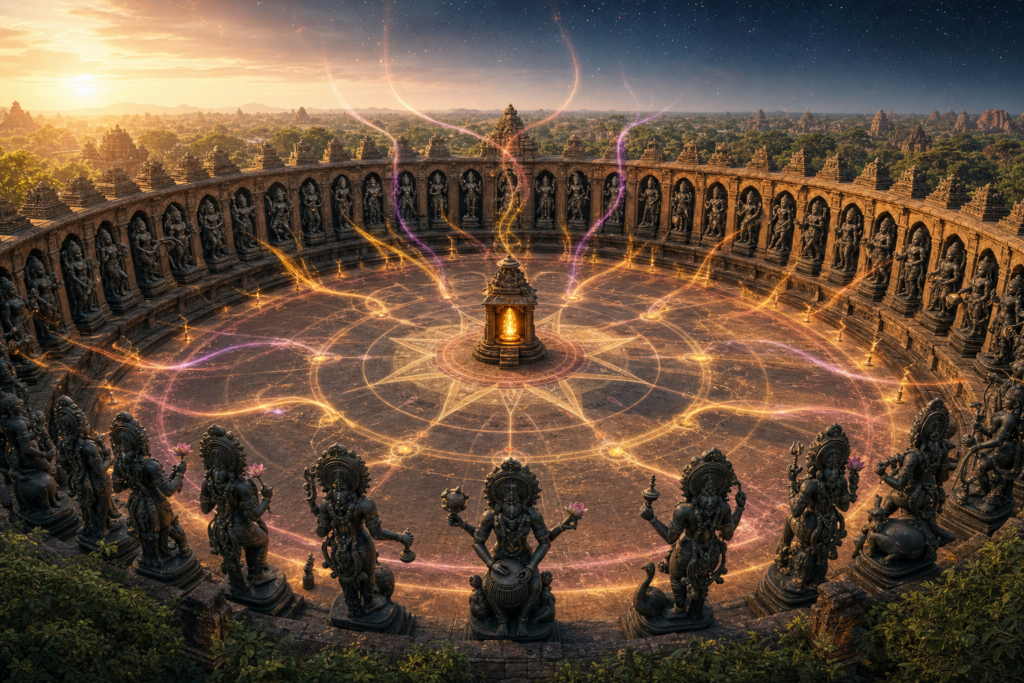
Chittorgarh Fort, a UNESCO World Heritage Site, once radiated royal splendor, cultural wealth, piety, and Rajput power. Straggling over roughly five kos and resembling the massive coils of a python from above, the fort-city had been renowned for centuries for its unbending resolve. The Mughal siege of 1567–68 under Akbar turned this flourishing nucleus into a grave expanse of charred homes and ruined sanctuaries. The Vijaya Stambha, once the proud Tower of Victory, now rises like a solitary sentinelmajestic yet surrounded by a soundless gloom that constantly interrogates the meaning of victory and loss. The palace complex of the Maharanas lies to the southeast in desolate ruin, like wounds awaiting a healer who does not arrive.
At Rampolstill defiant in its stone sinewPadmasimha recalled a three-month defense in which warriors stood with one foot in the battlefield and the other in the grave, an image that has persisted in Rajput history and memory. Period sources and later traditions sometimes label the invaders as “Turushka” or “Mleccha,” terms that reflect historical perception more than present judgment. The siege pounded fortified gates, tore hinges and bolts from their settings, and silenced the war drums posted on the bastionsdrums that had served as the lion’s roar of valor. The memory here is not cultivated to inflame resentment; rather, it is curated to preserve courage, discipline, and moral clarity.
Ascending the hundred steps beyond Rampol, Padmasimha paused by the ruins of a modest shrine: Jagan-Mata Parvati in the auspicious form of Bhadrakali had once resided there. Tradition holds that the Murti was shattered, and the sacred stone lamp-post in the Garbha-Grihawhich had offered perpetual Aratiwas uprooted and later taken to Fatehpur Sikri. Whether viewed through epigraphy, local lore, or architectural archaeology, the point remains ethically constant: the loss of a sanctum demands not vengeance but resilient stewardship of memory, culture, and sacred geography.
At the sacred Jauhar Kund, Padmasimha removed his Peta, lifted it skyward in reverence, then knelt to perform a Sashtaanga Pranaam. Vikramasimha followed. The silence that ensued was weighty and unadorned, the kind that binds remembrance to responsibility. When he finally spoke, Padmasimha’s voice was steadyneither sorrowful nor enraged, but austereurging that the place be regarded and revisited as a true Tirtha-Kshetra even after coronation. The counsel underscored that statecraft, without remembrance, can drift into expedience; remembrance, without discipline, can harden into bitterness.
This mode of pilgrimage resonates across dharmic traditions. For Hindus, Buddhists, Jains, and Sikhs alike, landscapes of trial become classrooms of inner transformation. A Vira-Bhoomi can nurture both shaurya (courage) and ahimsa (non-violence), calling leaders and citizens to unite discipline with compassion, and valor with restraint. In that synthesis, the fort’s seeming desolation acquires meaningits quiet becomes a teacher, its ruins a text, its memory a vow.
Thus, Chittorgarh’s lesson is neither rage nor romanticism. It is the ethical grammar of Kshatra Dharma: to protect without cruelty, to remember without hatred, and to lead with steadiness anchored in sacred memory. As a living archive of Rajput history and a symbol of India’s cultural heritage, Chittorgarh Fort transforms grief into guidanceinviting a more united, reflective, and duty-bound future.
Inspired by this post on Dharma Dispatch.