A recent Archaeological Survey of India (ASI) survey at the protected monument known as Bhojshala–Kamal Maula in Dhar, Madhya Pradesh, has drawn renewed attention to the site’s layered building history. Technical observations and archival references indicate extensive reuse of earlier temple-era architectural fragmentscommonly described in archaeology as spoliawithin the present complex.
The monument, recorded in ASI documentation as Bhojshala/Kamal Maula Mosque, occupies a unique position in India’s heritage discourse. For many in Dhar and beyond, it is simultaneously remembered as a locus of learning associated in local tradition with Vagdevi (Saraswati) and cherished as a place of Islamic devotion connected to the Sufi figure Kamal Maula. Any discussion therefore benefits from a meticulous, evidence-led approach that centers conservation and interfaith harmony.
In the language of field archaeology, a ‘pre-existing structure’ refers to architectural phases predating the visible superstructure or to earlier material recycled in later construction. At syncretic sites across the subcontinent, including Delhi’s Quwwat-ul-Islam complex and Ajmer’s Adhai Din ka Jhonpra, researchers have long documented the practice of reusing carved stone from earlier shrines. Bhojshala–Kamal Maula appears to share this palimpsestic character.
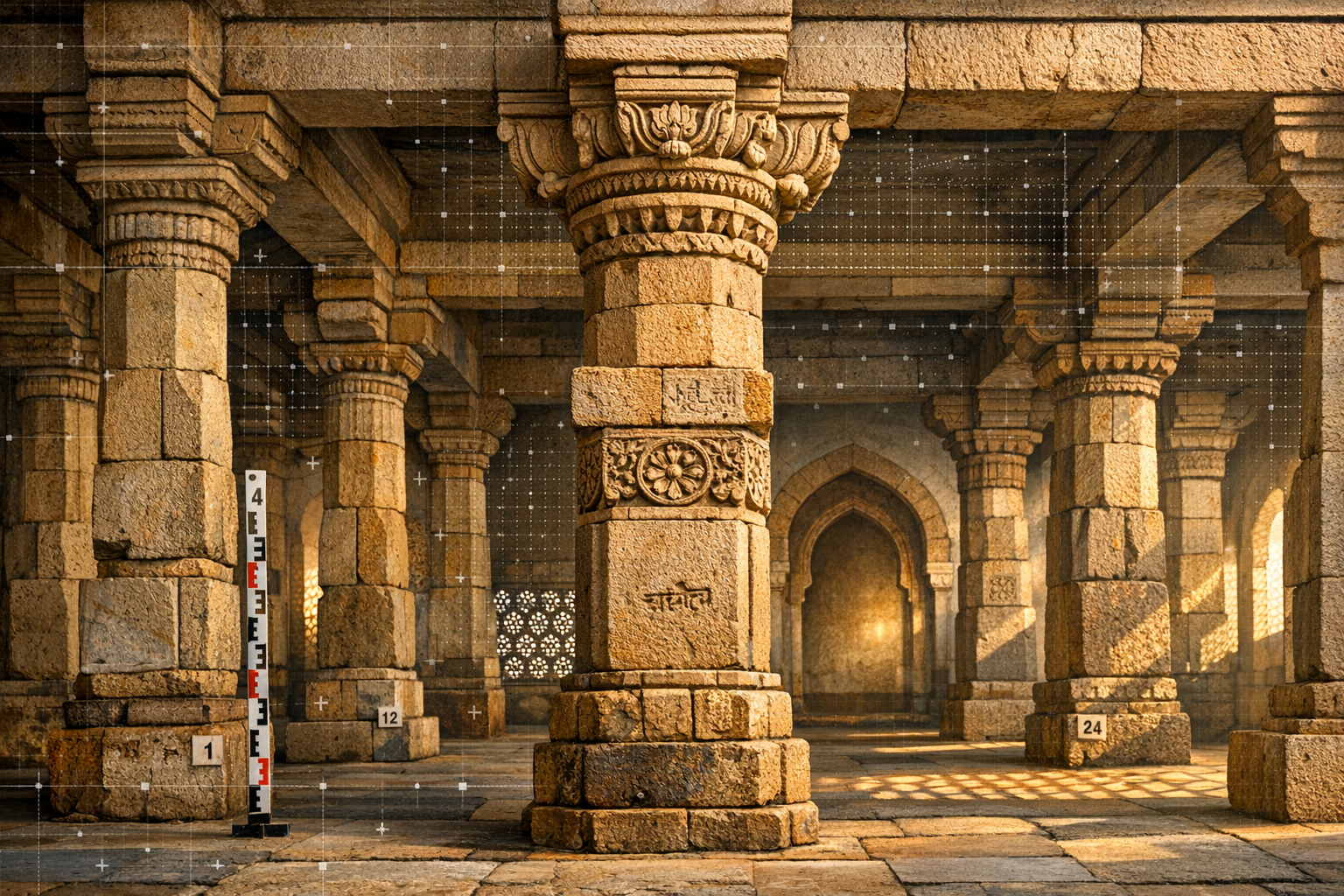
Architecturally, the complex displays hallmarks associated with temple craftcarved pillars, bracketed capitals, floral medallions, and mouldingsjuxtaposed with elements characteristic of a congregational mosque such as a mihrab orientation and open prayer spaces. The juxtaposition does not merely suggest proximity of two traditions; it also records how building materials, skills, and aesthetics traversed social boundaries in the medieval period.
Epigraphic and iconographic fragments visible in situ and in earlier photographic documentation include Nagari-script panels, lotus motifs, and portions of lintels and door jambs consistent with western Indian temple typologies of the late first and early second millennium CE. Some figurative carvings exhibit signs of secondary dressing, truncation, or inversion, which are standard indicators, in technical literature, of adaptive reuse.
Material analysis at comparable sites typically identifies fine-grained sandstone finished with chisel-and-punch tooling, orthostat alignment on stepped plinths, and bracket profiles with kapota cornices. Where recorded, such traits help date individual fragments, even when the composite structure has undergone multiple construction and repair episodes over centuries.
Historically, the region of Malwa flourished under the Paramara dynasty, with the reign of Bhoja (early eleventh century) associated in literary memory with centers of learning and prolific architectural patronage. Subsequent Sultanate-period interventions in Malwa introduced new building programs and devotional geographies. When seen through a long chronological lens, the present monument reads as a composite text shaped by successive political and cultural milieus.
Public filings and court-monitored surveys in recent years have emphasized method over rhetoric: careful measurements, photogrammetric documentation, 3D point-cloud models, masonry bond analysis, and, where permitted, limited sub-surface testing such as ground-penetrating radar (GPR) or micro-stratigraphic sondages. Such procedures establish relative phasing and fabric diagnostics without leaping to conclusions not borne out by the data.
Where matters are sub judice, including proceedings before the Madhya Pradesh High Court, technical submissions and affidavits best serve the public interest when they emphasize methods, limitations, and verifiable observations rather than conjecture.
From a conservation science standpoint, diagnostic markers for earlier phases include discontinuities in plinth courses, mismatched column bases and capitals, rotated or inverted carvings used as infill, and mortar horizons that segregate one building campaign from another. Each observation is logged against a grid, photographed with scales, and cross-referenced to archival plans, allowing later peer review.
Civil-society organizations and litigants have circulated photographic and testimonial claims asserting buried temple remains beneath the extant prayer hall. In professional archaeology, such assertions are evaluated through controlled stratigraphic methods and triangulated with structural analysis to differentiate probability from possibility.
For many residents of Dhar, walking into the monument’s hypostyle hall evokes both pride in craft heritage and poignancy at the site’s contested narratives. Heritage practitioners frequently note that such emotions, though deeply felt, are best held alongside a commitment to verifiable evidence, reversible conservation, and respect for the living practices of all communities engaged with the space.
Local tradition remembers Bhojshala as a seat of learning dedicated to Saraswati, with Tuesday darshan and Vasant Panchami observances serving as significant markers for Hindu devotees. Equally, the space carries Islamic sacred associations as the Kamal Maula Mosque, with Friday prayers and the memory of Sufi piety woven into its social life. Both strands coexist in the site’s administrative arrangements, which have, at various times, provided scheduled access for distinct religious observances.
Within dharmic thought broadlyacross Hinduism, Buddhism, Jainism, and Sikhismreverence for knowledge (jnana/gyan), non-violence (ahimsa), right conduct (dharma), and truthful inquiry (satya) provide a common ethical vocabulary for engaging layered monuments. Framing the monument as a shared classroom in history rather than a battleground for identity aligns with these values.
Comparative architectural analysis strengthens the interpretive framework. In many early mosques constructed during or after political transitions, masons retained familiar carpentry-in-stone techniques: corbelled ceilings, bracket-and-beam roofing, and repetitive bays relying on spolia pillars. The continuity of workmanship reflects guild structures and local supply chains as much as it does devotional change.
Epigraphists advise caution in reading fragmentary inscriptions. Palæographic datingbased on letter forms, ligatures, and orthographyyields ranges rather than single-year certainties. Where fragments mention deities, donors, or royal titles, they are interpreted within regional chronologies; where they are formulaic or eroded, they are treated as supportive rather than decisive evidence.
The ASI’s nomenclatureusing the hyphenated Bhojshala/Kamal Maulasignals recognition of multi-vocal significance. Its statutory mandate under the Ancient Monuments and Archaeological Sites and Remains (AMASR) Act focuses on protection, documentation, and presentation. In practice, that means stabilizing vulnerable fabric, managing visitor loads, and presenting history with balance and clarity.
Responsible heritage interpretation at this monument can draw on international charters such as Venice (1964), Burra (1979, revised), and Nara (1994), as well as India’s own conservation guidelines. These documents endorse minimal intervention, retention of historical evidence across all phases, and presentation that respects cultural diversity.
A practical, peace-affirming roadmap for Bhojshala–Kamal Maula could include five concurrent tracks: structural conservation; multi-phase historical interpretation; equitable access management; community dialogue; and transparent data sharing. None of these tracks prejudges theological claims; each instead builds public trust in process.
Structural conservation priorities typically start with drainage corrections, salt efflorescence mitigation, vegetation removal, micro-grouting at cracks, anchoring of unstable brackets, and sensitive flooring repairs using lime-based mortars matched to historic fabric. Routine condition mapping should be updated seasonally.
Multi-phase interpretation can be delivered through layered signage, tactile models, and an on-site gallery that explains Paramara-period craft, Sultanate-period additions, and modern conservation without privileging one over the other. Bilingual or trilingual panelsHindi, English, and where appropriate Urducan widen comprehension and dignity.
Equitable access management benefits from predictable schedules, clear codes of conduct, and trained docents who can mediate questions without polemics. Crowd-control infrastructure must be non-intrusive and reversible, ensuring that heritage presentation does not itself damage heritage fabric.
Community dialogue works best when it listens first. Facilitated roundtables with representatives from Hindu, Muslim, Buddhist, Jain, and Sikh communities in Dhar can articulate shared aspirationspreservation, safety, dignityand craft a locally-owned charter for shared sacred precincts.
Transparent data sharingpublishing survey drawings, 3D scans, and conservation reports onlinereduces rumor and strengthens scholarship. Where litigation runs parallel to conservation, releasing non-sensitive technical material in a timely manner helps ensure that public debate remains informed.
It is also important to contextualize spolia historically. Reuse of carved stone occurred in many directions across centuriesdriven by availability of material, patronage shifts, earthquakes, and changing ritual needs. Recording reuse is a factual exercise; assigning moral verdicts across large historical spans must be approached with humility.
For students of architecture, Bhojshala–Kamal Maula offers a living laboratory: comparative study of column modules, bracket typologies, cornice profiles, and tooling signatures can illuminate workshop practices in Malwa. For historians, the monument offers an entry point into epigraphy, patronage networks, and the circulation of texts associated with Bhoja’s intellectual milieu.
Visitors frequently report that the site’s quiet courtyards, filtered light, and tactile stonework create a contemplative ambience. In such moments, the monument transcends binaries; it becomes a teacher. That experiential dimensionbeauty prompting inward stillnessis as much a part of heritage value as inscriptions or mouldings.
Ultimately, the core findingpresence of temple-era spolia within the present complexshould be treated as an invitation to learn rather than a provocation to divide. Evidence-led scholarship, reverence for all living traditions at the site, and a commitment to dharmic ethics can together renew shared heritage in Dhar.
If approached with care, Bhojshala–Kamal Maula can stand not just as a record of historical change, but as a contemporary exemplar of how India’s diverse communities protect, interpret, and cherish the same stone together.
Inspired by this post on Struggle for Hindu Existence.