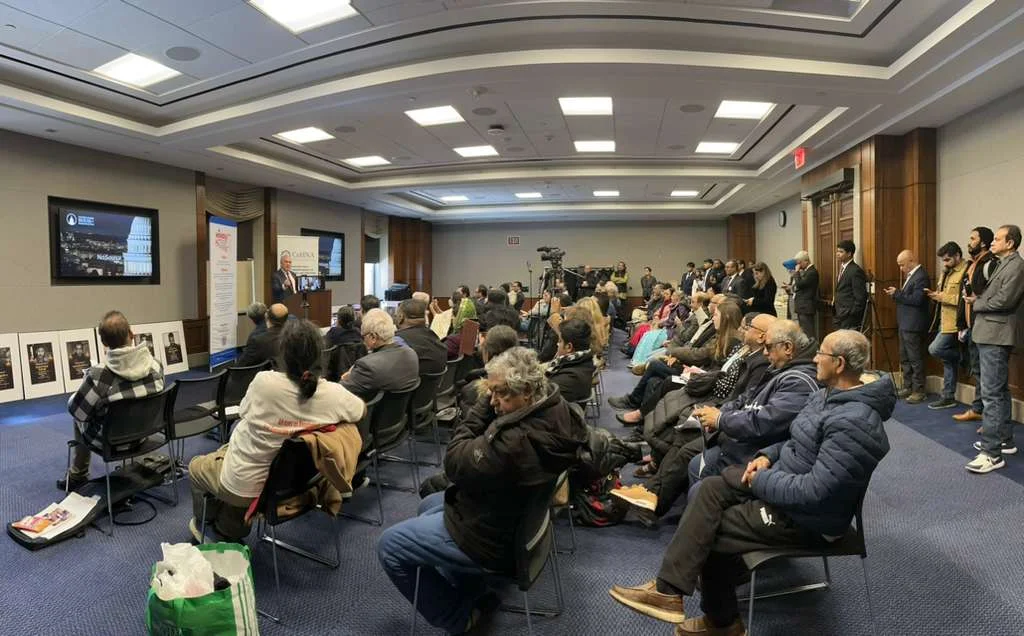
Washington, DC, February 11, 2026: A congressional briefing convened by the Coalition of Hindus of North America (CoHNA) and HinduAction presented urgent testimony alleging escalating, state-enabled persecution of religious minorities in Bangladesh under Chief Advisor Muhammad Yunus, ahead of a contested national election scheduled for February 12. Journalists, human rights advocates, survivors, and young members of the Bangladeshi Hindu diaspora described a deepening climate of fear, institutional breakdown, and impunity that, in their view, threatens pluralism and regional stability.
Speakers emphasized that the crisis cannot be understood solely as episodic unrest; rather, they framed it as a systematic erosion of rule of law and civic space with disproportionately grave consequences for Hindus and other vulnerable minorities. The accounts sought to center victim experiences and elevate urgent protective measures consistent with international human rights norms and U.S. policy tools.
“We need to listen to victim voices,” stated CoHNA board member Sudha Jagannathan, underscoring the magnitude of state failure alleged by witnesses. “Silence is not an option and the congressional briefing is one important way to draw attention to the pogrom underway.”
Testimony coalesced around four policy requests: public condemnation of the violence and the initiation of congressional hearings; the designation of Bangladesh as a Country of Particular Concern (CPC) under U.S. law on religious freedom; the designation of Jamaat-e-Islami as a Foreign Terrorist Organization (FTO); and the application of Global Magnitsky sanctions against Muhammad Yunus for alleged rights abuses.
Michael Rubin, senior fellow at the American Enterprise Institute, delivered the keynote and advocated targeted sanctions under the Global Magnitsky Human Rights Accountability Act, which authorizes the U.S. government to freeze assets and restrict entry of foreign individuals implicated in serious human rights violations. Drawing comparisons to Turkey and Iran, Rubin warned that U.S. engagement risks repeating the Myanmar precedent with Aung San Suu Kyi“embracing a Nobel laureate whose commitment to liberal principles was a complete fabrication.”
Members of Congress and senior staff engaged substantively. Rep. Tom Barrett (R-MI), a former U.S. Army officer, observed that even as conventional battlefronts subside, extremist threats persist. He encouraged continued advocacy aimed at informing policy shifts that deter violence and protect minorities.
Responding to the expert testimony, Rep. Suhas Subramanyam (D-VA) questioned whether the February 12 vote could be “truly free and fair,” given that one of the largest mainstream partiesSheikh Hasina’s Awami Leaguehas reportedly been banned since May 2025 and its student wing labeled a “terrorist organization” since October 2024. The remarks highlighted concerns over political representation and credible electoral processes.
In a recorded message, former U.S. Senator and International Religious Freedom Summit co-chair Samuel Brownback warned that patterns of state-sanctioned violence can rapidly reshape population stability and economic trajectories. “If Bangladesh goes in the wrong direction, you’re going to see them drive out most of their religious minorities,” he cautioned.
The briefing drew more than 70 attendees, including staffers from the offices of Sen. Cory Booker (D-NJ), Rep. Mike Levin (D-CA), Rep. Young Kim (R-CA), and Rep. David Min (D-CA), as well as members of the diplomatic community. The turnout signaled growing legislative attention to religious freedom and human rights in South Asia.
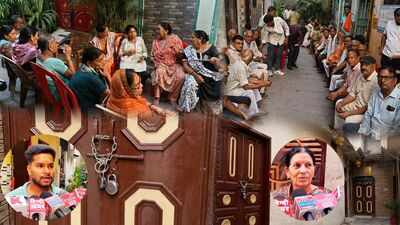
Witnesses offered granular accounts of coercion, intimidation, and institutional complicity. SriRam, speaking under an alias for safety, described coordinated attacks and the takeover of civic spaces by Islamist groups. He recounted neighbors surrounding his mother while chanting that Hindus were traitors who should be expelled, and detailed how his brother’s family-run hospital was allegedly seized, prompting continual threats that hinge on religious identity.
He further noted that December 16Victory Day commemorating Bangladesh’s independence in 1971passed without celebrations in his community, a stark departure from previous years. For him, the absence symbolized a loss of psychological safety and civic belonging that extends beyond physical violence.
Human rights advocate Shubho Roy, who was in Dhaka during the same period, summarized the continuity of persecution across decades: “I witnessed it, I went through the trauma. From 1971 till todaywe are facing the same. They are going after Hindus. They’re targeting minorities.” Echoing this assessment, SriRam warned, “Hindus will not survive another decade in Bangladesh. We will be erased from our homeland.”
The climate of fear has reverberated across the North American diaspora. Gita Sikanji, associate professor at the University of California, Irvine, described mobilizing rallies in 25 U.S. cities to raise awareness. When she invited an ISKCON leader in California to participate, he reportedly declined in tears, fearing reprisals against his community in Bangladesh if his face appeared publicly. “Even American Hindus here are traumatized by this series of events,” she testified, illustrating the phenomenon of vicarious trauma in transnational communities.
Youth voices underscored both documentation and policy advocacy. Ritvik Hari, a CoHNA policy analyst, urged Congress to condemn the violence, hold hearings, and designate Bangladesh as a CPC. Stony Brook University student Puja Debi, co-founder of Bengali Hindus of New York City, has been cataloging attacks amid limited mainstream coverage. High school senior Pramit Acharjee warned that “minority families are being forced to vote a certain way, and they are killed or displaced if they do not comply.” Queens student Swastika Biswas emphasized the pipeline from dehumanizing language to physical harm: “When words strip people of their humanity, violence follows.” Engineer Sayan Shil described a collapse of “psychological safety” for minorities.
Experts cataloged indicators of institutional breakdown. Priya Saha of the South Asian Minorities Collective cited cases in which security and management actors allegedly transferred Hindu victims to violent mobs, including Hindu police officer Santosh Chowdhury and garment worker Deepu Chandra Das. She also described a crackdown in Hazari Goli where police and military reportedly beat and arrested dozens of peaceful Hindu protesterspatterns indicative, in her assessment, of direct state involvement.
Arifa Rahman Ruma, associate professor at Bangladesh Open University, asserted that Islamist militants have been released with indemnity, further entrenching impunity. Farida Yasmin, president of the National Press Club of Dhaka, described December 2025 as a dark moment for independent journalism, with mobs torching major newspaper offices and constraining the press’s role as a check on power.
Rana Hassan Mahmud of the Center for U.S.–Bangladesh Relations warned that Bangladesh is heading toward “a sham election with predetermined results.” He argued that continued backing of the current arrangement “enabl[es] the creation of a new hub of terrorism whose repercussions will extend far beyond Bangladesh’s borders.” Utsav Chakrabarti of HinduAction contextualized the crisis in historical memory, cautioning that “the ongoing pogrom risks escalating into a full-scale repeat of the 1971 genocide,” and urging accountability for Jamaat-e-Islami given its role during the 1971 Liberation War.
From an atrocity-prevention perspective, the testimony maps onto several recognized early-warning indicators: sustained hate speech and dehumanization, visible impunity for perpetrators, politicization and paralysis of security institutions, intimidation of the press and civil society, and coercion of minorities in the electoral process. Such signals, taken together, suggest elevated risk for mass violations unless prompt, targeted, and lawful interventions restore accountability.
The policy instruments discussed at the briefing align with existing U.S. frameworks. A Country of Particular Concern designation, under the International Religious Freedom Act, is triggered by systematic, ongoing, and egregious violations of religious freedom and can entail measures ranging from diplomacy to sanctions. A Foreign Terrorist Organization designation requires evidence that a foreign entity engages in terrorism or retains capability and intent, posing a threat to U.S. nationals or national security. The Global Magnitsky Act permits targeted financial and visa sanctions against individuals responsible for serious human rights abusesan approach designed to isolate perpetrators without broad harm to civilian populations.
Speakers argued that careful use of these toolsgrounded in verifiable evidence, due process, and periodic reviewcould deter further abuses, re-establish credible red lines, and bolster local reformers. They emphasized that targeted sanctions should be paired with support for independent media, legal aid for victims, and election observation to uphold international standards.
The security implications reach beyond Bangladesh. Testimony highlighted the risk that weakened institutions and emboldened extremist networks can spill over into the Bay of Bengal region, strain India–Bangladesh relations, and seed transnational radicalization pipelines. For U.S. policymakers, the issue intersects with counterterrorism, maritime security, and the credibility of global human rights commitments.
At the values level, the briefing repeatedly invoked the civilizational ethos shared by dharmic traditionsHinduism, Buddhism, Jainism, and Sikhismwhich prize pluralism, nonviolence, and mutual respect. Upholding the safety and dignity of Hindus in Bangladesh was presented not as a sectarian aim but as essential to safeguarding the subcontinent’s broader tapestry of dharmic and non-dharmic communities alike.
The throughline of the event was sober but constructive: center survivor voices, document rigorously, and act with moral clarity and legal precision. Attendees were reminded that durable solutions require both accountability for perpetrators and investment in civic institutions that protect all citizens regardless of faith.
The briefing formed part of CoHNA’s ongoing grassroots engagement across North America. Testimony suggested that the cost of silence extends far beyond Bangladesh’s bordersundermining regional stability, emboldening transnational extremism, and eroding the credibility of democratic states that champion religious freedom and human rights.
Inspired by this post on CoHNA.