
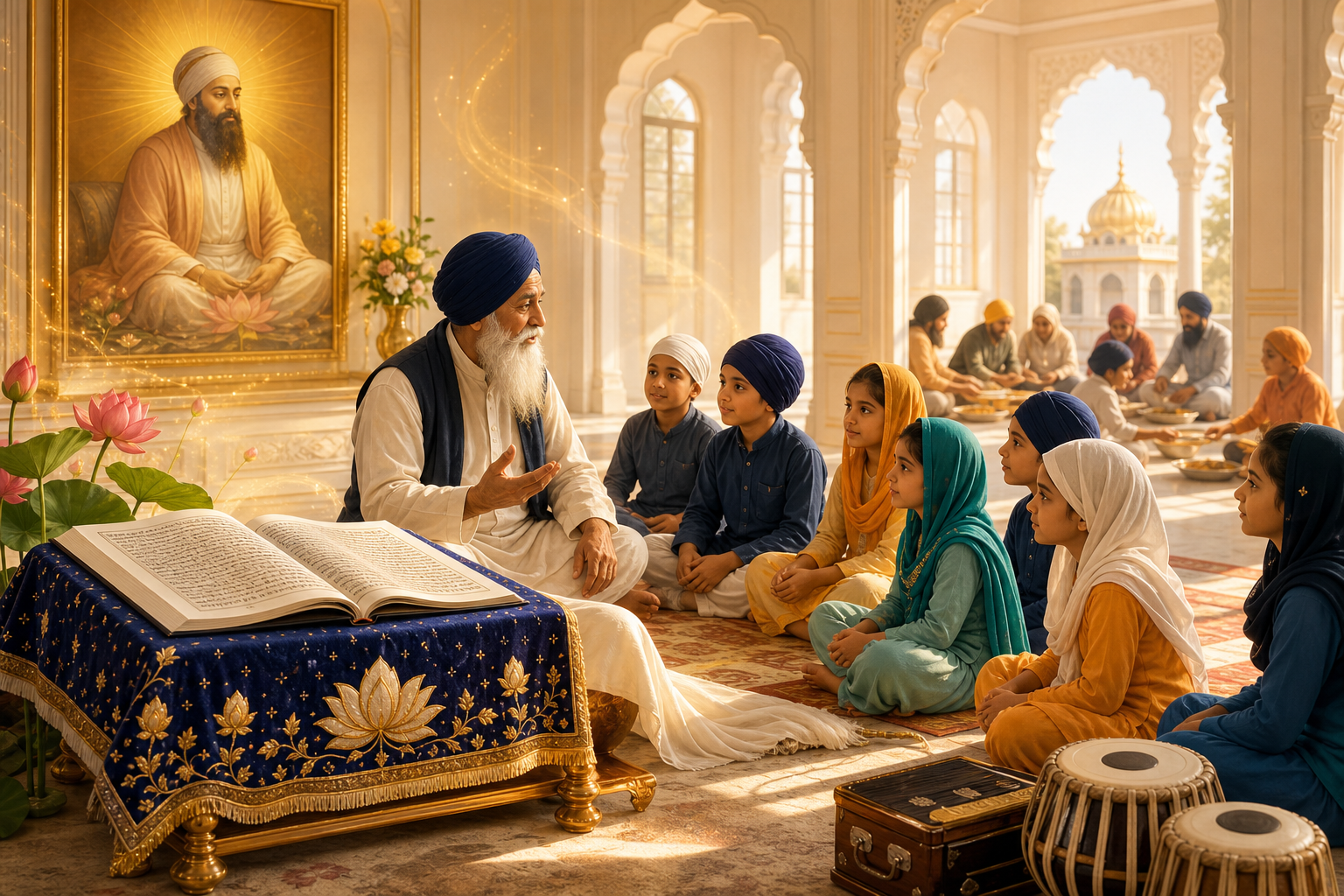
Guru Arjan Dev Ji’s Shaheedi occupies a central place in Sikh memory because it presents peace not as weakness, passivity, or silence before injustice, but as disciplined spiritual strength. For children, this history can become a profound lesson in inner steadiness, ethical courage, and compassion under pressure. The sweetness of sehj, or calm equipoise, offers a way to understand how a person can remain rooted in dignity even when confronted by suffering.
Guru Arjan Dev Ji, the fifth Sikh Guru, lived during a formative period in the development of Sikh institutions, scripture, music, and community life. He is remembered for compiling the Adi Granth in 1604, strengthening the tradition of sangat and pangat, and nurturing a spiritual culture in which devotion, equality, and service were inseparable. His life demonstrates that peace is not merely an emotion; it is a cultivated moral practice supported by prayer, reflection, disciplined conduct, and concern for all beings.
The word Shaheedi is often translated as martyrdom, but in the Sikh context it carries a deeper meaning than death alone. It refers to witness: a truthful standing for dharma, justice, and spiritual integrity even when worldly power demands compromise. Guru Arjan Dev Ji’s Shaheedi therefore teaches that peace is not the avoidance of conflict at any cost. It is the refusal to let cruelty, fear, resentment, or revenge become the governing force of the heart.
This distinction is especially important when teaching children. Many children first understand peace as quietness: no arguing, no shouting, no visible disturbance. The example of Guru Arjan Dev Ji widens that understanding. Peace becomes the ability to speak truth without hatred, to endure hardship without losing compassion, and to meet injustice with moral clarity rather than bitterness.
Sehj is the key to this teaching. In Sikh spiritual vocabulary, sehj suggests natural balance, composure, and spiritual maturity. It is not indifference. It is not emotional numbness. It is a refined state in which the mind is not dragged violently by anger, fear, ego, or despair. For a child, sehj may begin in simple forms: pausing before reacting, breathing before speaking, remembering kindness when hurt, and choosing truthful words instead of harsh ones.
Guru Arjan Dev Ji’s life makes sehj visible through action. His contributions were not isolated acts of private piety. The compilation of the Adi Granth created a sacred center of wisdom that included the hymns of Sikh Gurus along with the devotional voices of saints from diverse backgrounds. This inclusiveness itself was a form of peace education. It showed that spiritual truth is not diminished when human voices differ; it is enriched when humility allows wisdom to be recognized across social and religious boundaries.
This is where Guru Arjan Dev Ji’s legacy also supports unity among dharmic traditions. Hinduism, Buddhism, Jainism, and Sikhism each contain deep reflections on self-discipline, compassion, truthfulness, and liberation from ego. The vocabulary differs, the practices differ, and the theological frameworks differ, yet a shared civilizational concern remains: the human being must learn how to govern the mind, reduce harm, honor truth, and serve the larger good. Guru Arjan Dev Ji’s Shaheedi can therefore be taught in a way that strengthens respect across dharmic communities rather than encouraging sectarian separation.
In Hindu traditions, the idea of shanti is not merely external calm but alignment with dharma. In Buddhism, peace arises through the calming of craving, aversion, and ignorance. In Jainism, ahimsa demands vigilance toward the harm caused by thought, speech, and action. In Sikhism, sehj is cultivated through remembrance of the Divine, seva, truthful living, and acceptance of hukam. These traditions do not become identical, but they converse meaningfully with one another through a shared ethical seriousness.
For children, this comparative framework can be powerful because it prevents peace from becoming a vague moral slogan. Peace becomes practical. It can be practiced in the classroom when a child refuses to mock another child. It can be practiced at home when siblings disagree but choose not to humiliate each other. It can be practiced online when a young person decides not to join cruelty disguised as humor. In this sense, Guru Arjan Dev Ji’s Shaheedi speaks directly to modern childhood.
The historical memory of Guru Arjan Dev Ji’s suffering must be handled with care when taught to children. It should neither be softened until it loses meaning nor narrated in a manner that cultivates fear or hatred. The mature lesson is that injustice exists, that spiritual people have faced persecution, and that moral greatness is revealed by the way one responds to suffering. A child can understand that courage does not require cruelty and that remembrance does not require resentment.
This approach also protects the emotional development of the child. Stories of sacrifice can overwhelm young minds if they are presented only through pain. Guru Arjan Dev Ji’s Shaheedi should be framed through the larger sweetness of his life: the creation of sacred music, the gathering of wisdom, the feeding of communities, the dignity of labor, and the love of the Divine. The suffering is real, but it is not the whole story. The whole story is spiritual sovereignty.
Peace education rooted in Guru Arjan Dev Ji’s example begins with emotional literacy. Children can be invited to name what they feel when they are treated unfairly: anger, sadness, confusion, embarrassment, or fear. They can then be guided to ask a second question: what action would preserve dignity without increasing harm? This movement from impulse to reflection is the beginning of sehj.
Such teaching is not abstract. A child who loses a game may want to accuse others. A child who is excluded may want to insult the group. A child who is corrected may want to lie. Guru Arjan Dev Ji’s example does not demand that children suppress their feelings. It teaches them that feelings must be held within a larger discipline of truth, compassion, and self-command.
There is also a technical ethical lesson here: peace is sustained by institutions, not only by individual emotions. Guru Arjan Dev Ji’s work in compiling scripture and strengthening collective worship shows that communities need structures that train memory, humility, and service. The gurdwara, kirtan, langar, and sangat are not merely cultural markers. They are pedagogical institutions that teach equality, shared responsibility, and reverence through repeated practice.
Langar, in particular, gives children a visible model of peaceful society. People sit together, receive food together, and participate in service together. The act is simple, but the philosophy is profound. It dissolves hierarchy through practice rather than argument alone. In a world where children quickly absorb differences of class, language, appearance, and status, langar teaches that dignity is not earned by superiority; it is inherent in every person.
Guru Arjan Dev Ji’s relationship to sacred music also provides a refined way to teach peace. Kirtan is not entertainment in the ordinary sense. It is disciplined sound shaped by devotion, memory, and contemplation. Children who encounter kirtan learn that the mind can be trained through beauty. Sound can soften aggression, gather attention, and create a shared emotional field in which the heart becomes more receptive to truth.
The Adi Granth’s inclusive spiritual vision also offers a lesson in intellectual humility. Children often inherit the idea that being loyal to one’s tradition means dismissing every other path. Guru Arjan Dev Ji’s work challenges that insecurity. A tradition confident in truth can recognize wisdom wherever it appears. This is a vital lesson for dharmic unity: rootedness and respect are not opposites.
In modern family life, this lesson is urgently needed. Children grow up in plural societies, mixed classrooms, digital spaces, and extended networks where religious and cultural identities constantly meet. If they are taught only suspicion, they become brittle. If they are taught only vague sameness, they lose depth. Guru Arjan Dev Ji’s legacy offers a balanced path: know one’s tradition seriously, honor others sincerely, and never confuse disagreement with hatred.
The Shaheedi of Guru Arjan Dev Ji can also help children understand the difference between power and authority. Power can compel obedience through fear. Authority, in the spiritual sense, arises from truthfulness, sacrifice, compassion, and consistency. Guru Arjan Dev Ji’s moral authority endured precisely because it did not depend on domination. This is an essential lesson for leadership: the strongest person in the room is not always the loudest or the harshest.
Parents and educators can translate this into daily practice by asking children to notice different forms of strength. It takes strength to apologize. It takes strength to tell the truth when lying would be easier. It takes strength to include someone who has been ignored. It takes strength to walk away from provocation without becoming cowardly. These are child-sized expressions of the same ethical world that Guru Arjan Dev Ji’s Shaheedi illuminates.
Another important teaching concerns suffering. Many modern cultures try to hide suffering from children, while digital culture often exposes them to suffering without guidance. Sikh memory offers a third way: suffering is acknowledged, given meaning, and placed within a discipline of remembrance and service. Children can learn that pain should not be denied, but neither should it be allowed to harden into cruelty.
This is where personal reflection becomes educationally valuable even within an academic framework. Many families have seen how a child changes when an elder responds calmly to insult, disappointment, or loss. Children often learn more from witnessed composure than from formal instruction. When they see adults practice sehj, they learn that peace is possible under pressure. Guru Arjan Dev Ji’s example gives that ordinary family lesson a sacred historical depth.
Teaching this history also requires linguistic care. Words such as sehj, Shaheedi, seva, sangat, pangat, and hukam should not be flattened into quick English equivalents. Each term carries a world of practice and memory. Children benefit when these words are explained patiently, repeated respectfully, and connected to lived examples. Vocabulary becomes a bridge into spiritual imagination.
Sehj may be described to a child as a sweet steadiness inside the heart. Shaheedi may be described as standing for truth with complete courage. Seva may be explained as service done without selfish display. Sangat may be described as the company that helps one become better. Hukam may be introduced as the deep order of reality before which the ego learns humility. These explanations are simple, but they preserve philosophical seriousness.
The relevance of Guru Arjan Dev Ji’s Shaheedi becomes even clearer in the age of constant reaction. Children today are trained by screens to respond quickly, publicly, and emotionally. Anger is rewarded with attention. Mockery becomes a form of social currency. The discipline of sehj offers a counter-education. It teaches the child that not every provocation deserves a reaction and that not every reaction deserves expression.
This does not mean children should be taught to accept bullying or injustice silently. The Sikh tradition does not glorify helplessness. Rather, it teaches that resistance must be governed by dharma. A child can report harm, seek help, speak truth, and defend dignity without imitating the cruelty of the aggressor. This is one of the most practical lessons Guru Arjan Dev Ji’s Shaheedi can offer to parents and teachers.
Within dharmic education, Guru Arjan Dev Ji’s Shaheedi can be placed beside other examples of disciplined compassion. The Jain commitment to ahimsa, the Buddhist cultivation of karuna, the Hindu reverence for shanti and dharma, and the Sikh ideal of seva all help children see that peace requires training. It is not accidental. It is formed by repeated choices, sacred memory, and the company of those who value truth more than ego.
There is also an important civic dimension. A society that teaches children only competition will produce anxiety. A society that teaches only identity without humility will produce division. A society that teaches only tolerance without conviction will produce confusion. Guru Arjan Dev Ji’s legacy offers a more integrated model: conviction without hatred, devotion without arrogance, courage without cruelty, and peace without surrendering truth.
For educators, the classroom application can be structured around three questions. What happened in the life of Guru Arjan Dev Ji? What virtues did he embody? How can those virtues be practiced today? This method keeps the lesson historically grounded, ethically clear, and personally applicable. It prevents the narrative from becoming either mere memorization or sentimental storytelling.
For parents, the lesson may be even more intimate. During moments of conflict, a parent can ask a child what sehj would look like in that situation. Would it mean speaking more slowly? Would it mean telling the truth without shouting? Would it mean apologizing? Would it mean refusing to join a group that is being unkind? In this way, Guru Arjan Dev Ji’s Shaheedi becomes a living moral vocabulary inside the home.
The sweetness of sehj lies in its realism. It does not pretend that life is free from pain. It does not deny that injustice has marked history. It does not ask children to become emotionless. Instead, it teaches that the heart can be trained to remain luminous in difficult conditions. This is why Guru Arjan Dev Ji’s Shaheedi continues to speak across generations.
When children learn this history properly, they do not merely learn about the past. They learn how to inhabit the present with greater dignity. They learn that peace is not fragile politeness but disciplined strength. They learn that devotion can produce courage, that service can soften ego, and that remembrance can transform suffering into wisdom. Above all, they learn that true peace begins when the mind is anchored in truth and the heart refuses to abandon compassion.
Inspired by this post on SikhNet – News.











Leave a Reply
You must be logged in to post a comment.