
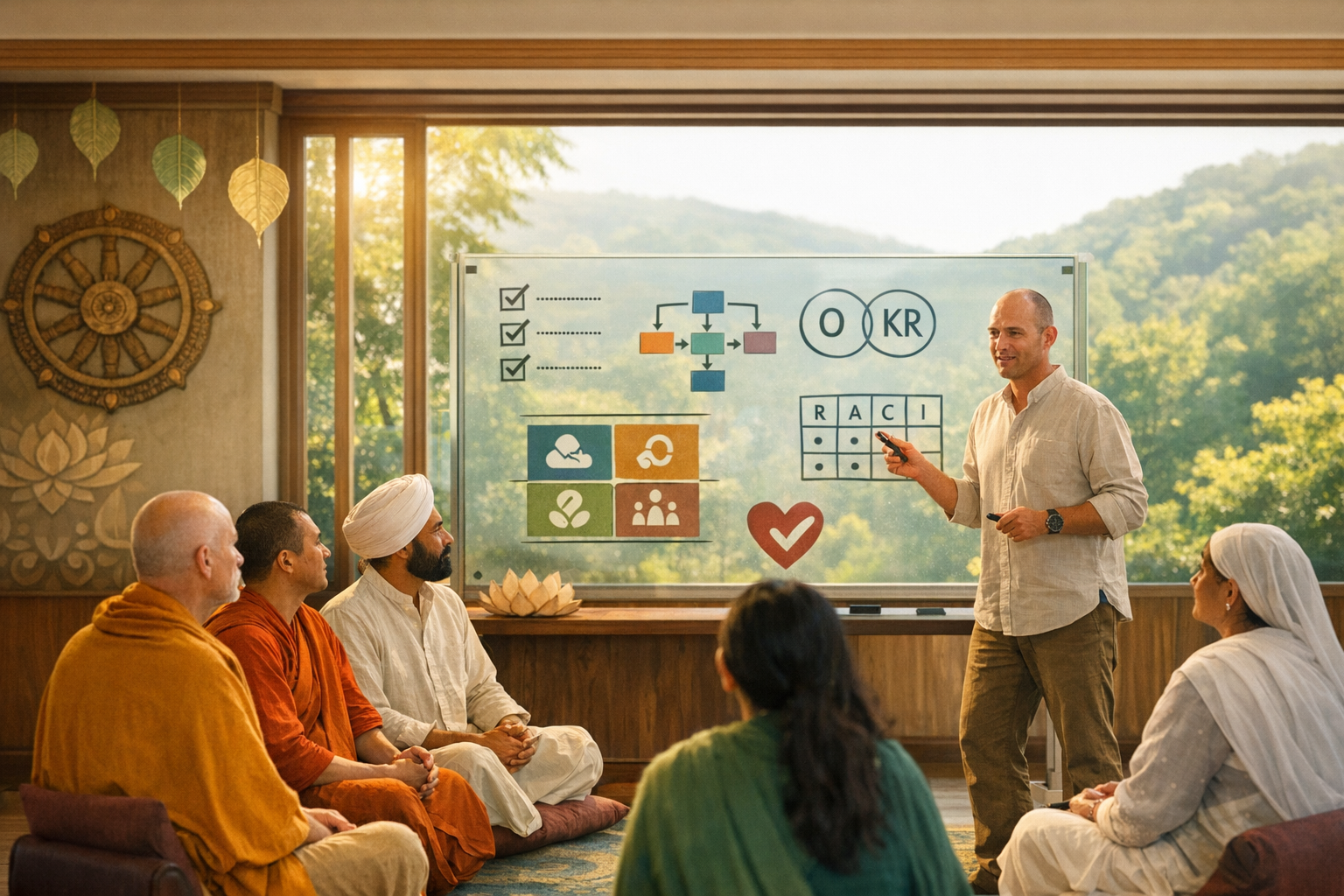
Over four days in New Vrindaban, more than forty devotees convened for a Leadership & Management Course facilitated by Anuttama Dasa. Participants consistently described the training as simple, practical, and grounding, oriented toward leading and serving with clarity and care. One attendee, Jaya Krsna, observed that, even in comparison with an MBA, it ranked among the most practical courses encountered, and many expressed a thoughtful sense of gratitude for the program’s actionable guidance.
Leadership education of this nature is particularly consequential for dharmic communities, where organizational effectiveness and spiritual integrity must advance together. In contexts spanning Hindu, Buddhist, Jain, and Sikh institutions, leadership is not a pursuit of personal authority but an expression of seva, ahimsa, satya, karuṇā, and sarbat da bhala. A course that foregrounds clarity and care directly supports this dharmic mandate: to guide communities in ways that are ethically sound, emotionally intelligent, and operationally proficient.
In light of the course’s emphasis on practicality and service, a research-informed synthesis of best practices illuminates how spiritual leadership and modern management can be harmonized. The synthesis below distills proven frameworks from nonprofit governance and organizational development and aligns them with dharmic principles, offering a replicable blueprint for temples, sanghas, ashrams, and seva trusts committed to excellence in both spiritual cultivation and community impact.
Pillar 1: Inner governance before outer governance. Effective spiritual leadership begins with personal discipline and self-regulation. Daily contemplative practices (such as japa, meditation, metta-bhavana, or shramanā-style introspection) stabilize attention, refine emotional balance, and reduce reactivity under pressure. This inner steadiness translates into better decisions, fairer conflict resolution, and consistency between stated values and enacted policiesa hallmark of credible dharmic leadership.
Pillar 2: Seva-centered stewardship. Across dharmic traditions, leadership is service. Sikh praxis elevates seva as a living commitment; Buddhist and Jain teachings emphasize karuṇā and aparigraha; Vaishnava and Shaiva lineages enjoin compassionate care for people and places. Stewardship frames leaders as caretakers of mission, people, assets, and ecological balance. This orientation anchors choices in long-term welfare rather than short-term gains, aligning with lokasangrahathe uplift of society.
Pillar 3: Community governance rooted in dharma. Practical governance for temples and trusts benefits from clear charters, role definitions, and participatory processes. Transparent decision-making and ethical norms (satya and ahiṃsā in communication and action) cultivate trust. Boards and councils function best when they balance wisdom (śāstra-sahita viveka) with evidence-based planning, regularly reviewing policies for coherence with core values and the lived needs of the community.
Decision-making frameworks for clarity and speed. Spiritual organizations frequently rely on consensus; however, consent-based methods and role clarity tools often preserve momentum while respecting voice. RACI charts (Responsible, Accountable, Consulted, Informed) or RAPID can eliminate ambiguity about who decides, who advises, and who executes. Decision logs and briefings codify institutional memory, preventing repeated debates and ensuring continuity when volunteer rosters rotate.
Strategy and alignment tools that respect mission. Objectives and Key Results (OKRs) help link high-level purpose to measurable progress without diluting spiritual aims. Complementary Balanced Scorecard perspectives (mission/learning, community engagement, internal processes, resource stewardship) provide a multi-dimensional dashboard so leaders can track both sādhanā-supporting activities and service outcomes. This safeguards against over-indexing on finances or attendance alone and keeps the focus on transformative impact.
Operational excellence adapted to ashram and sangha life. Lean and continuous improvement (PDCA cycles and Kaizen) can be tailored to festivals, yātras, kirtan schedules, and prasad distribution. Visual management (Kanban boards for seva rosters, cleaning cycles, or event prep) increases reliability while reducing volunteer fatigue. Crowd management plans, first-aid readiness, accessible facilities, and emergency protocols elevate safetyan essential expression of ahiṃsā in practice.
Financial integrity and compliance as spiritual duty. Clear internal controls (segregation of duties, dual signatories, procurement thresholds, and documented approvals) honor donor intent and prevent conflicts of interest. Annual budgets aligned to mission priorities, routine variance analyses, and simple cost-to-mission ratios support prudent stewardship. Regular independent reviews, gift acceptance policies, and transparent reporting foster public trust and comply with applicable nonprofit and temple-trust regulations.
Safeguarding and ethical conduct. A robust code of conduct covering harassment, boundaries, and digital etiquette; child and vulnerable-person protection (including a two-adult rule, vetted volunteers, and incident reporting); and secure grievance redressal with an ombudsperson are non-negotiable. Training cadences (onboarding, annual refreshers, tabletop drills) ensure policies live in practice. Ethical clarity protects the sanctity of spiritual spaces and the dignity of every participant.
People leadership that nurtures belonging. Psychological safety enables monks, nuns, lay volunteers, and staff to speak candidly without fear. Coaching-style supervision, timely appreciation, and structured mentorship increase engagement and retention. Practical techniquesNonviolent Communication for dialogue, appreciative inquiry for strengths discovery, and restorative circles for community healingtranslate dharmic compassion into everyday team dynamics across Hindu, Buddhist, Jain, and Sikh contexts.
Conflict mediation with dharmic sensibility. Conflicts are inevitable where conviction and service meet. Clear escalation pathways, short issue briefs that separate facts from interpretations, and facilitated mediations reduce personalization. Where appropriate, community elders and multi-tradition panels can model principled compromise grounded in satya, karuṇā, and mutual respect, ensuring that unity is preserved without suppressing legitimate concerns.
Learning design that makes training stick. Adult learning research recommends experiential formats: case clinics from lived scenarios (festival logistics, volunteer burnout), role plays for difficult conversations, and reflective journaling to consolidate insight. Peer circles and satsang-based debriefs deepen learning while honoring communal wisdom. Microlearning modules, checklists, and simple toolkits sustain adoption long after a Leadership & Management Course concludes.
Measurement and impact evaluation without losing soul. A light Theory of Change and a logic model clarify inputs, outputs, outcomes, and intended benefits. Practical metrics might include volunteer retention, training completion, incident response times, program participation equity, and qualitative testimonies of well-being. Ethical data practices (consent, minimal collection, secure storage) respect privacy and keep the emphasis on care rather than surveillance.
Inclusive design for pan-dharmic unity. Shared valuesseva, maitri/metta, ahimsa, aparigraha, sarbat da bhalaprovide common ground. Program language that is accessible across traditions, options for vegetarian/vegan prasadam that respect diverse vows, and sensitivity to monastic and lay rhythms build belonging. Rotating facilitation among Hindu, Buddhist, Jain, and Sikh practitioners strengthens mutual understanding and models unity in diversity.
Ecological and resource stewardship. Zero-waste event practices, water stewardship, energy-efficient lighting, and repair-and-reuse protocols exemplify responsibility to Mother Earth. Transparent budgeting for maintenance (rather than reactive fixes) and lifecycle planning for kitchen, accommodation, and transport assets lower long-term costs and environmental impactpractical management in service of dharmic duty.
Transparent communication as a trust multiplier. Periodic community updates, simple dashboards on noticeboards or websites, and post-event retrospectives make governance visible. Storytelling focused on outcomeslives touched, conflicts resolved compassionately, accessibility improvedavoids triumphalism and centers the purpose of spiritual leadership: inner growth flowering into outer service.
Participant reflections reinforce these design choices. Describing the New Vrindaban training as “simple, practical, and grounding,” attendees highlighted how the program translated ideals into steps anyone could follow. The phrase “lead and serve with clarity and care” resonated across conversations, pointing to a leadership philosophy that is neither transactional nor abstract. Jaya Krsna’s comparison to MBA pedagogy underscores a key insight: spiritual leadership becomes credible when it is as rigorous in practice as it is elevated in aspiration.
A 30–60–90 day blueprint for adoption. First 30 days: form a cross-functional seva council, define 3–5 OKRs aligned to mission, publish a code of conduct, and pilot a RACI for one recurring process (e.g., weekly kirtan/pravachan scheduling). Days 31–60: train supervisors in coaching and psychological safety, implement PDCA for one event workflow, and stand up a basic safeguarding protocol with reporting channels. Days 61–90: introduce a balanced dashboard, convene an inter-tradition learning session (Hindu–Buddhist–Jain–Sikh), and run a retrospective to lock in improvements.
The New Vrindaban experience illustrates a vital trajectory for dharmic leadership today: integrity anchored in sādhanā, compassion translated into systems, and unity expressed through inclusive practice. Courses that are practical and compassionatesuch as the one led by Anuttama Dasaequip communities to preserve sacred lineages while meeting modern organizational demands. When clarity and care guide management, spiritual spaces flourish as safe, transparent, and transformative homes for all seekers.
Inspired by this post on Dandavats.
