
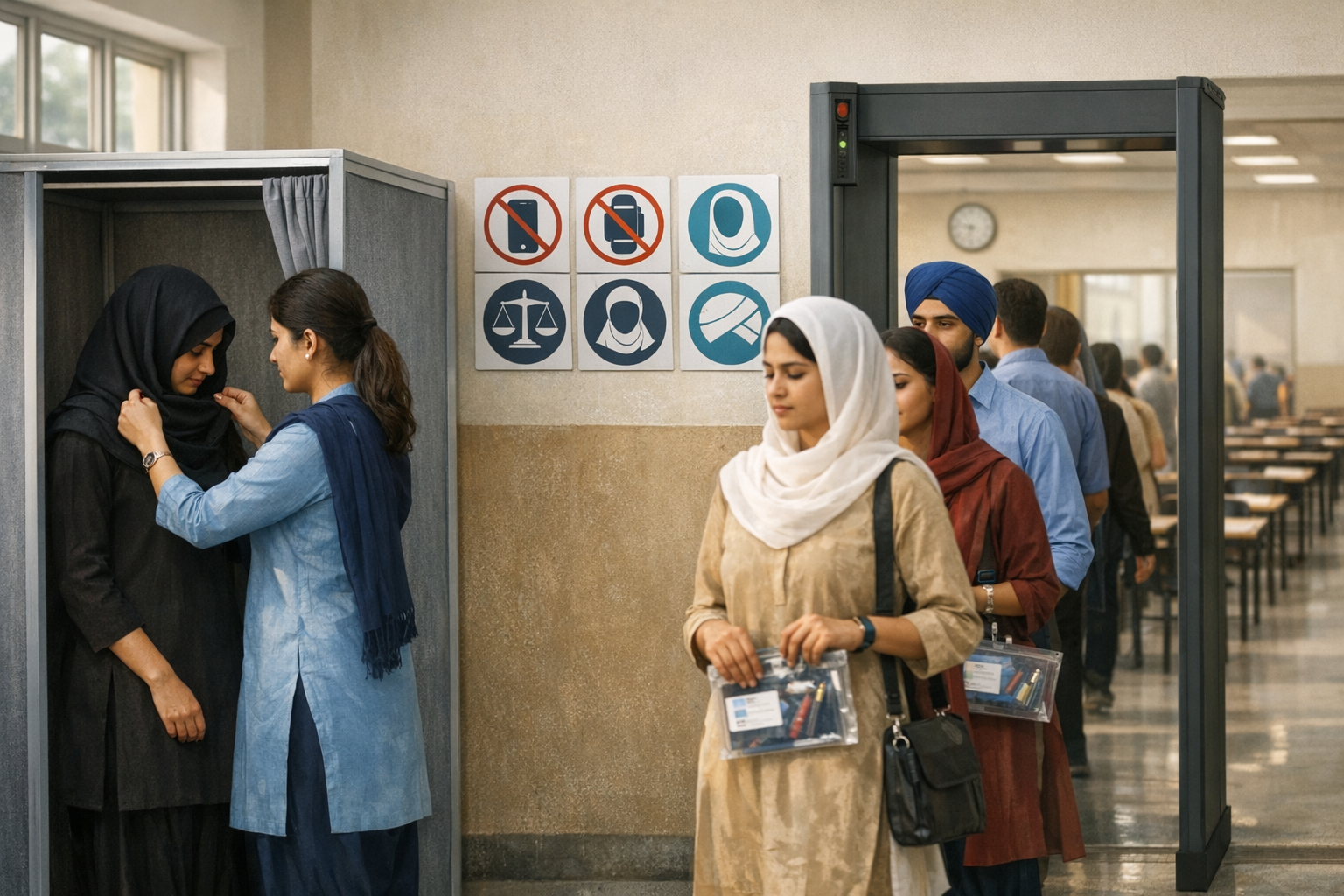
Reports from Jalgaon indicate that during Class 12 examinations, some female Hindu candidates were asked to remove their dupattas, while examinees wearing burqas or hijabs were permitted to write the exam without alteration. The development prompted community representations and a peaceful protest, with Hindu Rashtra Samanvay Samiti and other concerned citizens submitting a memorandum to the College Principal and the District Collector.
Irrespective of where responsibility ultimately lies, the incident foregrounds a recurring governance challenge in India’s education sector: how to implement exam hall dress code protocols in a manner that is religion‑neutral, gender‑sensitive, and legally sound.
The applicable constitutional baselines are clear. Students are entitled to equality before the law and equal protection (Article 14), protection from discrimination (Article 15), dignity and privacy as facets of life and personal liberty (Article 21), and the freedom of conscience and the right freely to profess and practice religion (Article 25). Examination authorities, in turn, may impose proportionate, content‑neutral restrictions to protect the integrity and security of high‑stakes assessments.
Across boards and competitive examinations, dress and accessory restrictions exist to prevent concealment of notes, cameras, or communication devices. Where religious attire is involved, established practice is to allow such garments subject to reasonable verificationtypically by trained female staff in private areasso that integrity safeguards and religious freedom can both be respected.
When a dupatta is disallowed while a burqa or hijab is permitted, or vice versa, inconsistent enforcement can appear discriminatory even if unintended. Such asymmetry erodes trust in institutional neutrality, heightens perceptions of Discrimination, and distracts students during a high‑stress moment such as a Class 12 board exam.
For any 17‑ or 18‑year‑old, an unexpected directive at the examination gateespecially one that touches clothing, identity, or modestycan feel humiliating and destabilizing. The educational duty of care therefore requires advance clarity, consistent practice, and compassionate handling in the exam hall.
In Jalgaon, community stakeholders responded within democratic norms: Hindu Rashtra Samanvay Samiti and devout Hindus organized a protest and lodged a formal memorandum with the College Principal and the District Collector. Such petitions are part of the civic process and should trigger a timely, impartial administrative review.
A minimally intrusive fact‑finding exercise would confirm the precise instructions issued, the written dress code (if any) circulated before the exam, the rationale offered on site, and the steps taken to ensure parity across categories of attire. Findings should be communicated transparently to restore confidence.
Beyond case‑specific accountability, the moment is an opportunity to standardize a religion‑neutral, gender‑sensitive religious attire policy in Indian examsone that is implementable from Jalgaon to other districts and reduces discretionary, last‑minute decision‑making by invigilators.
First, communication must be unambiguous and early. Pre‑exam circulars, admission cards, and school briefings should clearly list permitted and restricted items, explicitly referencing dupattas, hijabs, burqas, turbans, patkas, stoles, scarves, and accessories such as kara, rudraksha, or maalas, with a note that religious attire is allowed subject to verification.
Second, checks must be proportionate and equal. If a dupatta is subject to verification, so too should a hijab, burqa, or any comparable garmentapplied uniformly and without stigma. The relevant standard is least‑restrictive means: verify without compelling removal unless a concrete, articulable security risk exists and no alternative can address it.
Third, screening must protect dignity. Female candidates should be verified only by female staff, in private enclosures, with clear consent‑based procedures and no visual exposure to others. Briefing sheets should instruct staff on respectful language and non‑intrusive methods.
Fourth, real‑time escalation pathways should be available. If there is doubt, invigilators should consult a designated nodal officer rather than impose ad hoc rules. This shifts discretion upward and reduces inconsistent enforcement at the gate.
Fifth, a grievance and audit loop is essential. A simple, time‑stamped incident log, a help desk number on the admit card, and a post‑exam appeal window allow students to be heard and authorities to refine protocols. Periodic, anonymized reporting of complaints and resolutions promotes accountability.
Sixth, training matters. Scenario‑based workshops for principals, superintendents, and invigilation staffcombined with multilingual signage at exam centerscan translate policy into practice and reduce subjective bias.
Seventh, inclusion must be explicitly pan‑faith and pan‑community. Hindu, Sikh, Jain, and Buddhist students, as well as Muslim, Christian, and other students, should experience the same respectful, neutral process. Unity in Diversity is not merely a slogan; in an exam hall, it is a procedural design choice.
Handled this way, an attire dispute becomes a catalyst for better governance rather than communal friction. The goal is not to privilege any symbol or garment but to ensure equal, lawful treatment for all students, preserve exam integrity, and protect dignity.
Given the reports from Jalgaon, a prompt clarification by the local examination authorityendorsed by district administrationwould help reassure families ahead of future sittings. Clear, public guidance reduces ambiguity, protects invigilators, and anchors the conversation in rule‑of‑law rather than rumor.
Education systems earn legitimacy when rules are predictable, non‑discriminatory, and human‑centred. A transparent, religion‑neutral dress code for Class 12 exams, communicated well in advance and implemented with care, offers a practical path to fairness and social harmony.
Inspired by this post on Hindu Jagruti Samiti.










