
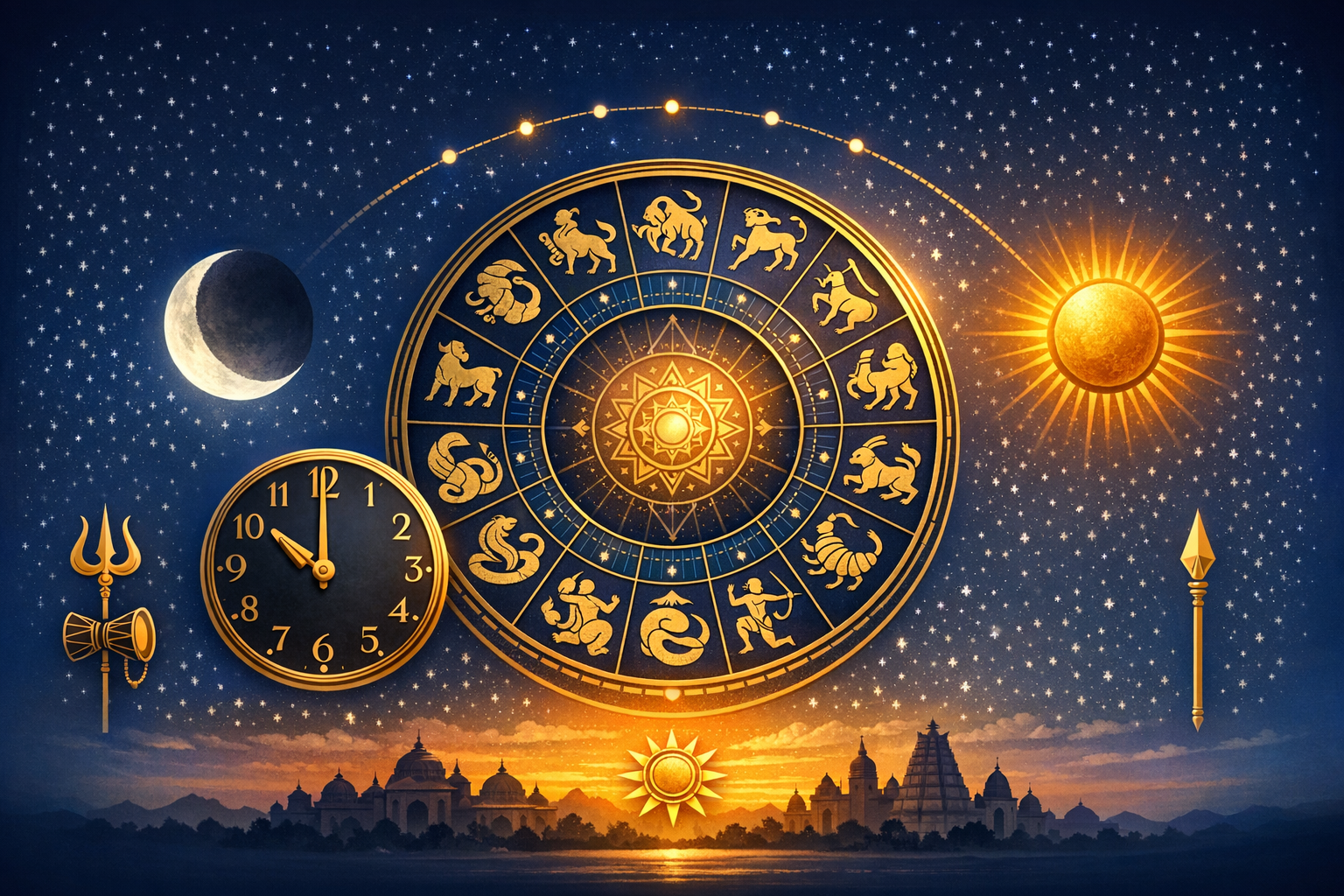
Monday, March 9, 2026 (IST): In the Hindu calendar (Panchang), the day begins with Krishna Paksha Sashti as the sunrise tithi. Krishna Paksha Sashti continues until 10:03 PM IST, after which Krishna Paksha Saptami commences and carries forward into the following civil date. This sequence is consistent with most regional Panchang computations for India.
A tithi is defined astronomically as each 12° increment of angular separation (elongation) between the Moon and the Sun in sidereal longitude. Because the Moon’s orbital speed is non-uniform, a tithi’s duration varies day to day and can begin or end at any clock time. For daily observances and vratas, the tithi prevailing at local sunrise is generally considered operative for that civil day, following classical Dharmashastra conventions; on this date, that is Krishna Paksha Sashti.
Month naming across India follows two principal systems. In the Amanta tradition (prevalent in the south and west), this date falls in the Krishna Paksha of Phalguna. In the Purnimanta tradition (common in the north), the dark fortnight after the full moon is reckoned as Krishna Paksha of Chaitra. Both systems are astronomically consistent; the difference is nominal and regional rather than substantive.
As a weekday, Monday (Somvar) is traditionally associated with Shiva. Many households integrate Somvar practicessuch as japa of “Om Namah Shivaya,” simple fasting, or temple darshanalongside the tithi-based rhythm of the day. With Sashti at sunrise, practitioners who observe monthly Sashti vrata (particularly for Kartikeya/Murugan) may choose to perform upasana during daylight hours, while those inclined to Saptami observances align them post 10:03 PM IST or on the following day when Saptami prevails at sunrise.
Nakshatra and Moon Rashi for March 9, 2026 are time-sensitive and location-dependent because the Moon can change nakshatra and sign (rashi) within the day. For precise local results, computation should use sidereal longitudes (commonly the Lahiri ayanamsa in Indian almanacs). In method: determine the Moon’s sidereal longitude at the target time, map it to one of the 27 nakshatra sectors (each 13°20′) for Nakshatra identification, and to the 12 equal 30° sectors for the Moon’s Rashi. Reliable regional Panchang data or astronomy-grade ephemerides yield accurate values for one’s locality.
Shubh Muhurat (Good Time) windows on any given date depend on local sunrise and sunset. Two widely referenced anchors are Brahma Muhurta (approximately 96 minutes before sunrise; supportive for meditation and japa) and Abhijit Muhurta (centered on local solar noon; often treated as broadly auspicious when specific muhurta selection is not possible). For applications such as commencing study, spiritual practice, or routine tasks, choosing a time outside the inauspicious blocks below and within Abhijit or other benefic periods improves alignment with Panchang guidance.
Rahu Kalam, Yamaganda, and Gulika are computed by dividing daylight (sunrise to sunset) into eight equal parts and assigning each segment according to the weekday. On Mondays, the standard sequence places Rahu Kalam in the second segment of daylight, Yamaganda in the fifth, and Gulika in the seventh. When sunrise is assumed as 6:00 AM and sunset as 6:00 PM for illustration only, the approximate windows would be: Rahu Kalam 7:30–9:00 AM, Yamaganda 12:00–1:30 PM, and Gulika 3:00–4:30 PM. Actual timings must be calculated with local sunrise and sunset for accuracy.
Observance notes: Krishna Paksha Sashti is traditionally favorable for Kartikeya/Murugan devotionsimple naivedya, deepa, and recitation of “Om Saravanabhavaya Namah” are common. As Saptami begins after 10:03 PM IST, Surya-related worship (e.g., Aditya Hridayam) may be reserved for the following morning when Saptami spans the sunrise, aligning with the sunrise-tithi rule for vratas. Monday’s Shiva orientation gracefully coexists with these practices, embodying the Panchang’s integrative character.
The Panchang’s luni-solar logic underpins shared time-reckoning across dharmic traditions. Hindu, Buddhist, and Jain communities use lunar days (tithis) and phases to pace practice and reflection, while Sikh householdsthough guided primarily by the Nanakshahi solar frameworkoften remain culturally attuned to the wider subcontinental calendar. This interlinked heritage fosters unity in diversity: common celestial markers, diverse devotional languages, and a shared ethic of mindful timing.
For those outside India, the stated tithi change (10:03 PM IST) should be adjusted by time zone. As IST = UTC+5:30, 10:03 PM IST corresponds to 4:33 PM UTC on March 9. Local Panchang applications or almanacs convert these boundaries to the observer’s longitude and daylight cycle, ensuring that Shubh Muhurat selection, Rahu Kalam avoidance, and Nakshatra/Rashi tracking remain precise and context-specific.
Summary: March 9, 2026 begins with Krishna Paksha Sashti and shifts to Krishna Paksha Saptami at 10:03 PM IST. With Monday’s Shiva association, Kartikeya and Sūrya upasana can be meaningfully sequenced across the tithi boundary, while practical planning benefits from Abhijit, Brahma Muhurta, and the standard Monday pattern for Rahu Kalam, Yamaganda, and Gulika. Accurate Nakshatra and Rashi require local computation, reflecting the Panchang’s essential principle: the sky above guides, and locality completes, one’s auspicious timing.
Inspired by this post on Hindu Blog.
