“Hey! They’ve got a Boy George lookalike in there…..and he’s REALLY good….!” The excited remark carried across the pavement outside a small, buzzing cafe in the City of London on 8 February 2023, drawing a cluster of curious onlookers to its tall windows.
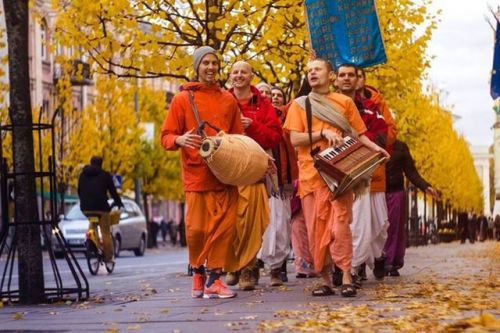
Inside, Hare Krishna followers offered a gentle, rhythmic kirtan—mridanga and kartals setting the cadence as voices rose in unison. The saffron hues, tilak markings, and welcoming smiles created an atmosphere both contemplative and alive, a familiar scene to those acquainted with ISKCON (International Society For Krishna Consciousness) gatherings in global urban centers.
The playful case of mistaken identity—linking a kirtan singer’s aesthetic to the pop iconography of Boy George—did more than amuse passersby. It suspended everyday haste and invited collective curiosity. In a diverse metropolis like London, the moment functioned as a cultural bridge, reframing a chance encounter as an entry point into living traditions of Krishna bhakti.
From the window’s vantage, the scene conveyed a central feature of ISKCON outreach: accessible spirituality rooted in music, mantra, and community. Rather than exclusivity, the setting projected openness—an implicit invitation to listen, ask questions, and experience how devotional practice can be simultaneously traditional and contemporary.
Analytically, the episode illustrates how popular culture can facilitate interfaith dialogue and cultural understanding. A pop-referential quip became a catalyst for engagement with a dharmic practice whose values—love, tolerance, and service—resonate across Hinduism, Buddhism, Jainism, and Sikhism. Such resonance underscores a broad ethical common ground: compassion, non-violence, and respect for plural paths.
In the City of London’s multicultural fabric, the Hare Krishna soundscape thus operated as a gentle public pedagogy: familiar enough to invite approach, distinctive enough to inspire reflection. This unity in diversity substantiates an enduring insight—music and ritual, when shared with humility, transform curiosity into connection and reinforce harmony of faiths in everyday civic life.
Inspired by this post on Dandavats.