Onam, within the spectrum of Cultural Festivities, is widely recognized as an inclusive tradition that bridges regional and linguistic boundaries. Participation does not depend on Kerala ancestry or Malayalam fluency; it often begins through Malayali friendships, shared hospitality, and open invitations. This practice-based entry to cultural identity fosters belonging and exemplifies Unity in Diversity in contemporary social life.
At the festival’s core is the remembrance of Mahabali, the revered asura king whose ethical governance offers a paradigm of just leadership. Traditional narratives recount how the devas, concerned about his expanding influence, witnessed Bhagwan Vishnu manifest as Vamana to test humility and integrity. Mahabali’s surrender of all possessionseven offering his head for Vamana’s final stepelicited divine blessings and the assurance of an annual homecoming. Onam marks this return and honors humility, generosity, and reciprocity as enduring social virtues within Dharmic Traditions.
Beyond mythology, the Mahabali story functions as a social template for belonging. It signals to those distant from ancestral roots that home can be reconstructed through shared rituals, communal meals, and collective memory. In this way, Onam operates simultaneously as remembrance and practice, sustaining cohesion across diverse locations and reinforcing its contemporary relevance.

Early encounters with Onam often begin through foodways: banana chips and jaggery sweets exchanged at schools and workplaces, followed by a first invitation to a harvest-season sadhya. The layered aromas of roasted coconut and cumin, the cadence of Malayalam conversations, and the warmth of maternal hospitality convey the festival’s affective core. Many participants report that Onam nourishes more than the body; it strengthens social ties and supports emotional well-being, especially in multicultural and diasporic settings.
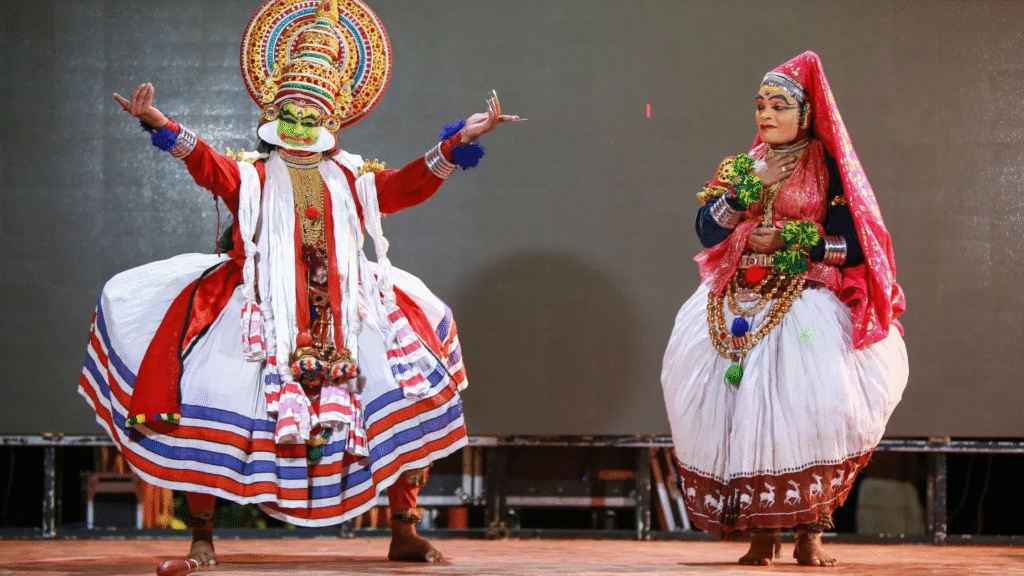
Participation tends to deepen organically: arranging pookkalam designs in courtyards, moving to thiruvathira rhythms, and coordinating weeks in advance“Who’s bringing payasam?” “I’ll come early to help with flowers.” Even with limited language proficiency, the alignment with Onam’s spirit remains unmistakable. The celebration foregrounds joy, generosity, and continuitymemories transmitted through tradition, reinforced by friendship, and shared across communities.

In lived practice, Mahabali is experienced less as a distant monarch and more as a living sentimentremembered, longed for, and welcomed home each year. This sentiment resonates strongly across the diaspora, where the rhythm of seasonal returnliteral or symbolicsustains identity and intergenerational bonds. Such meaning-making helps explain why Onam maintains vitality far beyond Kerala, offering an inclusive cultural identity anchored in shared values and practical hospitality.
The ethical grammar of Onam aligns closely with widely shared values across Dharmic Traditions. Practices of dāna (generosity), karuṇa (compassion), ahimsa (non-harm), and seva (service) find expression in communal dining and hospitality, echoing anna-dāna and Sikh langar. Floral designs such as pookkalam resonate with contemplative mandalas across meditative lineages. Rooted in Hindu custom yet harmonizing with Buddhism, Jainism, and Sikhism, Onam offers a proven bridge to Unity in Diversity through shared practice, common ethical commitments, and mutual respect.

Participation in Onam thus appears less as a birthright and more as an open cultural contractsustained by fragrance, food, stories, and flowers. Onashamsakal! May every heart find its way to a home that welcomes change while preserving continuity, and may the remembrance of Mahabali guide Onam toward lasting unity and social harmony across dharmic communities worldwide.