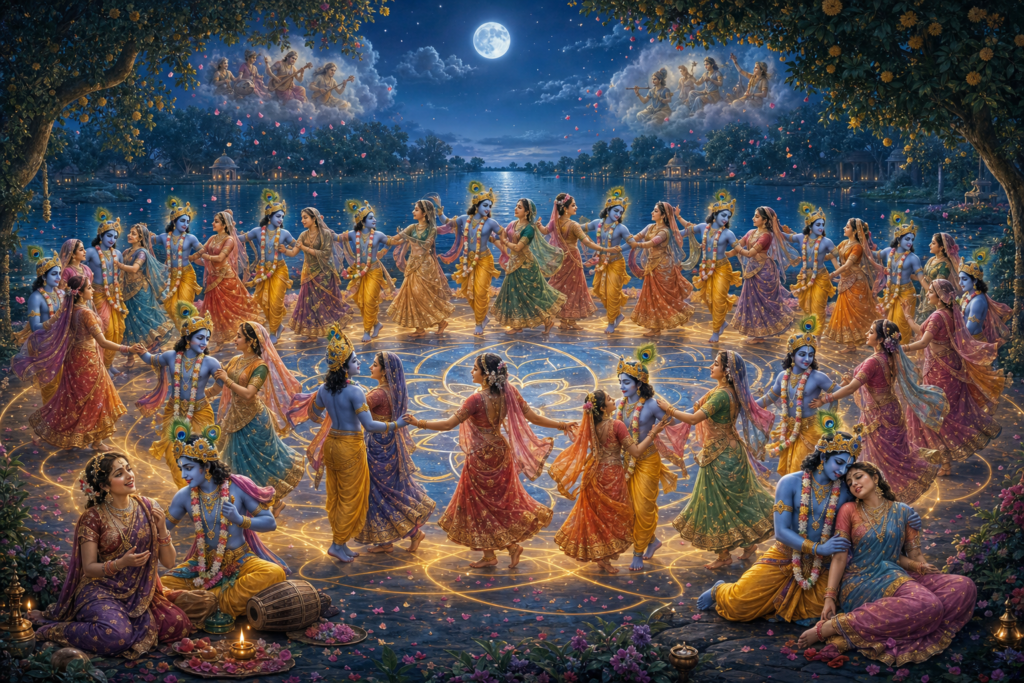
Across Hollywood Boulevard, Fifth Avenue, Oxford Street, and the Champs Élysées, a recurring urban tableau invites curiosity: a circle of singers and dancers moves with the cadence of cylindrical drums and hand cymbals, men in flowing robes with shaven heads beside women in vibrant Indian saris. The refrain“Hare Krsna, Hare Krsna …”rises above the city’s hum, prompting a familiar question: what precisely is unfolding here?
What observers encounter is public kirtan, or sankirtana, a devotional practice within the Bhakti traditionmost prominently associated with Gaudiya Vaishnavismwhere sacred sound is sung collectively to cultivate inner clarity and higher consciousness. The instruments often heard are the mridanga (cylindrical drum) and karatals (hand cymbals), which support call-and-response chanting. Rather than protest or performance art, this is a form of mantra meditation presented in public space, inviting participation through listening, singing, or simply witnessing.
This practice is rooted in a deep cultural history. From early Vedic and Upanishadic reflections on śabda (sacred sound) to the medieval Bhakti movements, chanting has served as a pathway to devotion and contemplative focus. In the 16th century, Sri Chaitanya popularized sankirtana as a communal practice, emphasizing accessibility and heartfelt participation. Centuries later, global migration and new religious movements carried kirtan into Western cities during the mid-20th century, where it became a distinctive expression of living heritage and diaspora culture.
Public chanting also resonates with a wider dharmic tapestry. While “Hare Krsna, Hare Krsna …” is associated with Vaishnava devotion, related practices appear across Hinduism, Buddhism, Jainism, and Sikhism. Buddhist traditions maintain mantra recitation for mindfulness and compassion; Jain communities revere the Navkar Mantra as foundational to inner purification; and Sikh practice centers on kirtan and naam simran as pathways to remembrance of the Divine. These diverse yet convergent modalities illustrate unity in spiritual diversity and a shared emphasis on compassionate living.
Contemporary research and lived experience align on the effects of chanting. Group singing can synchronize breath and rhythm, easing stress, improving emotional regulation, and fostering social connection. In public squares and along busy avenues, the steady pulse of mantra meditation often softens the pace of passersbysome pause briefly, others join for a few stepsillustrating how cultural traditions can gently transform communal spaces into moments of reflection and inclusivity.
Common misconceptions persist. Public kirtan is neither a theatrical spectacle nor a political demonstration; it is devotional expression conducted respectfully within local regulations. Its purpose is not coercion but invitation: to hear, to contemplate, or to participate freely. In this sense, public chanting functions as cultural heritage in motion, carrying forward historical practices while engaging pluralistic, modern societies.
The continuity of chanting as a time-tested contemplative method underscores its enduring relevance. Whether encountered on a bustling boulevard or within a quiet temple, the sonic architecture of mantras offers an accessible doorway to stillness, ethical self-cultivation, and shared human connection. As a living thread linking dharmic traditions, public kirtan exemplifies unity without uniformitydemonstrating how spiritual practices can adapt across cultures while preserving their essential aim: the realization of higher consciousness and compassionate community.
Inspired by this post on Dandavats.