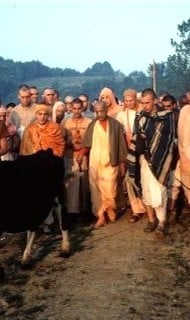
Srila Prabhupada’s four visits to New Vrindaban stand as formative moments for the Hare Krishna movement, offering enduring guidance on simple living that continues to inform ISKCON (International Society For Krishna Consciousness) rural farm communities. His association in this sacred Appalachian setting emphasized a Vedic lifestyle rooted in self-sufficiency, devotion, and reverence for land and cows, shaping community practice and spiritual culture alike.
During the first visit, from May 20 to June 23, 1969, Srila Prabhupada encouraged the small group of devotees to embrace the austerity inherent to New Vrindaban life. He praised their modest lodgings as practical and purifying, and he particularly relished the unadorned gifts of the placecool well water and fresh milk taken straight from ISKCON’s first cow, “Kaliya.” These moments, noted for their simplicity, demonstrated how daily necessities can become devotional offerings when approached through bhakti.
The preference for austere, contented living exemplified principles long upheld within the Bhakti Tradition and the broader Vedic lifestyle: disciplined habits, cow protection, sustainable food systems, and the sanctity of rural work. Such guidance translated spiritual ideals into tangible practices, showing how community design, agricultural rhythms, and shared service (seva) support both inner growth and social cohesion.
The ethos expressed in New Vrindaban resonates across dharmic traditionsHinduism, Buddhism, Jainism, and Sikhismthrough values of simplicity, restraint, compassion, and community responsibility. By centering daily life on ethical consumption, care for living beings, and mindful stewardship, these visits illustrate how shared dharmic commitments foster unity without erasing diversity. The outcome is a practical, inclusive model of village life that honors distinct paths while celebrating common ground.
As reflected in historical accounts, including those documented by Madhava Smullen, the lessons drawn from New Vrindaban remain timely. For contemporary spiritual communities, planners, and seekers, Srila Prabhupada’s New Vrindaban guidance offers an actionable template: align devotion with ecological realism, let service organize communal life, and allow simple, honest labor to nourish both body and spirit. In doing so, ISKCON’s rural projects continue to embody a living heritagewhere spiritual depth and sustainable practice reinforce one another.
Inspired by this post on Dandavats.