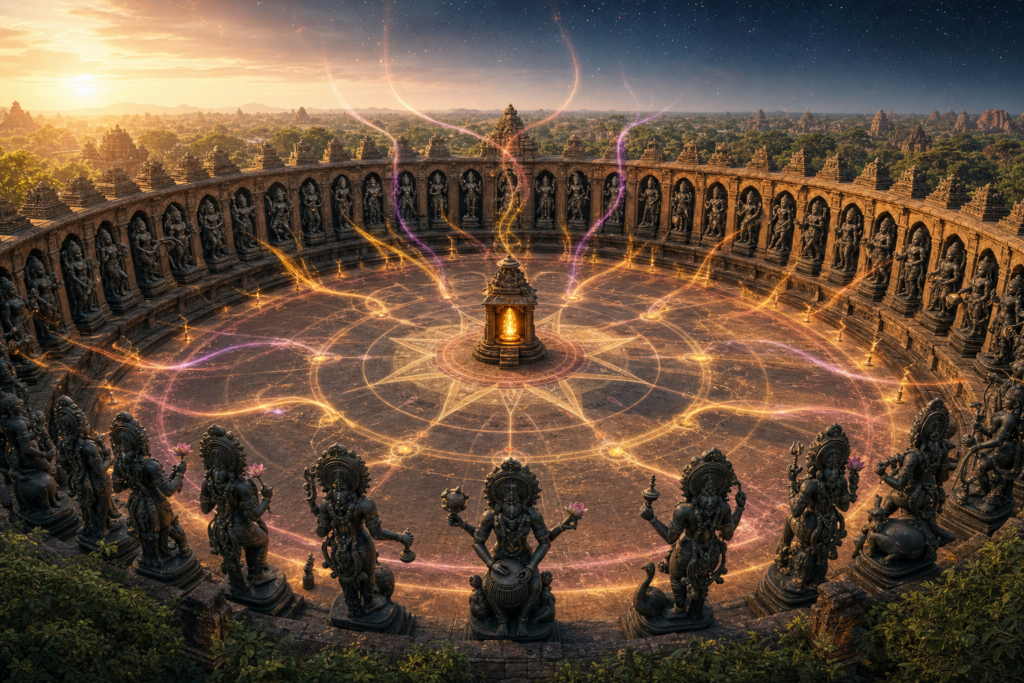
Across the sacred arts of the Dharmic world, few emblems are as pervasive and resonant as the lotus (padma, kamala). In Hindu iconography, deities may be shown seated upon a lotus throne or holding a lotus in the hand. Although both center on the same sacred flower, these two visual codes communicate different layers of meaning: one expresses enthronement within cosmic order and transcendence over the world, the other signals a quality or blessing actively bestowed. Recognizing the distinction deepens engagement with Hindu sculptures and fosters an appreciation of the shared symbolism that also nourishes Buddhist, Jain, and Sikh traditions.
The lotus is a botanical and metaphysical lesson. Rising pristine from murky waters, it presents an enduring metaphor for purity, resilience, and enlightened awareness. Sanskrit sources and śilpa-śāstra traditions describe several lotus types and colors: white (śveta) for sattva and clarity, red (rakta, often associated with Lakshmi) for auspicious vitality and abundance, and blue or dark lotus (utpala/nīlotpala) for profound, inward knowledge. These chromatic nuances often converge with the deity’s function, mood (bhāva), and the theological message art is meant to reveal.
Two core iconographic patterns frame the lotus in Hindu sculptures. The first is the lotus throne (padma-pīṭha, sometimes called kamalāsana), a pedestal or seat made of an open lotus, often in a refined “double-lotus” profile. The second is the lotus as a held attribute (padma-hasta or utpala-dhārin). The throne communicates status, domain, and a deity’s transcendence; the held flower functions as an emblem, signaling the energies, virtues, and boons the deity confers upon the world.
Sitting on the lotus throne is a visual theology of detachment and sovereignty. The lotus seat symbolizes the power to remain unsullied by the world while supporting and ordering it. It is common for this padma-pīṭha to appear beneath deities in serene aspects (śānta, saumya), indicating dominion grounded in sattva. Sculptural manuals and regional schools fashion the lotus pedestal with meticulous geometry, sometimes as a viśva-padma (“world-lotus”) that implies macrocosmic harmony. Whether the deity is cross-legged (padmāsana), in royal ease (lalitāsana), or seated upright (sukhāsana), the lotus seat frames the figure as enthroned within the moral and metaphysical cosmos.
Holding a lotus, by contrast, carries the sense of a quality in motion. A bud intimates latent potential or the nascent unfolding of grace; a full bloom suggests manifest auspiciousness and spiritual maturity. The flower’s orientation can also guide interpretation: an upward-facing blossom evokes aspiration and ascent, while a lotus presented toward the viewer emphasizes bestowal and reception. In this way, padma-hasta functions as an iconographic verbexpressing intent, agency, and the active transmission of blessings such as purity, prosperity, or compassionate insight.
No deity illustrates these nuances more clearly than Goddess Lakshmi (also called Padmā, Kamalā). When Lakshmi is shown standing or sitting upon a fully opened red or pink lotus, the image communicates prosperity and auspiciousness established in the world; the cosmos itself becomes fertile ground for śrī (radiant wellbeing). When she holds lotusesoften twothe symbols emphasize her role as the bestower of abundance and purity, gifts that cause the devotee’s life to unfold like the flower. In Ashtalakshmi traditions, variations in her attributes and posture elaborate the specific domains of wealth and wellbeing she nurtures, while preserving the lotus as the constant grammar of grace.
Saraswati is frequently enthroned on a white lotus, a succinct expression of knowledge seated in clarity. The whiteness signals sattva, the quality of luminance and truth, just as the surrounding water suggests the boundless reservoir of wisdom. While she more commonly holds the vīṇā, a book, and a rosary, the occasional lotus in hand highlights the blossoming of discrimination (viveka) and refined speech (vāk), virtues that open like petals through learning and contemplation. The lotus seat anchors these gifts in serenity; the lotus attribute points to their unfolding in the devotee’s life.
Brahma’s relationship to the lotus is cosmogenic. The classical image of a lotus rising from Viṣṇu’s navel (Padmanābha) with Brahma seated upon it dramatizes creation emerging from the undifferentiated waters of potentiality. Here, the lotus throne does not merely elevate; it births the very plane of ordered manifestation. While Brahma is more often depicted with the Vedas, a rosary, and water pot, the lotus seat remains his primal stage, aligning creation with purity and intelligible form.
For Viṣṇu, the lotus functions both as throne and attribute. As Padmanābha, the lotus manifests the creative principle; as padma-hasta (one of the four principal emblems alongside śaṅkha, cakra, and gadā), it signifies purity, compassion, and the gentle governance of dharma. In many regional traditions, a lotus pedestal supports his standing or seated forms, underscoring that protection (rakṣaṇa) and preservation (sthiti) are exercised from a ground of luminous detachment.
Śaiva and Śākta images also make prolific use of lotus thrones. In Tantric iconography, goddesses such as Tripurasundarī and Kamalā are enthroned upon lotuses to announce sovereignty over desire, abundance, and wisdom, harmonized within the awakened heart. Some forms of Gaṇeśapopularly known as Padma or Padma Ganapatihold a lotus among other attributes, the emblem marking the auspicious blossoming of insight that removes obstacles. In each case, the lotus throne tones the icon in serene majesty, while the lotus in hand highlights the active grace specific to the deity’s function.
The difference between “sitting on” and “holding” is therefore a difference between field and force. The throne encodes the existential field of the deitycosmic placement, transcendence, and dominionwhereas the attribute encodes the operative forcewhat quality the deity channels, transfers, or awakens. When both appear together, viewers can read a complete sentence in visual Sanskrit: enthroned purity (seat) issuing in bestowal (held flower).
Pedestal craft sharpens this reading. South Indian bronzes from the Chola period often present deities over a crisply modeled double-lotus base, petals radiating with rhythmic regularity to amplify serenity. Hoysala and Vijayanagara stone sculpture frequently articulates deep, undercut petals, allowing light and shadow to create the sensation of a living bloom. In Pāla-Sena and related schools in eastern India, both Buddhist and Hindu images share closely related lotus pedestals, underscoring the interwoven heritage of Dharmic aesthetics.
Buddhist art echoes the same grammar. The Buddha and bodhisattvas are repeatedly depicted on lotus thrones, an icon of awakened mind’s stainless clarity. Avalokiteśvara (Padmapāṇi) holds the utpala, his lotus attribute symbolizing inexhaustible compassion that blooms even in conditions of suffering. Jain images likewise display lotus thrones, with Padmaprabhawhose very name announces his emblemaffirming the lotus as a sign of victory over karmic obscurations. The shared motif attests to a civilizational tapestry that values purity, wisdom, and compassion beyond sectarian boundaries.
Sikh scriptural poetry adds another layer of continuity. The Guru Granth Sahib employs the lotus metaphor to evoke the state of being in the world yet unstained by it, a succinct restatement of the lotus ideal that Hindu, Buddhist, and Jain traditions visualize. The confluence is not coincidental; it reveals a unifying insight across Dharmic paths: spiritual life is the art of blossoming without absorbing the mud.
Tantric and yogic literature interiorizes the lotus as the subtle body’s map. The cakras are envisioned as lotuses of varying petal counts, culminating in the sahasrāra, the “thousand-petaled” lotus at the crown. This inner cartography clarifies the iconographer’s outer language: to be seated on a lotus is to be centered in awakened awareness; to hold a lotus is to activate and transmit a particular currentof knowledge, abundance, or compassionwithin and around the practitioner’s life.
For viewers standing before a murti or sculpture, a practical way to read the image is to notice the sequence seat–posture–attribute. First, identify the pedestal: if it is a padma-pīṭha, expect themes of transcendence, serenity, and rightful sovereignty. Next, observe posture: padmāsana suggests profound inwardness; lalitāsana conveys regal poise; standing over a lotus often signals auspicious presence radiating into the world. Finally, read the lotus if held: as bud or bloom, toward the heart or extended outwardeach small detail clarifies what is being awakened or bestowed.
Color, too, refines meaning. A white lotus in the context of Saraswati heightens sattvic purity and truthful speech; a red or pink lotus with Lakshmi emphasizes fertility, abundance, and joyful auspiciousness; a darker utpala can intimate contemplative depth and the cool compassion of bodhisattva-like resolve. When combined with other attributessuch as the vīṇā, śaṅkha, cakra, gadā, or rosarythe lotus participates in a semantic ensemble that Śilpa-śāstra traditions have preserved across centuries.
The same logic illuminates one of the most evocative scenes in Hindu mythic imagination: Viṣṇu reclining on Śeṣa in the cosmic ocean, with the lotus arising from his navel and Brahma seated upon it. The ocean is undifferentiated potential, Viṣṇu the all-pervading ground, the lotus the first articulation of intelligible order, and Brahma the architect of manifest worlds. Here the lotus seat does not merely signal detachment; it narrates creation as purity emerging from depth, a story echoed in every lotus pedestal gracing Hindu, Buddhist, and Jain temples.
From a devotee’s perspective, the contrast between sitting on and holding a lotus resonates existentially. To perceive a deity on a lotus is to be reminded that life’s turbulence can be met from a still center; to see a lotus held is to feel an invitationthe possibility that purity, wealth of spirit, and wisdom can unfold petal by petal in concrete experience. Museum-goers often report this dual impression: serene distance in the seat, intimate nearness in the hand-held flower.
The unity of this symbolism across Dharmic traditions strengthens a shared cultural heritage rather than divisions. Hinduism, Buddhism, Jainism, and Sikhism converge on the lotus as a master metaphor for ethical clarity, contemplative depth, and compassionate action. Recognizing this common language enriches intertradition understanding: the lotus throne honors the transcendent ground these paths hold in reverence; the lotus in hand celebrates the living virtues they invite into daily life.
In sum, the lotus as throne and the lotus as attribute articulate complementary dimensions of sanctity in Hindu sculptures. The former enthrones transcendence; the latter mobilizes grace. Reading them together transforms viewing into understanding: one perceives not only divine beauty but also a disciplined grammar of meaning crafted by generations of artisans and guided by śilpa-śāstra wisdom. Through that grammar, the lotus continues to teach a timeless lessonremain unstained, and let the heart flower.
Inspired by this post on Hindu Blog.