Set against the quiet lakes and forests of Scandinavia, Sweden’s Almvik Farm presents a living encounter with Hare Krishna devotional life where Shraddha (faith) matures through disciplined practice, cooperative community, and ecological responsibility. The setting itselfclean air, long summer light, and deliberate social rhythmssupports contemplative attention and lends clarity to devotional intent.
Scandinavian landscapes have long been associated with restraint, order, and care for the commons. That civic temperament aligns naturally with the International Society for Krishna Consciousness (ISKCON) emphasis on shared duty (seva), simple living, and high thinking. Within this context, Almvik Farm functions as an immersive environment for cultivating steady devotion and purposeful work.
Almvik Farm is a rural ISKCON community in Sweden dedicated to living bhakti, the devotional science of Gaudiya Vaishnavism, in a manner that integrates spiritual practice with practical sustainability. Rather than remaining a mere retreat, it acts as a laboratory for applied spiritualitywhere liturgy, learning, agriculture, and artisanal labor reinforce one another in daily life.
At the center of this life is Shraddha. In Gaudiya Vaishnava thought, Shraddha denotes intelligent trust in the efficacy of a spiritual patha confidence grounded not in blind belief but in lived experience and scriptural reasoning. Classical texts such as Bhakti-rasamrita-sindhu describe Shraddha as the threshold to a graduated development of devotion: sadhu-sanga (holy association), bhajana-kriya (regulated practice), anartha-nivritti (clearing of impediments), nishtha (steadiness), ruchi (taste), asakti (deep attachment), bhava (devotional emotion), and prema (pure love of God).
In this framework, Almvik Farm nurtures Shraddha by structuring each day around sadhana. Like many ISKCON communities, the schedule typically orients to early morning worship: maṅgala-ārati before sunrise; personal japa (mantra meditation, often targeting sixteen rounds of the Hare Krishna mantra); kīrtana (congregational chanting); guru-pūjā; and study of Bhagavad-gita and Srimad-Bhagavatam. The routine transforms time into a scaffold for attention, gently moving practitioners from intention to embodiment.
Kīrtana and japa form the psycho-spiritual core of this routine. Contemporary research on mantra meditation associates such vocalization and breath-regulated repetition with improvements in attention, mood, and heart-rate variabilityphysiological markers linked to resilience. Group kīrtana, in particular, fosters synchrony, prosocial bonding, and emotional regulation, allowing devotion to become both personal and collective.
Scriptural learning at Almvik Farm complements practice with philosophy. Study of Bhagavad-gita, the teachings of Sri Chaitanya, and the commentarial tradition of the Goswamis provides a rational and ethical architecture for Shraddha. The synthesis is deliberate: cognition (what is understood), conation (what is willed), and devotion (what is offered) are brought into alignment.
The community’s economy of care extends into land and resource stewardship. Aligned with principles common to ISKCON rural projects in northern Europe, Almvik Farm emphasizes vegetarian or vegan prasadam, responsible dairy rooted in ahimsa ethics, soil health, composting, and seasonally appropriate horticulture. These practices are not merely utilitarian; they are theological in aim, translating reverence (seva to the earth and its beings) into measurable patterns of regenerative living.
Scandinavian climatic constraints require intelligent adaptation. Insulation, careful energy budgeting, greenhouse cultivation, cold-hardy crops, and winter-proof workflows illustrate a design mindset in which bhakti and bioregional realism meet. The result is a devotional ecology: reduced waste, resource mindfulness, and a seasonal rhythm that supports contemplative life.
Community governance at Almvik Farm typically mirrors cooperative norms: shared decision-making, rotational service, and transparent stewardship of common goods. Such arrangements minimize hierarchy in daily operations while preserving clarity in spiritual guidance. The structure itself teaches Shraddhaconfidence grows when processes are fair, communication is frank, and outcomes are evident.
Festivals punctuate the year with accessible public devotion. Janmashtami, Gaura Purnima, Ratha-yatra events in Swedish cities, and periodic kirtan gatherings offer opportunities for cultural exchange and community engagement. These celebrations transform devotion into civic hospitality, allowing neighbors, scholars, and seekers to experience the aesthetics of bhaktimusic, dance, ritual cooking, and sacred theaterfirsthand.
Documentation work at Almvik Farm, including film and audio projects, serves an archival and pedagogical function. By recording kīrtana, daily sadhana, and seasonal practices, the community contributes to the safeguarding of intangible cultural heritage. Such media become resources for educators, interfaith dialogues, and future generations, demonstrating how Shraddha evolves within a Scandinavian milieu.
In the broader dharmic context, Almvik Farm models values shared across Hinduism, Buddhism, Jainism, and Sikhism: ahimsa (non-harm), seva (service), satsanga (good company), mindfulness in consumption, and humility in learning. This shared ethical grammar strengthens unity among dharmic traditions without erasing distinctive metaphysical views. The convergence is practical and humanecultivating compassion, discipline, and responsibility.
The educational atmosphere nurtures children and youth through value-based learning: stories from the Puranas and epics, Sanskrit terms in context, music and mridanga rhythms, and hands-on gardening. Moral reasoning, conflict resolution, and cooperative play are treated as extensions of sadhana, guiding young minds toward empathy and steady attention.
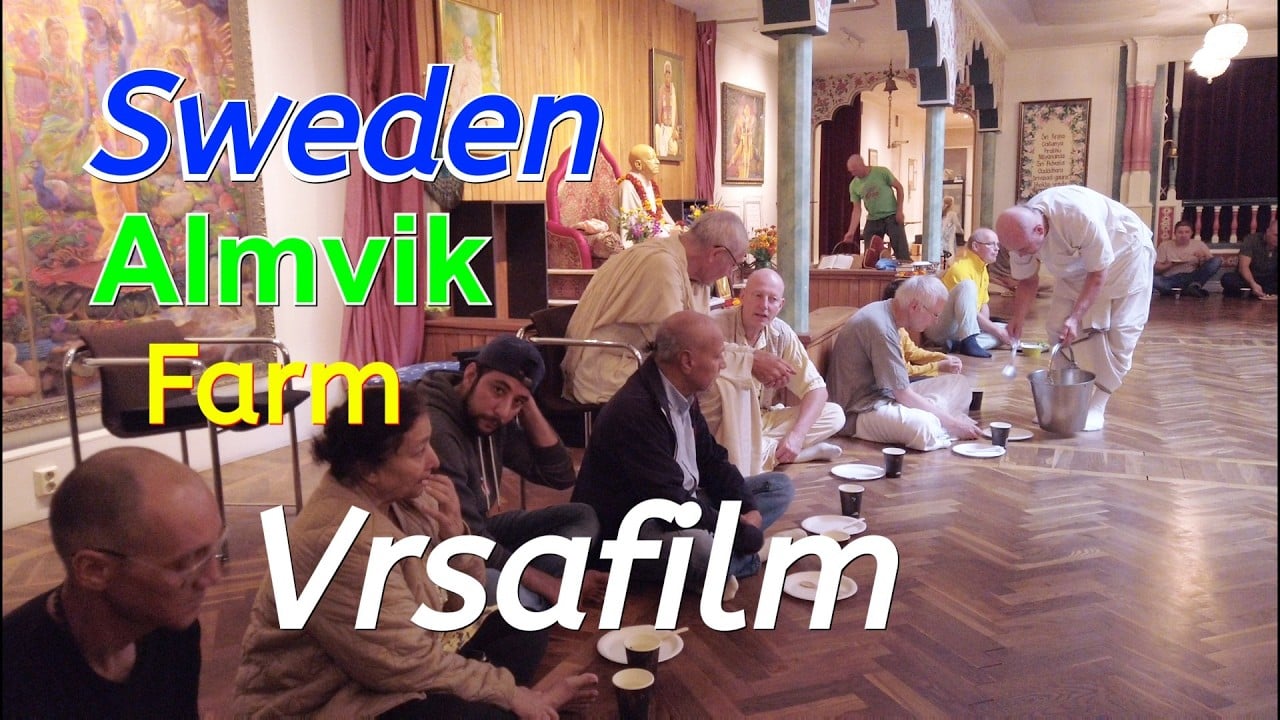
Culinary culture at Almvik Farm illustrates how Shraddha can be tasted as well as contemplated. Prasadam preparation emphasizes sattvic ingredients, seasonal menus, and community distribution. Shared meals collapse social distance, strengthen trust, and turn everyday choices into ethical practicefood as fellowship, ecology, and devotion at once.
Aesthetics shape experience. Nordic understatement and the colorful iconography of Gaudiya Vaishnavism meet in a dialogue of form: clean lines alongside sacred images; quiet rooms resonant with mantra; natural materials balanced with ritual adornment. The sensory environment tempers the mind and orients it toward remembrance (smarana).
Contemporary life often trends toward accelerated consumption and distraction. Communities like Almvik Farm offer a countervailing pattern: deceleration, intentionality, and service. The result is not isolation but rootednessa capacity to engage society from a place of clarity rather than compulsion.
Challenges exist. Northern winters test morale and logistics; volunteer fatigue can appear in peak seasons; resources must be planned with precision. Yet these pressures become occasions for institutional learning: better rota systems, sabbath-like rest periods, mentoring for new residents, and resilient budgeting. Obstacles, approached with Shraddha, refine competence and deepen collective bonds.
For visiting scholars, seekers, or neighbors, the value proposition is experiential clarity. Rising before dawn, joining kīrtana, sharing prasadam, and participating in simple seva crafts an embodied understanding of bhakti that no theory alone can supply. Even brief exposure often leaves a traceable improvement in mood, focus, and interpersonal warmth.
In a plural and multi-faith Europe, Almvik Farm demonstrates how an ancient Indic tradition can adapt without dilution. The community remains anchored in Gaudiya Vaishnava theology while speaking fluently to contemporary concernssustainability, mental well-being, and civic harmony. Shraddha here is not passive assent but a disciplined, joyful orientation toward the good.
Ultimately, Almvik Farm shows that a devotional community in Sweden can cultivate spiritual depth, ecological intelligence, and social trust in one coherent practice. In doing so, it affirms a wider dharmic insight: when inner life and outer life are integrated through compassion and duty, both the person and the polis flourish.
Inspired by this post on Dandavats.