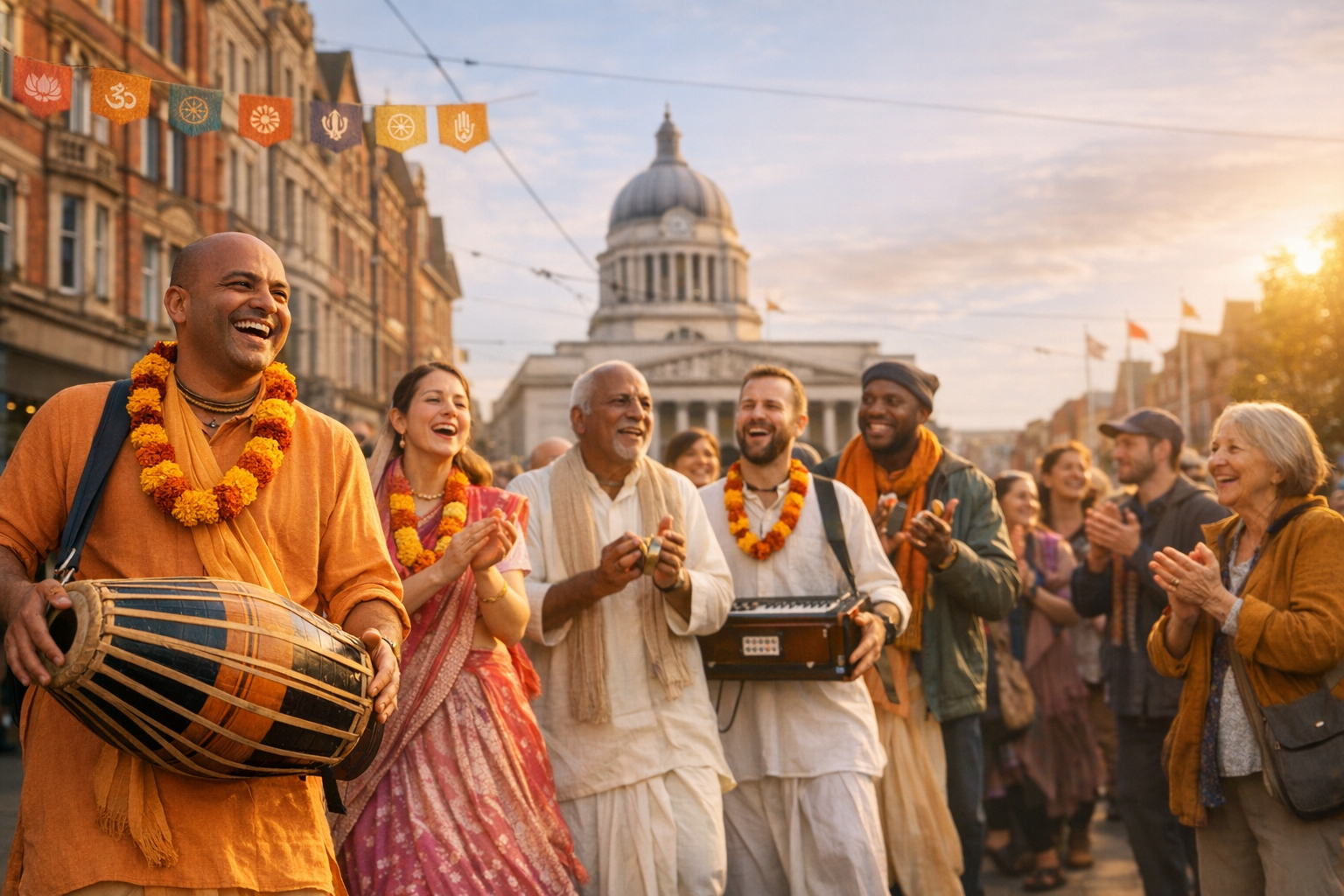

Over Easter weekend 2026, the third annual UK National ‘Rise’ Retreat opened with a vibrant harinam through Nottingham city centre. Rhythmic chanting, call-and-response melodies, and spontaneous dancing transformed the urban thoroughfare into a shared sacred space. Passersby paused, filmed, smiled, and in many cases joined the clapping; the city’s everyday cadence gave way to an atmosphere of welcome and curiosity that befitted the retreat’s guiding theme: “The Community of Love.”
Harinam (harinama-sankirtana) emerges from the Bhakti Tradition, where the collective chanting of the divine name is both a spiritual practice and a social act. It democratizes devotion by placing sacred sound in public space, inviting engagement without precondition or boundary. Historically refined in the Gaudiya Vaishnava lineage and popularized globally by ISKCON (International Society For Krishna Consciousness), congregational kirtan uses accessible musical structures—steady tempo, repetitive refrains, and communal rhythms—to lower barriers to participation while emphasizing ethical virtues such as humility, compassion, and joy.
Comparable modalities appear across the broader dharmic family. Sikh kirtan in the gurdwara, Buddhist sutra chanting and metta recitations, and Jain stavan and samayik practices all integrate voice, rhythm, and intentional attention to cultivate serenity, empathy, and solidarity. These convergences illustrate a deep civilizational insight shared by Hinduism, Buddhism, Jainism, and Sikhism: sacred sound and mindful repetition can quiet distraction, align intention, and strengthen community bonds without privileging a single path. In this sense, harinam does not compete with other practices; it complements a plural landscape that values unity in diversity.
From a sociological perspective, public chanting generates what is often described as collective effervescence—an emergent, prosocial energy that heightens belonging and dissolves social distance. The immediate effect is visible: strangers synchronize claps and steps; families linger longer than planned; onlookers explore unfamiliar yet welcoming traditions. Over time, such events correlate with greater community cohesion, as shared positive encounters reduce misperceptions and increase the likelihood of future collaboration across neighborhoods and faiths.
Physiologically, group singing and rhythmic movement support coherence between breathing and heart rate, engaging the vagus nerve and encouraging a shift from stress-dominant states toward calm alertness. Even light movement at kirtan tempo coordinates breath patterns, while melodic repetition eases cognitive load and allows attention to rest in the present. These responses align with well-documented pathways in contemplative disciplines: pranayama improves breath awareness; mantra regulates focus; and the mind–body connection strengthens through synchronized, prosocial activity. Participants frequently report a composite outcome—grounded energy, uplifted mood, and a felt sense of relational warmth.
Urban settings like Nottingham provide a distinctive canvas for such encounters. City centres concentrate diversity, making public devotional art forms both visible and dialogic. When devotional soundscapes enter civic space respectfully and joyfully, they encourage gentle intercultural learning: those unfamiliar with the Bhakti Tradition glean its ethical and aesthetic sensibilities; participants encounter the city as a partner in spiritual life rather than an obstacle to it. In plural societies, this is community engagement at its most organic—meeting people where they are, inviting without insisting, and building trust through lived example.
The retreat’s theme—The Community of Love—resonates across dharmic philosophies. In Hindu thought, prema (divine love) and daya (compassion) orient the heart toward service. In Buddhism, maitrī/mettā cultivates boundless goodwill. In Jainism, ahimsa and anukampā emphasize non-violence and empathetic care. In Sikhism, seva and sarbat da bhala (welfare of all) articulate love as practical solidarity. Together they echo the time-honoured ideal of Vasudhaiva Kutumbakam—the world as one family—linking inner cultivation with the ethical imperative to act for collective flourishing.
While specific program elements vary by year, retreats of this nature commonly integrate congregational chanting, guided meditation, scriptural reflection, and seva-oriented workshops. The pedagogy balances head, heart, and hands: philosophical inquiry deepens understanding; devotional music refines emotion; and service-oriented praxis translates intention into community benefit. This integrative design reflects a mature spiritual curriculum in which contemplation, study, and action reinforce one another.
Technically, kirtan organizes participation through simple, repeatable structures. Call-and-response refrains reduce performance anxiety; layered percussion and handclaps establish a rhythmic container; and melodic contours invite both novices and seasoned practitioners. The result is an inclusive acoustic architecture that supports one-pointed attention, even amid the sensory complexity of a city centre. This is not entertainment, but engaged ritual—a living interface of cultural heritage, contemplative science, and civic life.
Attendees frequently describe several converging benefits. Newcomers find an accessible entry point into dharmic spirituality; families appreciate intergenerational participation; students and young professionals note stress reduction and renewed clarity; long-time practitioners value the chance to deepen sadhana in community. Organizers, reflecting on multiple years of practice, observe that such gatherings often serve as catalysts: friendships extend beyond the event; study circles and seva projects emerge; and participants carry a more confident, compassionate public presence into daily life.
Importantly, the tone remains invitational rather than prescriptive. Dharmic traditions have long affirmed spiritual plurality—Ishta (a chosen form or approach) differs from person to person, and that difference is to be respected. In this spirit, harinam models a non-coercive ethos: the practice is offered, not imposed; public joy stands in place of polemic. This aligns with interfaith dialogue at its best—listening before speaking, sharing before asserting, and discovering common cause in care for neighbours and the natural world.
As cultural heritage, congregational chanting is both ancient and adaptive. It preserves memory—melodies, mantras, and stories—while evolving new forms suited to contemporary public space. In diaspora contexts, it also anchors identity without erecting walls: cultural expression becomes a bridge rather than a boundary, articulating continuity with ancestral wisdom and openness to shared civic futures.
The civic implications are practical. Events that foreground compassion, discipline, and service reduce social friction, encourage volunteerism, and normalize everyday kindness. By demonstrating that devotion and public life are mutually enriching, retreats like this offer a scalable template for community cohesion: small circles become neighbourhood initiatives; neighbourhoods network into citywide festivals; and cities learn to welcome plural sacred expressions as partners in social harmony.
In summary, the opening harinam in Nottingham did more than inaugurate a weekend; it instantiated a thesis about spiritual life in a plural society. Love—articulated as prema, maitrī, ahimsa, and seva—is not merely a sentiment but a civic resource. The Community of Love is thus both a vision and a method: gather in sound, align breath and intention, honour diverse paths, and translate inner awakening into service for all. In doing so, communities across Hinduism, Buddhism, Jainism, and Sikhism demonstrate that unity need not erase difference; rather, it cultivates a humane, resilient diversity anchored in shared ethical purpose.
Inspired by this post on Dandavats.