Rongali Bihu, also known as Bohag Bihu, marks the Assamese New Year and the onset of spring’s agricultural cycle. In 2026, the principal day of observance falls on 15 April, aligning with regional calendars that center festivities around the first day of Bohag (Vaisakha). As a living heritage of Assam, Rongali Bihu blends agrarian rites, music, dance, cuisine, and communal reciprocity, sustaining both seasonal rhythms and social bonds.
Calendrically, Bohag Bihu coincides with Mesha Sankranti, the Sun’s sidereal ingress into Aries, which typically occurs on 14 or 15 April. The Assamese solar calendar begins its year in Bohag, and local observance may follow sunrise- or Sankranti-based reckoning, explaining minor date variations by location. The 2026 date of 15 April situates Manuh Bihu at the heart of celebration, with associated observances unfolding immediately before and after this day.
While contemporary practice commonly condenses Rongali Bihu into three focal daysGoru Bihu, Manuh Bihu, and Gosai Bihumany communities retain a seven-day cycle that frames these core observances. The condensed format preserves essential meanings: reverence for cattle and agrarian wellbeing (Goru Bihu), renewal of personal and social ties (Manuh Bihu), and devotion to household deities for prosperity (Gosai Bihu).
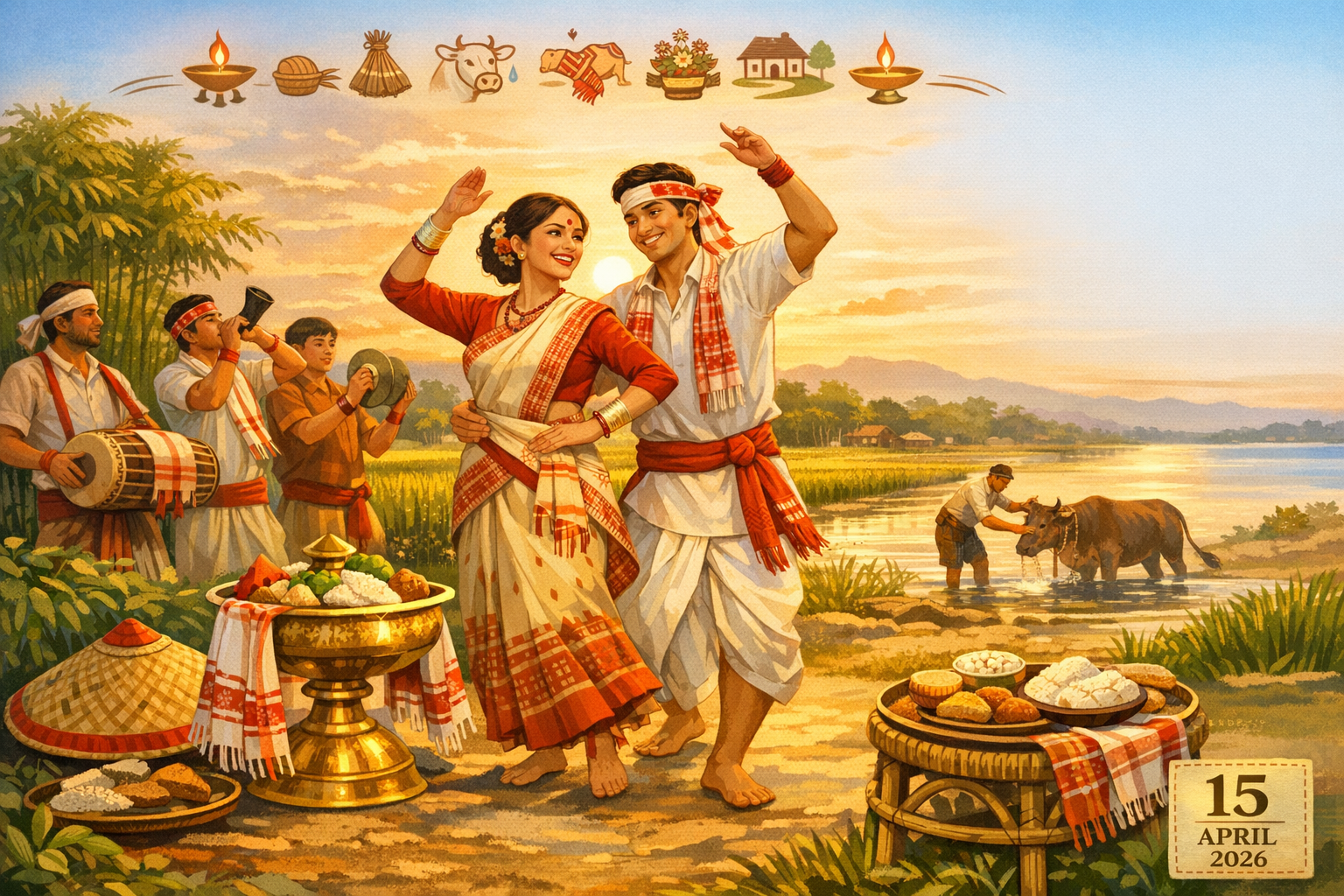
Goru Bihu emphasizes agrarian ethics and gratitude. Cattle are bathed, gently anointed, and offered fresh fodder as guardians of the agrarian household. Traditional verses such as “Lau kha, bengena kha, bosore bosore barhi ja” express affectionate wishes for strength and growth. The practice foregrounds non-violence, care, and reciprocity between people, animals, soil, and seasonprinciples central to agrarian dharmic life.
Manuh Bihu, observed on 15 April 2026, centers on human renewal and social cohesion. Individuals don new attire, exchange bihuwan (gamocha) as tokens of respect, and seek blessings from elders. Open-air Bihu dance (Mukoli Bihu) and bihugeet (Bihu songs) animate courtyards and public spaces, while husori troupes visit homes to sing blessings for health, abundance, and harmony. Communities in Guwahati, Jorhat, Dibrugarh, Tezpur, and beyond host Bihu sanmilans (festive gatherings) that showcase intergenerational participation.
Gosai Bihu is dedicated to household deities and the protective sacred presence that sustains livelihoods. Offerings are placed on a xorai (brass pedestal), often adorned with a gamocha, and prayers invoke auspiciousness for the agricultural year ahead. Many families integrate Vaishnavite devotional practices and collective hymns, reflecting Assam’s plural spiritual matrix and its emphasis on compassion, unity, and stewardship.
Beyond the three-day core, the extended cycle varies by district but commonly includes Raati Bihu (evening gatherings with rustic instruments), Chot Bihu (the preparatory day), Kutum Bihu (visiting relatives), Mela Bihu (community fairs), and Sera Bihu (the closing day). These phases weave conviviality with seasonal tasks, ensuring that celebration and agronomy remain synchronized.
Music and movement are central to Rongali Bihu’s identity. Bihu naas (dance) is celebrated for its expressive dynamism and call-and-response energy between performers and musicians. Husori troupesnow including both traditional mixed groups and mahila husori (women’s ensembles)perform blessings in courtyards and public gatherings, reinforcing community bonds through ritualized art.
The sonic texture of Bihu is defined by the dhol (drum), pepa (buffalo-horn pipe), gagana (jaw harp), taal (cymbals), toka (clapper), and xutuli (clay whistle). These instruments create a distinct acoustic ecology that is immediately identifiable as Assamese, while the improvisational flair of bihugeet captures themes of love, nature, wit, and seasonal hope.
Culinary traditions anchor the Assamese New Year in hospitality and seasonal abundance. Families prepare jolpan (festive breakfast platters) with chira-doi-gur (flattened rice, curd, jaggery), akhoi (puffed rice), and an array of pitha such as til pitha, ghila pitha, sunga pitha (cooked in bamboo), and tekeli pitha (steamed). These foods, both nourishing and symbolic, affirm the agrarian cycle from seed to hearth.
Iconic Assamese symbols consolidate identity and exchange. The jaapi (conical hat) and xorai signify honor and welcome, while the gamocha functions as both daily textile and ceremonial gift. Its weaving traditions, safeguarded by artisans across Assam and recognized with geographical indication protection, underscore the craft heritage at the heart of Bihu gifting and etiquette.
Scholarly perspectives trace Bihu’s roots to agrarian communities across the Brahmaputra valley, with linguistic links proposed to Bisu/Bishu among Tibeto-Burman groups signifying a year’s turn. Historical references document Bihu’s continuity over centuries, even as performance styles evolved and urban stages proliferated. The festival’s elasticityadapting to village commons and city auditoriums alikeillustrates how intangible heritage remains vibrant through community custodianship.
Rongali Bihu aligns with a wider dharmic and pan-Indian new year constellation tied to Mesha Sankranti. In the same seasonal window, communities observe Vishu (Kerala), Puthandu/Varusha Pirappu (Tamil Nadu), Pohela Boishakh (Bengal), Vaisakhi (Punjab), and regional new-year practices across the subcontinent. Though calendars differ (solar or lunisolar), the shared ethos is unmistakable: gratitude to the divine and to nature, renewal of ethical intent, and strengthening of familial and social harmonyvalues cherished across Hindu, Buddhist, Jain, and Sikh traditions.
For 2026 planning, community events and Bihu sanmilans will cluster around 15 April, with Goru Bihu typically observed the preceding day and Gosai Bihu the following day, subject to local calendrical reckoning. Diaspora associations often mirror Assam’s schedule, hosting husori, workshops on Bihu dance, and culinary showcases to keep intergenerational knowledge transmission strong.
Participation etiquette emphasizes reciprocity and respect. Accepting or offering a gamocha is a gesture of esteem; seeking permission before photographing performers or rituals honors community norms. Supporting local weavers and instrument makers sustains the ecosystem that enables Bihu to thrive, while eco-conscious choicesnatural dyes, reusable decor, and minimal wastekeep celebration aligned with the festival’s nature-centric spirit.
As Assamese New Year 2026 unfolds, Rongali Bihu stands as both seasonal threshold and ethical compassaffirming care for cattle and land, reverence for deities, renewal of human relationships, and solidarity across dharmic communities. By uniting devotion, artistry, and agronomy, Bihu remains a luminous exemplar of cultural continuity, shared heritage, and springtime hope.
Inspired by this post on Hindu Pad.