Pohela Boishakh (Poila Baisakh), the Bengali New Year, will be observed in West Bengal on 15 April 2026, inaugurating Naba Barsha 1433 in the Bengali calendar. The occasion is anchored in Mesha Sankranti, the solar transition when the Sun moves from Meena Rasi (Pisces) to Mesha Rasi (Aries), marking the first day of the month of Boishakh in the Bengali Panjika. In Bangladesh, where the reformed Bangla calendar is followed for civil observance, Pahela Baishakh is fixed on 14 April each year; as a result, in 2026 communities across the region will greet the New Year across 14–15 April. The shared spirit is captured in the greeting Shubho Noboborsho, welcoming a season of renewal, goodwill, and cultural unity.
The timing of Pohela Boishakh is determined by the Sun’s ingress into sidereal Aries, a moment known as Mesha Sankranti (also called Mesha Sankramana). Bengali calendrical practice is traditionally sidereal and sunrise-based: the New Year begins at the sunrise following the instant of Sankranti. This astronomy-to-calendar linkage is calculated and published annually in the Bengali Panjika, drawing on either classical Siddhanta methods or modern observational (drik) computations. These methods, along with the sunrise rule, explain why the date sometimes shifts by a day in West Bengal, even as Bangladesh observes a fixed civic date.
Bangabda (the Bangla era) counts from 593/594 CE, making 2026 correspond to 1433 Bangabda. In West Bengal, leading panjikas for 2026 place Poila Baisakh on 15 April, in line with the sunrise-after-Sankranti convention. In Bangladesh, Pahela Baishakh remains on 14 April under the revised calendar used for public life. Families that span borders, as well as diaspora communities, often mark the festival on the locally recognized date while acknowledging the larger two-day window of observances.
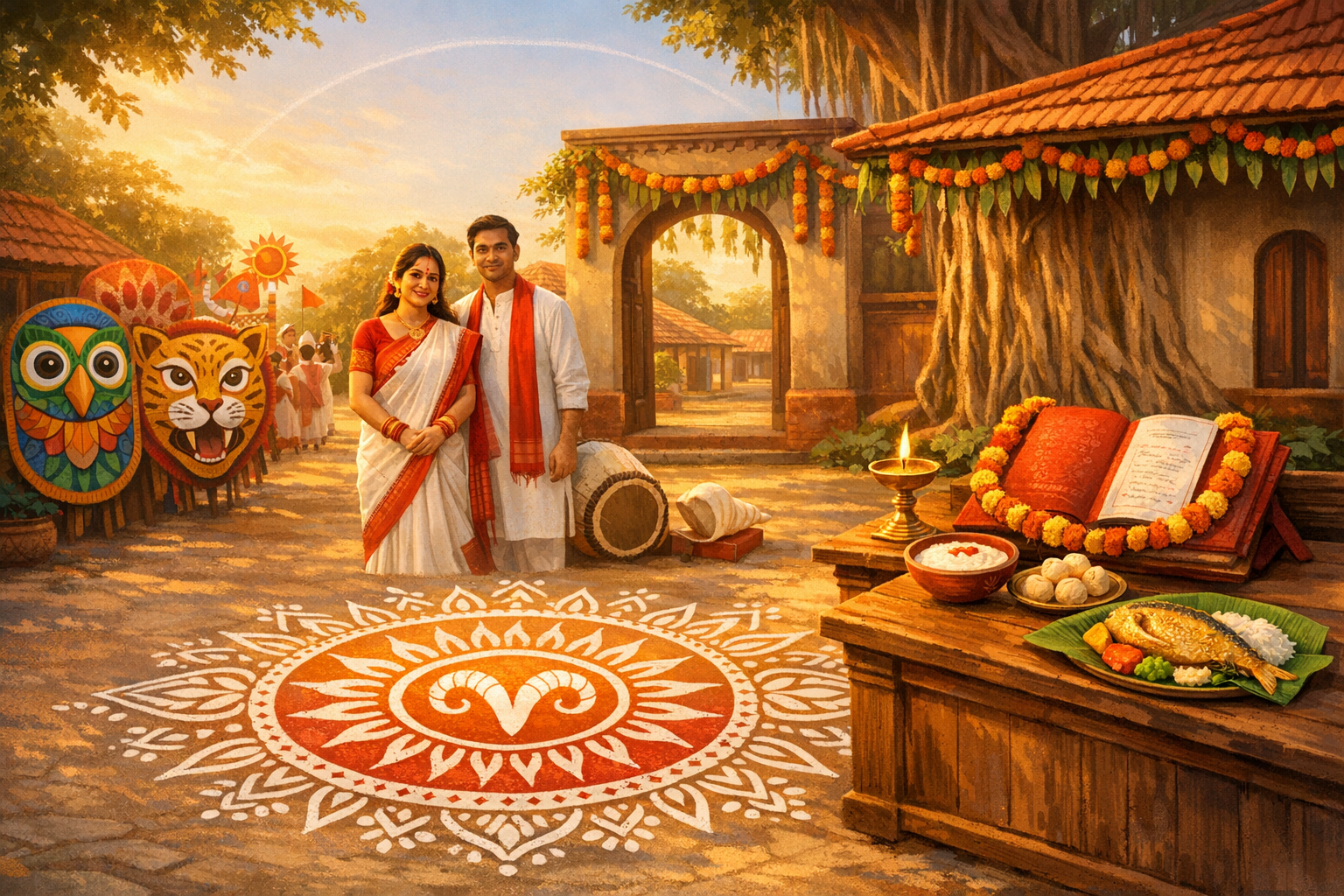
Pohela Boishakh is preceded by Choitro Sankranti, the last day of the previous month, which many communities observe with fasting, charity, household cleaning, and local fairs. In several parts of Bengal, the folk observance of Charak Puja coincides with Choitro Sankranti, symbolically closing the old year with vows, penance, and community worship. The next morning, Poila Baisakh opens with prabhat pheri (early morning processions), rhythmic dhak drums, and intricate alpana designs welcoming auspicious beginnings.
Ritual practice commonly includes simple home puja to Lakshmi and Ganesha for prosperity and clarity of purpose, reflecting a longstanding ethos that marries spiritual aspiration with practical life. The household ambiancefreshly washed courtyards, floral torans, and new garmentsunderscores renewal. For many families, the rustle of white-and-red saris and the cadence of dhak evoke cherished memories of childhood mornings and neighborhood gatherings, making the festival both intimate and communal.
Halkhatathe ceremonial opening of new account books by traders and artisansis a hallmark of Bengali New Year commerce. Shopkeepers invite patrons to sign the fresh ledger, offer prasad, and inscribe auspicious invocations for ethical trade and sustained relationships. Although many businesses now maintain digital records, the ritual persists as a living symbol of trust, reciprocity, and the blended moral-economics that has characterized Bengali mercantile life for centuries.
Foodways and music shape the cultural texture of the day. Panta bhat with ilish (hilsa), seasonal vegetables, luchi, mishti doi, and sandesh remain favorites across households and community feasts. Rabindra Sangeetespecially Esho He Boishakhalong with Nazrul Geeti and folk repertoire provide the festival’s emotive soundtrack. In recent years, conversations on sustainable consumption and hilsa conservation have encouraged mindful menus that honor tradition while supporting riverine ecology.
In Bangladesh, the Mangal Shobhajatra on Pahela Baishakha vibrant procession conceived by the Faculty of Fine Arts, University of Dhakahas been inscribed by UNESCO (2016) as Intangible Cultural Heritage of Humanity. Giant masks, folk motifs, and handcrafted effigies parade through city streets, affirming resilience, inclusivity, and social harmony. The visual language of the Shobhajatra intentionally centers universal valuesbanishing misfortune, welcoming wellbeingthereby resonating across communities and generations.
The astronomical moment behind Pohela Boishakh is shared widely across the subcontinent. The Sun’s ingress into sidereal Aries underlies multiple regional New Years and harvest festivals observed around the same time: Puthandu (Tamil New Year), Vishu (Kerala), Pana Sankranti (Odia New Year), Vaisakhi (Punjab, including the Sikh community), and Bohag Bihu or Rongali Bihu (Assam). This common celestial marker highlights a civilizational thread that unites diverse Dharmic traditionsHinduism, Buddhism, Jainism, and Sikhismaround renewal, virtue, and gratitude for the rhythms of nature.
Technically, Mesha Sankranti is computed using the sidereal zodiac with an ayanamsa (commonly the Lahiri ayanamsa in Bengali Panjikas) to account for precession. The Bengali day begins at sunrise, so the New Year is determined by whether the Sankranti occurs before or after local sunrise. Variations among Panjikasclassical Siddhanta models versus observational drik calculationscan lead to differences of several hours in the computed ingress, occasionally shifting the observance to the next sunrise. This is the principal reason Poila Baisakh in West Bengal falls on 15 April 2026.
Urban and diaspora celebrations amplify these traditions through Boishakhi Mela, cultural stages, and community fairs. Kolkata’s neighborhoods, from College Street to cultural precincts, host curated programs of Rabindra Sangeet, dance, and theatre, while Dhaka’s parks and boulevards fill with processions and folk art workshops. Beyond South Asia, London’s Boishakhi Mela and events in New York and Toronto demonstrate how Pohela Boishakh has become a global marker of Bengali identity and an open invitation to neighbors from all faiths to celebrate together.
For households and community organizers planning Pohela Boishakh 2026 in West Bengal, 15 April is the operative date for puja, prabhat pheri, and Halkhata. In Bangladesh, the civic celebration remains 14 April with the signature Mangal Shobhajatra. As always, exact local timings for puja, sunrise-based observances, and any shrine-specific rituals are best aligned with the regional Bengali Panjika. Many families living across time zones and borders choose to honor both dates, extending festivities and deepening shared connection.
Nomenclature varies across regions and scriptsPohela/Poila Boishakh (Bengal, India), Pahela Baishakh (Bangladesh), and the broader Naba Barsha/Noboborshoyet the essence remains constant: ethical renewal, cultural continuity, and community wellbeing. The confluence of astronomy, seasonal change, art, music, and shared meals transforms a calendrical threshold into a living heritage. In 2026, Pohela Boishakh (Poila Baisakh) offers a particularly meaningful opportunity to celebrate Naba Barsha 1433 with Dharmic unity and global camaraderie.
Inspired by this post on Hindu Pad.