
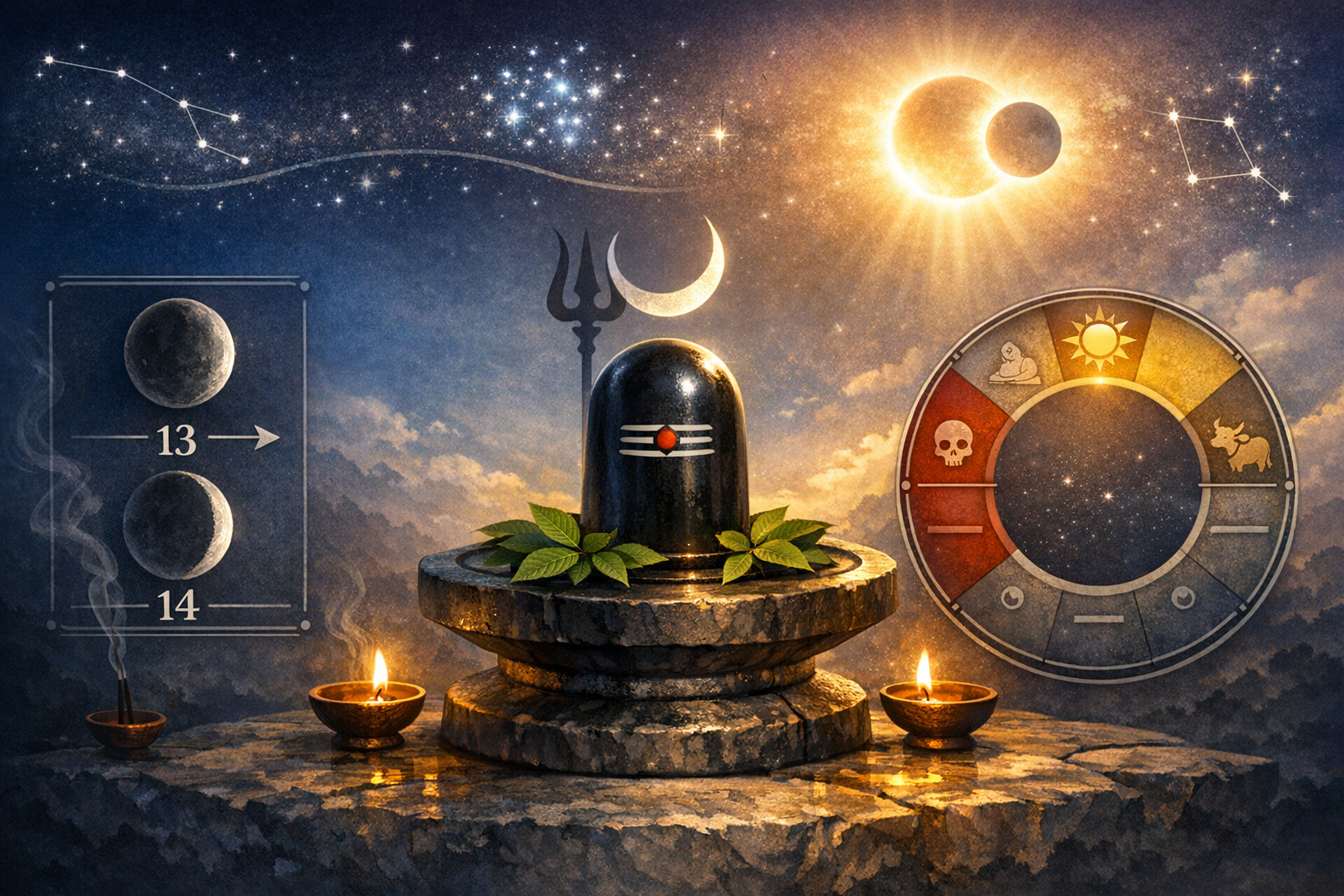
May 15, 2026 (Friday) in the Hindu calendar falls in Krishna Paksha and marks a clear tithi transition. In most Indian regions (IST baseline), Krishna Paksha Trayodashi ends at 05:52 on May 15; from that point onward, Krishna Paksha Chaturdashi prevails until Amavasya. This overview situates the date within the Panchang framework—tithi, paksha, Nakshatra, Rashi, and commonly used auspicious windows—so householders and practitioners can plan worship, study, travel, and routine activities with clarity.
Tithi and its significance: A tithi is a lunar day defined by the elongation between the Sun (Surya) and the Moon (Chandra). Trayodashi (13th) is traditionally associated with Pradosh worship of Shiva when the tithi spans the twilight period after sunset (Pradosh Kaal). Because Trayodashi ends at 05:52 (IST) on May 15, Pradosh Kaal on this calendar date in most Indian cities does not coincide with Trayodashi; any Pradosh observance for this fortnight would have fallen on the evening of May 14. After 05:52, Chaturdashi (14th) governs the remainder of the day, culminating toward Amavasya.
Monthly Shivaratri: Krishna Paksha Chaturdashi is the monthly Shivaratri. The core vrata and puja are aligned to the night and especially to the Nishita Kaal (the midnight window near local solar midnight) when Chaturdashi prevails. On May 15, 2026, with Chaturdashi active through the day in India, monthly Shivaratri worship is expected during the late night of May 15–16, subject to each location’s precise tithi span at Nishita Kaal. Devotees typically observe upavasa (fasting), perform Shiva abhisheka with pañcāmṛta or pañcopachāra/ṣoḍaśopachāra puja, and undertake japa and dhyana through the night.
Month naming across regional traditions: Owing to the two prevalent civil reckonings, this day can be described as Krishna Paksha of Vaiśākha (Amānta system, used widely in western and southern India) or as the closing fortnight of Chaitra (Pūrṇimānta, common in northern India). The astronomical sky is the same; only the civil month-label differs. This shared lunar framework also underpins observances in closely related dharmic traditions—Buddhism (e.g., Vesak in Vaiśākha), Jainism (vratas mapped to lunar tithis), and Sikh households that consult the Panchang for family rites—affirming a civilizational unity in timekeeping while honoring regional diversity.
Nakshatra and Rashi context: Surya is in Vṛṣabha (Taurus) around mid-May in the sidereal zodiac, so May 15, 2026 is a Vṛṣabha Surya day. As Chaturdashi approaches Amavasya, Chandra lies close to Surya in the zodiac. For much of May 15 in India, Chandra is expected in Meṣa (Aries), traversing late Bharani and approaching Kṛttikā, with a subsequent ingress to Vṛṣabha occurring regionally as Amavasya nears. Exact Nakshatra and Moon Rashi boundaries are location- and time-specific; therefore, a city-level Panchang should be consulted for the precise Nakshatra end-time and any late-night ingress on May 15–16.
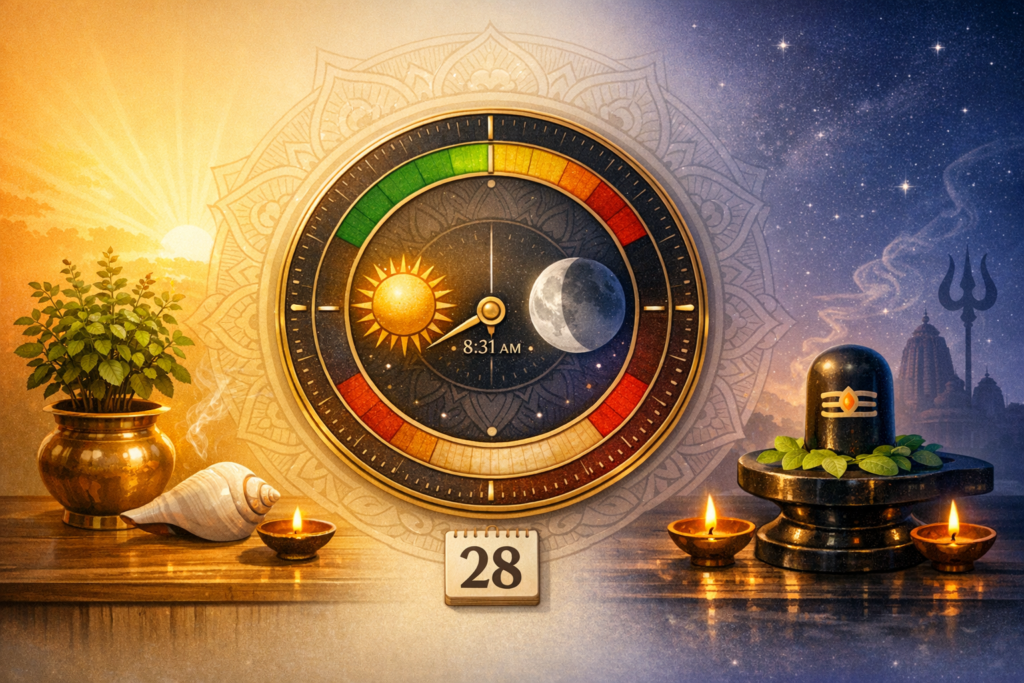
Auspicious windows and cautionary periods (Shubh Muhurat, Rahu Kalam): The daily practice of selecting times complements the tithi. Abhijit Muhurta—widely regarded as auspicious—centers on local midday (approximately 24 minutes before and after the local solar noon); it is well-suited for initiating important but non-ritual tasks. Brahma Muhurta begins roughly 96 minutes before local sunrise and supports meditation, japa, and study. Godhuli Vela (around sunset) is devotional, particularly for sandhyāvandana and deepa offerings. For Friday, the commonly referenced daytime segments (normalized to an approximate 06:00 sunrise) are: Rahu Kalam ≈ 10:30–12:00, Yamaganda ≈ 15:00–16:30, and Gulika Kalam ≈ 07:30–09:00. If, for example, sunrise is 05:30 IST in a given city, each of these segments should be scaled to the day’s actual sunrise–sunset span. Avoid initiating high-stakes undertakings in Rahu Kalam; use Abhijit and well-reviewed personal muhurta windows for commencements.
Planning guidance for the day: With Chaturdashi active after 05:52 (IST), the day favors Shiva-upāsana, introspection, and letting-go rituals. Monthly Shivaratri worship during late night is aligned with dhyana, mantra-japa (such as “Om Namah Shivaya”), and satvika ahara. Those observing vrata can break fast after local sunrise on the following day when Amavasya or post-ritual constraints are satisfied, as per sampradaya. Routine work and study may be scheduled around Abhijit Muhurta for a momentum boost, while travel and contract signings are best kept outside Friday’s Rahu Kalam.
Accuracy and regionalization: Panchang elements are intrinsically location-dependent because sunrise, sunset, and the Moon’s position vary with longitude, latitude, and daylight-saving rules. The 05:52 figure provided here is an IST baseline for most Indian regions; cities far east or west in India may show minute-level differences, while locations outside India will show larger shifts. For precise Nakshatra, Moon Rashi transitions, and Nishita Kaal verification for monthly Shivaratri, a reliable, topocentric Panchang calculation for the specific city should be consulted.
Shared dharmic resonance: The same lunar grammar—tithi, Nakshatra, and Yoga—guides Hindu, Buddhist, Jain, and Sikh families in varied ways: from vrata and dana to parayana and community gatherings. Recognizing this common sky and shared timekeeping strengthens mutual respect across traditions, encourages collective observance in homes with multiple practices, and preserves the civilizational continuity that Panchang represents.
In summary, May 15, 2026 is dominated by Krishna Paksha Chaturdashi in India, with Trayodashi concluding at 05:52 (IST). There is no Pradosh in the evening of this specific date, and monthly Shivaratri is expected during the late night of May 15–16, subject to city-level Nishita Kaal and tithi checks. Surya is in Vṛṣabha; Chandra is near conjunction, typically in Meṣa moving toward Vṛṣabha, implying Nakshatra progression from Bharani toward Kṛttikā. Use Abhijit Muhurta for initiations, avoid Friday’s Rahu Kalam for critical starts, and align spiritual practice with the contemplative arc of Chaturdashi.
Inspired by this post on Hindu Blog.




Leave a Reply
You must be logged in to post a comment.