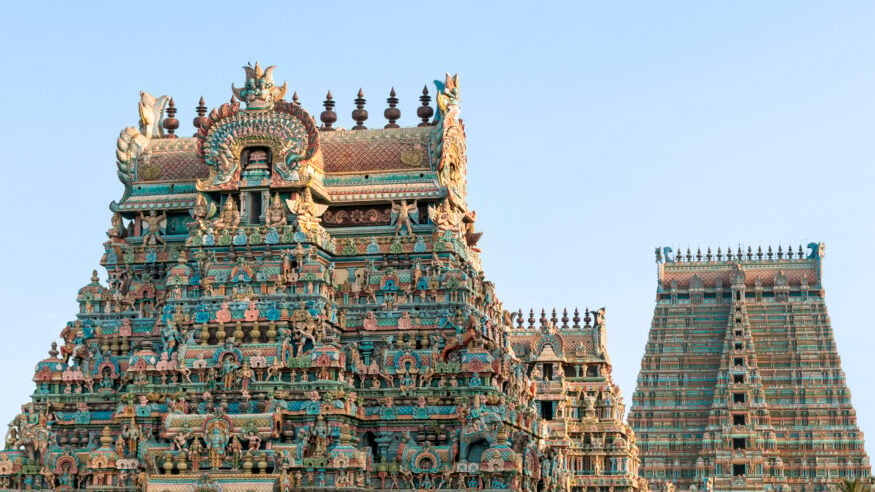
Patotsavalso spelled Patotsavais the annual re-consecration rite that renews the sacred presence of the murti in Hindu mandirs, especially across Gujarat and Rajasthan. Rooted in Vedic and Agamic liturgy, this observance commemorates the tithi (lunar anniversary) of the original Prana Pratishtha, the foundational act that invited divine presence into the temple’s central image. Over time, Patotsav has traveled well beyond the subcontinent as Gujarati and Rajasthani communities established mandirs across India and the global diaspora, preserving a living tradition that blends precise ritual grammar with deep communal devotion.
In liturgical terms, Patotsav functions as a punar-adhivasaa periodic re-sanctification that affirms and refreshes consecrated spacerather than a repeat of the full Prana Pratishtha. The ritual emphasizes śuddhi (purification), mantra, abhisheka (oblations), homa (fire offerings), and alankara (adornment), culminating in darshan and prasada for the assembled community. Its scholarly scaffolding is provided by Agamic canonsprimarily Pancharatra and Vaikhanasa for Vaishnava shrines and the Shaiva Agamas for Shaiva templesadapted to local sampradaya practice, priestly lineages, and regional aesthetics of Gujarat and Rajasthan.
Scheduling is based on the temple’s original consecration tithi as recorded in its archival patrika or register. The date shifts annually on the Gregorian calendar and is finalized by consulting a panchang. In the diaspora, Patotsav is often observed on the closest weekend to maximize participation while preserving the tithi through a sankalpa that binds the rite to the original muhurta.
Preparation begins days in advance. Volunteers and priests coordinate alaya-śuddhi, thorough cleansing of the garbhagriha and precincts, polishing of metalwork, and freshening of textiles. Doorways receive toran, courtyards are graced with rangoli, and the sanctum’s thresholds are readied to mark the renewed flow of sacred presence. This groundwork reflects a central Patotsav conviction: purity of place, materials, mantra, and mind together create the conditions for ritual efficacy.
The morning of Patotsav typically opens with achamana and sankalpa, followed by punyahavachanathe sanctification of water through Vedic recitation. Priests assemble tirtha-jala containing, when possible, Ganga-jal and waters representing regional rivers, symbolizing the confluence of pan-Indian sacred geography with local devotion. The rite underscores that sanctity is both universal and situated, harmonizing Gujarat’s and Rajasthan’s living cultures with the broader Indic sacred landscape.
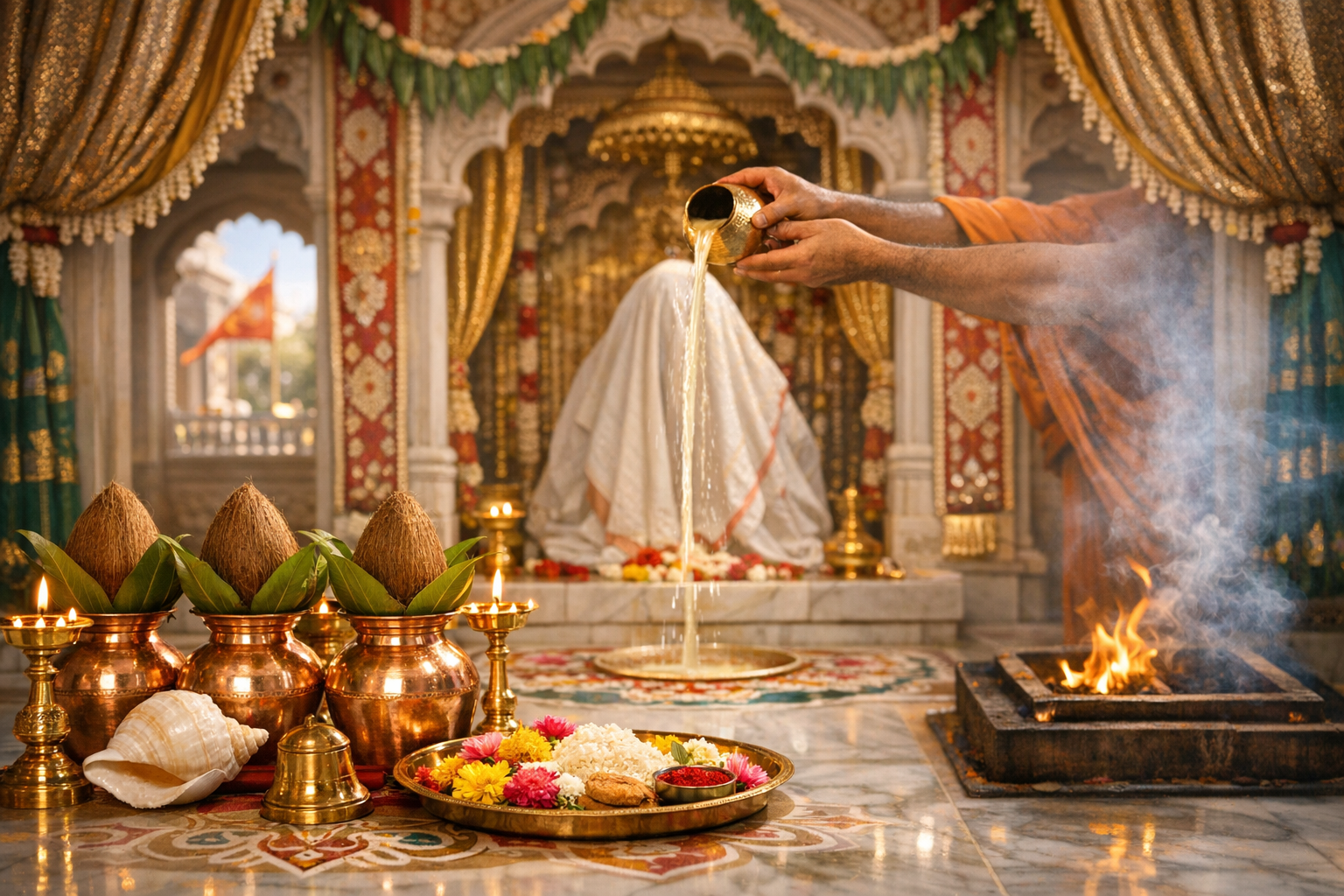
Kalasha-sthapana follows. One or more kalasharitual vessels filled with sanctified water, herbs, and grainsare prepared with coconut and mango leaves. In larger mandirs, a shata-kalasha abhisheka (hundred-pot oblation) is planned; in more intimate settings, a smaller number of kalasha is used while preserving the complete liturgical sequence. Devata-avarana (ritual encirclement with mantras), nyasa, and protective invocations seal the sanctity of the consecrated space.
Abhisheka stands at the Patotsav core. The murti receives Panchamritatraditionally milk, curd, ghee, honey, and sugarsometimes preceded by gau-maya and gomutra śuddhi when prescribed by the sampradaya. Vedic hymns such as Purusha Sukta, Narayana Sukta, Sri Sukta, and Rudram (with Chamakam) are chanted according to lineage. In Vaishnava temples, Vishnu-sahasranama or Gopala-mantras may be intoned; in Shaiva shrines, Mahanyasa-purvaka Rudrabhisheka is common. Theologically, abhisheka signifies the community’s offering of rasa (essence) back to the divine source, renewing the mutual bond of seva and grace.
Homa generally accompanies the ablutions. Depending on tradition, Sudarshana homa (Vaishnava), Rudra homa (Shaiva), Navagraha homa, or a composite Agamic fire-rite is conducted. Oblations of ghee and samidha are offered with svaha, aligning the temple’s ritual time with cosmological order (ṛta). The homa fire serves as a visible mediator that carries offerings to the deities while sanctifying the assembled congregation through mantra and smoke.
Alankara then reveals the deity in festive splendor. In Rajasthan’s haveli-style Vaishnava mandirs, pichwai textiles frame the murti and are seasonally rotated to echo the calendar of seva, while garlands and zari fabrics impart regal luminosity. In Gujarat, especially within Swaminarayan mandirs, meticulously crafted vastra, floral decor, and ornaments accentuate serene divinity aligned with satsang aesthetics. The visual grammar differs, but the intent is shared: darshan that elevates mind and heart.
Many Patotsav observances include dhwaja-arohaṇa (flag hoisting) at the dhwaja-stambha and a shobha yatra in the neighborhood. Nagara-sankirtan with mridanga, jhanj, and manjira may be accompanied by local devotional formsgarba in Gujarat and bhajan or ghoomar-influenced festivities in Rajasthansubject to each temple’s tradition. These processions create a porous boundary between temple and town, affirming that sacred renewal belongs to the wider community.
Shodashopachara (sixteen-fold worship) completes the liturgical arc before maha-arati and prasada. Annadana, fruit offerings, and sweets prepared to local taste signal the hospitality at the heart of Patotsav. In Pushtimarg temples, an expanded rajbhog may be offered; in some settings, a chhappan bhog is prepared on special milestones, though scale varies by resources and custom. The guiding principle remains unwavering: devotion measured not only in abundance but in purity of intent.
Conceptually, Patotsav distinguishes itself from related rites. Pavitrotsavwidely observed in many Vaishnava templesis a specific festival of purification usually tied to Shravan, whereas Kumbhabhishekam or Samprokshana marks large-scale re-consecration following renovation or at multi-year intervals. Patotsav, by contrast, is the temple’s annual heartbeata scholarly precise, community-facing reaffirmation of the original consecration vow.
Regional nuances are significant. In Gujarat, Patotsav frequently features Mahapuja conducted by devotees under priestly guidance, scriptural pravachans, and extended bhajan sessions rooted in satsang culture. The Swaminarayan sampradaya has particularly contributed to the structured dissemination of Patotsav in the diaspora, emphasizing accessible liturgy, youth participation, and clarity of ritual meaning alongside Vedic fidelity.
In Rajasthan, especially in Pushtimarg’s haveli tradition centered on Srinathji and related lineage temples, Patotsav is woven into the ashtayam-seva rhythm (the eight daily darshans). Seasonal pichwai, intricate vastra-seva, and an emphasis on madhurya-bhava color the day. The rajbhog on Patotsav often carries special emphasis and may be paired with community nagarsankirtan, aligning aesthetic devotion with public celebration.
Temple management typically records the Patotsav tithi, priestly lineages (archaka parampara), and variations authorized by acharyas or trusts. Documentation ensures continuity, especially when communities relocate across regions or nations. Volunteers coordinate logistics, crowd management, and interpretive materials so that both seasoned devotees and first-time visitors can follow the rites with informed reverence.
Patotsav’s theology is accessible and profound. By ritually renewing the sacred field within the garbhagriha, the community affirms the temple as a living seat of presence (sannidhya) rather than a static monument. The murti, served with mantra, water, light, fragrance, and food, becomes the axis around which ethical life, hospitality, and shared identity revolve. The annual cycle thus couples rigorous liturgy with social cohesionan integration emblematic of Gujarat’s and Rajasthan’s temple cultures.
Shared dharmic resonances are noteworthy. Jain derasars across Western India also mark annual installation anniversaries as Patotsav with Snatra Puja, Kalasha abhisheka, and Vaskep (saffron-sandal paste), highlighting a parallel ethic of ritual renewal and non-violence-centered devotion. In Buddhist communities, consecration traditions such as rabne (rab gnas) periodically re-sanctify sacred images and spaces. Sikh gurdwaras, while distinct in theology and practice, likewise express communal rededication through Nishan Sahib seva and langar, emphasizing service, equality, and remembrance. These convergenceseach within its doctrinal framestrengthen a shared civilizational message of continuity, service, and harmony.
In the global diasporafrom East Africa and the United Kingdom to North America and AustraliaPatotsav anchors identity by combining precise ritual with bilingual explanations, child-friendly learning stations, and volunteer-led seva. Adaptations maintain liturgical integrity while accounting for local constraints on time and space. The outcome is a community-affirming rite that preserves Vedic traditions without sacrificing accessibility.
For devotees preparing to participate, recommended observances include simple vrata or mindful restraint, early arrival for sankalpa and punyahavachana, and a focus on attentive darshan during abhisheka and maha-arati. Offerings may align with local traditionflowers, fruits, grains, or seva commitments. Many temples also encourage study of core prayers relevant to their sampradaya so that collective chanting becomes an act of shared scholarship as well as devotion.
The material ecology of Patotsav is receiving growing attention. Several mandirs in Gujarat and Rajasthan have adopted water-conservation protocols for abhisheka, responsible sourcing for Panchamrita ingredients, and eco-conscious disposal of flowers and biodegradable decor. Such practices reflect classical principles of ahiṃsa, dana, and stewardship applied to contemporary environmental contexts.
Historically and textually, Patotsav is intelligible as a synthesis: Vedic mantras frame sacred sound; Agamic procedure orders space and gesture; regional aesthetics translate devotion into color, fabric, and fragrance. The rite’s longevity rests on this layered precision paired with community warmtha combination that explains why Patotsav remains an indispensable milestone in Gujarati and Rajasthani mandirs at home and abroad.
Seen in full, Patotsav is both a scholarly faithful ritual and a social covenant. It renews the temple’s vow to be a place of refuge, learning, and service; it renews the community’s vow to live by dharma in everyday life. In celebrating the annual anniversary of Prana Pratishtha, temples across Gujarat, Rajasthan, and the diaspora keep sacred presence luminous, year after yearan enduring testament to India’s civilizational heritage and the unifying spirit of its dharmic traditions.
Inspired by this post on Hindu Blog.