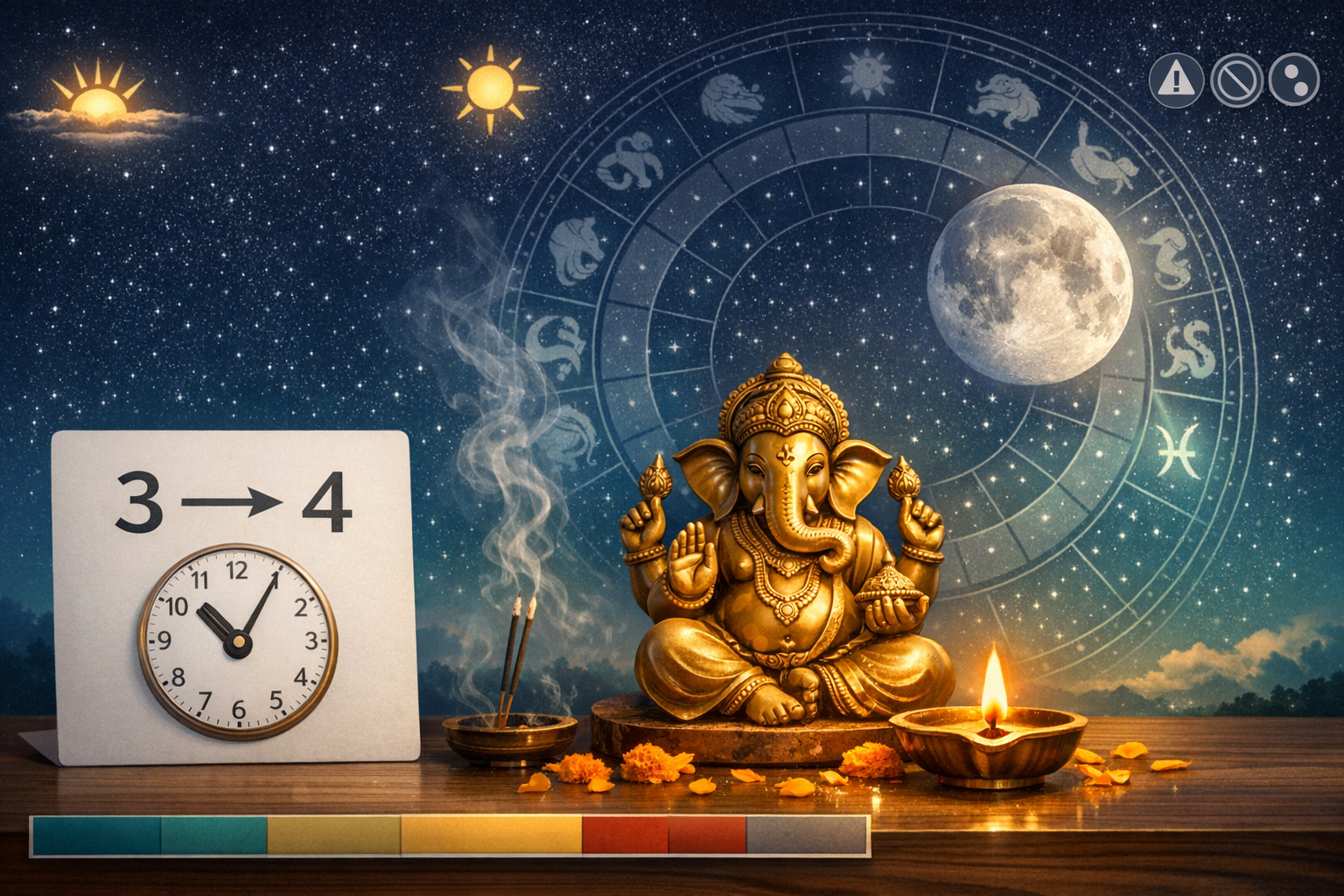
On Sunday, April 5, 2026, the Hindu calendar (Panchang) records Krishna Paksha Tritiyathe third lunar day of the waning fortnightuntil 10:04 AM. From 10:04 AM onward, the day transitions to Krishna Paksha Chaturthi, the fourth lunar day of the dark half, in most regional computations. This split day is typical in lunar calendrics and shapes daily observances, fasts, and muhurta selection across traditions.
A tithi denotes the angular separation between the Moon and the Sun in 12-degree segments. As the Moon’s longitude minus the Sun’s longitude advances through each 12-degree arc, the calendar moves from one tithi to the next. Krishna Paksha indicates the waning half of the month, culminating in Amavasya. Because tithi boundaries are astronomical, a tithi may start or end at any time of the civil day, and therefore the sunrise tithi and the tithi prevailing at moonrise (for certain fasts) are both operationally important.
Krishna Paksha Tritiya is traditionally classified as a Jaya tithi in the Nanda–Bhadra–Jaya–Rikta–Poorna cycle, associated with initiative, strategic clarity, and measured assertion. It is contextually suitable for planning, skill-building, and completing pending tasks. While Akshaya Tritiya in the bright half is widely celebrated, the waning Tritiya carries a quieter, disciplined energy conducive to introspection, learning, and consolidating gains.
From 10:04 AM onward, Krishna Paksha Chaturthi prevails. Chaturthi falls under the Rikta classgenerally avoided for inaugurating major venturesyet it is also the principal lunar day for the worship of Ganesha as remover of obstacles. In many regions, the Krishna Paksha Chaturthi is observed as Sankashti Chaturthi. The vrata is traditionally kept from sunrise to moonrise, with the fast concluded (parana) after sighting the Moon and offering arghya, followed by Ganesha puja and the reading of the Sankashti Chaturthi katha. As a rule of observance, if Chaturthi prevails at local moonrise, the fast is kept that day; if it does not, the observance shifts to the next calendar day.
For spiritual practice, simple and effective routines on Chaturthi include recitation of Ganesha stotras such as Ganesha Atharvashirsha, Sankashta Nashana Ganesha Stotram, or the mantra Om Gam Ganapataye Namah. A concise puja may follow the Panchopachara protocol: gandha (fragrance), pushpa (flowers), dhoopa (incense), deepa (lamp), and naivedya (offering). The intent is to refine focus and invite śubha (auspiciousness) by aligning personal effort with the symbolic intelligence of the tithi.
Good Time indicators (shubh muhurta) on any given day are best identified locally, yet several pan-Indian heuristics assist planning. Brahma Muhurta, approximately 1 hour 36 minutes to 48 minutes before local sunrise, is ideal for meditation, pranayama, and japa. Abhijit Muhurta centers on local solar noon (roughly 24 minutes before and after true midday) and is regarded as a success-supporting window for decisive actions when other clear auspicious slots are not available. These windows are independent of weekday but depend on local sunrise, sunset, and equation-of-time adjustments.
Care is also taken to avoid routine inauspicious segments. Rahu Kalam, Yamaganda, and Gulika Kalam divide the daylight interval into eight equal parts, with a fixed weekday sequence. On Sundays, the standard ordering places Yamaganda around the 5th segment of daylight, Gulika Kalam around the 7th segment, and Rahu Kalam toward the final segment of daylight. To compute precisely, divide the interval from local sunrise to sunset into eight equal parts and apply the Sunday sequence. Actions such as starting a journey, signing contracts, or initiating major purchases are typically deferred outside these periods.
Choghadiya provides another practical layer for day planning, especially in western and northern India. Daytime and nighttime are each split into eight segments that cycle through quality labels. Amrit, Shubh, and Labh are considered favorable, while Rog, Kaal, and Udveg are avoided. Since Choghadiya depends strictly on local sunrise and sunset, practitioners derive the schedule for their latitude and season to select windows aligned with intended outcomes.
Nakshatra and Rashi are computed from the Moon’s nirayana (sidereal) position. The lunar mansion (nakshatra) is one of 27 sectors of 13°20′, and the Moon’s sign (rashi) is one of 12 zodiacal segments of 30°. Because the tithi boundary on April 5, 2026 spans the morning, nakshatra and rashi may also shift intra-day depending on locale and ayanamsa standard. For actionable decisionssuch as matching Tarabalam or Chandra Balathe locally computed nakshatra and rashi for the precise time and place should be referenced.
Seasonally, the Sun remains in Meena (Pisces) in the sidereal framework until Mesha Sankranti in mid-April, a backdrop associated with reflection, compassion, and closure of the seasonal cycle before the energetic onset of sidereal Aries. This solar context supports completing open loops, decluttering mental and physical spaces, and setting intentions that will be carried into the forthcoming solar ingress.
The observance of lunar days such as Tritiya and Chaturthi resonates across Dharmic traditions. Hindu households commonly use the Panchang to time vrata and puja; many Buddhist communities observe Uposatha around quarter phases; Jain practice accords special sanctity to tithi-based austerities; and Sikh families, while following the Nanakshahi (solar) calendar institutionally, often maintain Panchang rhythms in personal and community life. This shared attention to lunar time fosters a sense of harmony, ethical focus, and inter-traditional continuity.
For Sankashti Chaturthi, the concluding moonrise is essential. As moonrise varies by latitude and longitude, parana timing should be taken from a credible local almanac. The concluding ritual typically includes darshan of the Moon, offering water and akshata, followed by Ganesha puja and distribution of prasada. Where health or duty requires flexibility, Dharma texts and living sampradaya counsel a spirit of sincerity, moderation, and non-harm in adjusting observances.
Those employing more advanced Panchang layers may consult Tithyamsa for nuanced suitability, as well as yoga and karana operative at task time. Selection tends toward Sarvartha Siddhi Yoga and Amrita Siddhi Yoga when available, and away from Vyatipata or Vaidhriti. Since these yogas are derived from a combination of weekday, nakshatra, and other elements, exact availability on April 5, 2026 will be location-specific and should be computed accordingly.
Practical guidance for the day integrates time-tested simplicity. Begin with a short period of silence in Brahma Muhurta if feasible, recite a chosen stotra, and dedicate the work of the day to loka-samgraha (the welfare of all). If observing Sankashti, maintain a sattvic diet during the fast, offer simple naivedya at moonrise, and close with gratitude. Activities of study, service, and mindful charity align naturally with the waning fortnight’s inward movement.
In summary, April 5, 2026 moves from Krishna Paksha Tritiya to Krishna Paksha Chaturthi at 10:04 AM, marking a day that invites both consolidation and obstacle-removal practice. With thoughtful attention to shubh muhurta, care around Rahu Kalam and related segments, and reverent alignment to nakshatra and rashi as computed locally, the day supports purposeful action. The shared lunar sensibility across Hinduism, Buddhism, Jainism, and Sikhism underscores a unifying ethic: time is sacred when guided by awareness, compassion, and the intention to benefit all beings.
Inspired by this post on Hindu Blog.