Across India’s electoral map, the Tamil Nadu Assembly Elections 2026 represent a rare inflection point. The state’s political historylong anchored by larger-than-life figuresnow faces a high-stakes contest defined by leadership transition, fluid alliances, and an electorate recalibrating expectations after a decade of social and economic churn. Observers widely note that conventional models of psephology struggle to capture the state’s fast-shifting alignments and unusually volatile undercurrents.
The pivot began in 2021, the first state election without J. Jayalalithaa and M. Karunanidhi. A residual sympathy wave for the Dravida Munnetra Kazhagam (DMK), combined with the All India Anna Dravida Munnetra Kazhagam (AIADMK)’s internal implosions, delivered power to M.K. Stalin. Even then, margins in a notable number of constituencies were slender, foreshadowing a 2026 battle where micro-swings and last-mile mobilization could prove decisive.
This cycle is the first true test of Tamil Nadu’s post-charismatic era. Both the DMK and AIADMK confront a leadership drought, where organizational muscle and coalition engineering must substitute for the emotive, personality-driven politics that once dominated the state. The AIADMK’s prolonged factionalism deepened after Jayalalithaa’s passing; the process reached a fresh inflection when former Chief Minister O. Panneerselvam publicly aligned with the DMK on 27 February 2026, reshaping opposition arithmetic and morale.
M.K. Stalin’s stewardship is, in many ways, an intergenerational experiment. Unlike Karunanidhiwhose political craft was honed over decades of ideological agitation, legislative mastery, and coalition statecraftStalin had limited opportunity to mature under his father’s direct shadow. The task before him is not simply electoral consolidation; it is also the modernization of a Dravidian party apparatus to fit the demands of a digitally networked, youth-heavy electorate.
Public sentiment toward the incumbent government is mixed and intensely debated. Critics allege corruption, episodic law-and-order lapses, and an uneven administrative focus on religious institutions, while supporters point to welfare delivery, urban infrastructure upgrades, and social justice measures. Since the pandemic, enforcement agencies have intensified operations against drug trafficking, with several cases alleging transnational linkages. For many voters, rule of law, transparency in temple administration, and the credibility of anti-narcotics measures have converged into core concerns for 2026.
Strategically, Stalin leans on DMK’s core Dravidian vote, an alliance ensemble of largely caste-based micro-parties, and sustained minority outreach. The Indian National Congressmarginalized since its 1967 ousterremains a limited factor in the state’s present configuration. The weight of incumbency, however, has sharpened scrutiny: promises of expanded welfare, jobs, and industrial diversification must be communicated with precision and executed with speed to neutralize anti-incumbency vectors.
Equally consequential is the transformation of the ideological arena. The grammar of political persuasiononce dominated by party newspapers, cinema, and platform oratorynow flows through social media, hyperlocal influencers, and issue-based volunteer networks. In this ecosystem, narratives travel faster than institutions can respond. Parties that fail to adapt risk ceding agenda-setting power to agile digital actors who can frame debates on Dravidianism, development, and identity in real time.
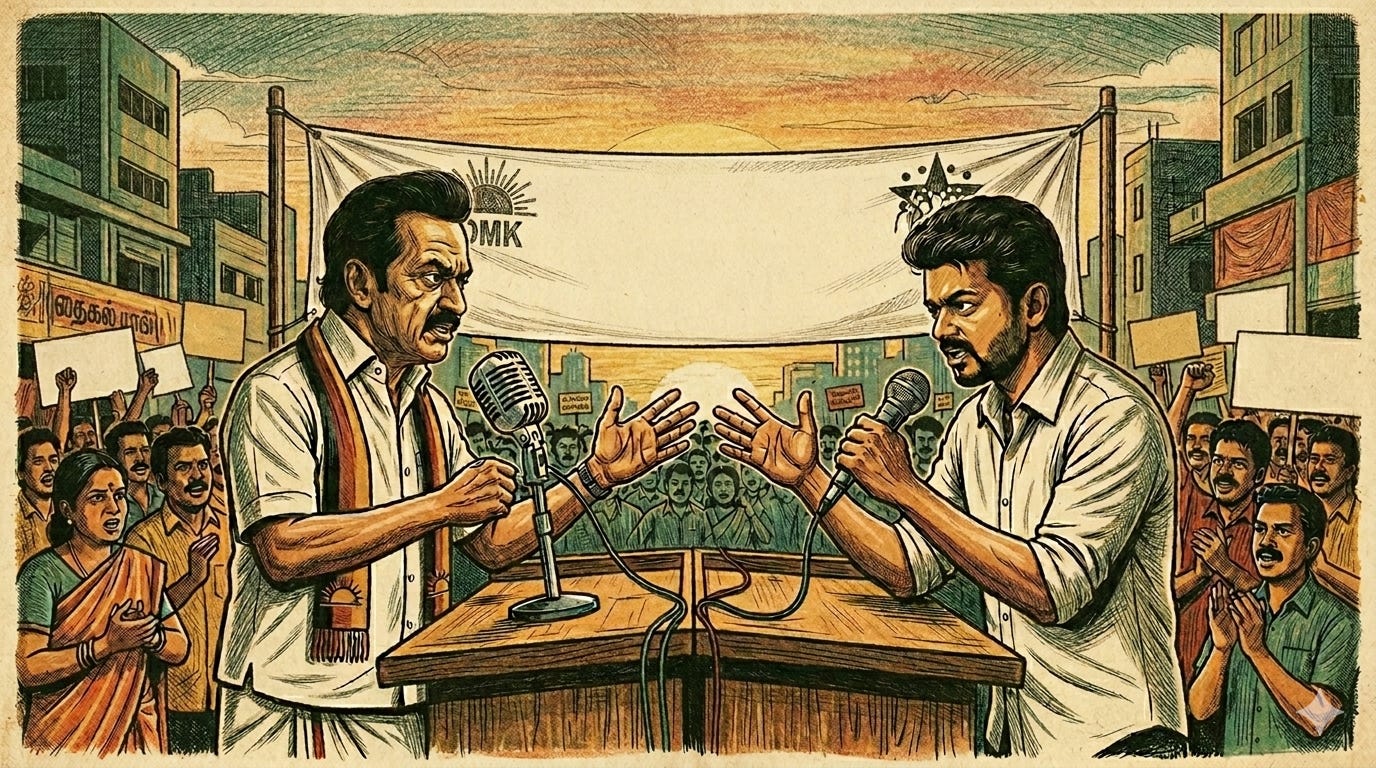
A new variable in this equation is film actor Joseph Vijay and his Tamilaga Vettri Kazhagam (TVK). His political intent first surfaced in 2011 through overt support to Jayalalithaa. Fifteen years on, TVK’s foray places celebrity capital at the center of a state-wide mobilization effort. Yet the party’s ideological plank remains indistinct, its organizational scaffolding fledgling, and its public messaging careful to avoid direct confrontation with Dravidianism or E.V. Ramaswamy Naicker’s legacy.
Public scrutiny of TVK intensified after a tragic stampede reported in Karur during a 2025 rally, which led to multiple fatalities according to contemporaneous accounts. In Tamil Nadu’s exacting political culture, crisis management, empathy toward affected families, and institutional learning from such episodes profoundly shape perceptions of leadership readiness.
Inevitable comparisons have been drawn to M.G. Ramachandran (MGR) and N.T. Rama Rao (NTR)the only two film icons to ascend to chief ministership on their maiden attempt. MGR, expelled from the DMK, built the AIADMK around a powerful moral and organizational counter-narrative; NTR, invoking Telugu self-respect, decisively challenged Congress centralism. Both combined star power with deep societal interaction, professional discipline, and an intuitive grasp of administrative symbolism. Tamil Nadu in 2026, however, is not the Tamil Nadu of 1977; celebrity alone no longer guarantees a durable political machine.
TVK’s early supporters appear concentrated among 18–30-year-olds in urban-peripheral and semi-urban belts, amplified by a longstanding fan-network infrastructure. Reports also suggest sections of the Christian community view TVK favorably, signaling a subtle reconfiguration of minority voting behavior. Whether this coalition can mature into a state-wide, booth-level, get-out-the-vote organization is the critical unknown; India’s recent political history suggests that star-led movements either institutionalize rapidly or risk quick absorption into established parties.
The AIADMK’s trajectory remains pivotal. Prolonged intra-party contests for leadership, cadre fatigue, and the gravitational pull of winnability narratives have thinned its coherence in key districts. Where it does retain strength, the party’s ability to protect vote banks from poaching and to articulate a forward-looking development pitch will determine whether it resurfaces as a major pole or cedes the opposition mantle to newer entrants.
The Bharatiya Janata Party (BJP) contests on ideational grounds, challenging the Dravidian consensus on language, culture, and center–state relations, while emphasizing national integration, infrastructure, and investment pipelines. Decades-old stereotypesportraying the BJP as a party of Brahmins (derogatorily called “Paarpanars”) and “Aryans” from the Northpersist in segments of the discourse, even as the party positions itself as a pan-caste, development-first alternative. The BJP has made ideological inroads; converting that into winnable seat geographies remains an uphill but not implausible task.
Amid these rivalries, voter priorities are unmistakably pragmatic. Households reference jobs, MSME credit, cost of living, public safety, water management, urban flooding, and school-to-work transitions more than they reference abstract identity tropes. In districts with heightened drug-enforcement activity, families emphasize rehabilitation and youth skilling alongside strong policing. Where temple administration is salient, stakeholders ask for transparent, accountable governance that respects community sentiment while upholding constitutional norms.
For a state defined by its plural inheritance, an integrative social compact is indispensable. A constructive path forward centers on unity among the dharmic traditions of Hinduism, Buddhism, Jainism, and Sikhismtraditions that have historically coexisted in Tamil cultural spacewhile maintaining respect for all faiths present in the state. Policies that reduce communal polarization, protect places of worship, and nurture inclusive cultural literacy can reinforce social trust, which in turn lowers the temperature of political competition.
Within this dharmic-pluralism frame, three strategic tests loom large. First, can the DMK refresh its governance narrative beyond legacy welfare to a metrics-driven program on jobs, industrial corridors, and civic services, especially for youth? Second, can TVK translate celebrity into cadre, constituency services, and a clear programmatic charter? Third, can the BJP stitch together a socially expansive coalition that softens historical stereotypes and localizes its development pitch without diluting national coherence?
The 2026 outcome will likely turn on micro-factors: tactical seat adjustments among smaller allies, turnout management in swing urban wards, diaspora remittance belts’ preferences, and women’s voting behavior in welfare-linked schemes. Social media framing wars may set the tone, but ground logisticspolling agents, transport on voting day, and last-mile persuasionwill determine final margins.
Multiple scenarios remain plausible. A DMK-led coalition could return with a trimmed majority if governance reassurance trumps disaffection. A hung assembly is conceivable if TVK and the BJP both expand at the expense of the AIADMK in different regions, disrupting traditional bipolarity. A more disruptive outcomewhere either a new actor becomes kingmaker or a mid-sized resurgence of the AIADMK reshapes coalition equationscannot be dismissed in such a fluid environment.
However the arithmetic resolves, a history-altering election is one that changes how politics is done. If Tamil Nadu’s parties move beyond sabotage and poaching toward transparent governance, evidence-backed policy, and an ethos of dharmic unity and interfaith respect, the state can set a national benchmark for post-charisma democratic consolidation. If, instead, personality and polarization outpace program and performance, the cycle risks devolving into an expensive stalemate.
In sum, Tamil Nadu’s 2026 contest is a referendum on leadership renewal, administrative credibility, and the capacity to harmonize identity with development. The Dravidian tradition has shown extraordinary adaptability across decades; its next chapterand the counter-narratives it now faces from TVK and the BJPwill be written not only in rallies and hashtags, but in the quiet arithmetic of credibility earned at the panchayat, ward, and booth.
Inspired by this post on Dharma Dispatch.