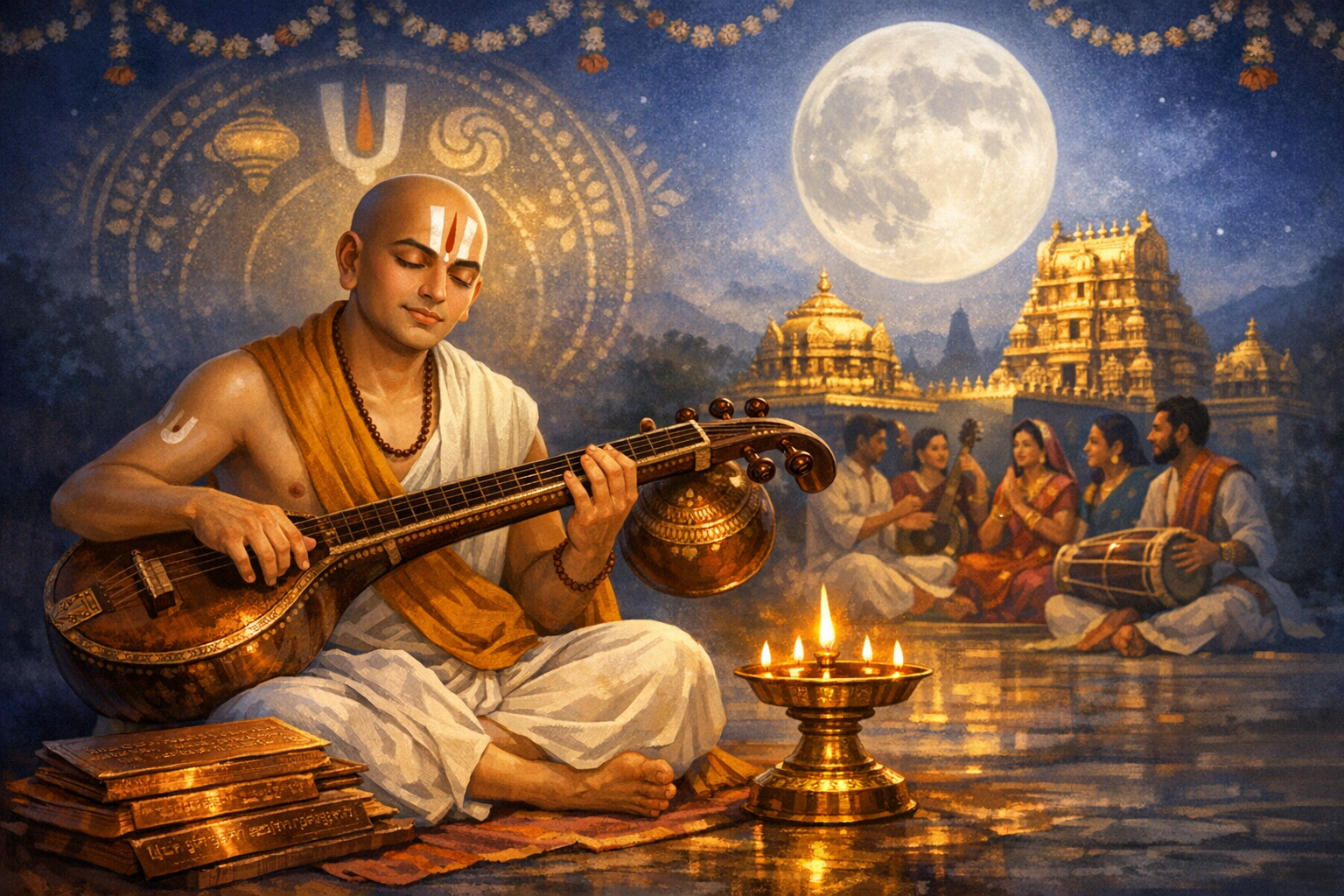
Annamacharya Jayanti 2026 falls on 1 May, coinciding with Vaishakha Pournami, the full-moon day of Vaishakh month in the Hindu lunisolar calendar. Observed widely in Andhra Pradesh and across the global Telugu diaspora, this Jayanti honors Tallapaka Annamacharya (c. 1408–1503), the revered Vaishnava saint-poet whose devotional sankeertanas to Sri Venkateswara of Tirumala helped shape the literary and musical contours of the Bhakti tradition.
In calendrical terms, the Jayanti aligns with Vaishakha Purnima. Regional panchangs may differ slightly in tithi start–end timings due to local moonrise and moonset, and variations between Amanta and Purnimanta reckoning. For most locations in India, observances are scheduled on 1 May 2026; devotees are advised to confirm local panchang details for precise puja windows.
Historically situated in Tallapaka (present-day YSR Kadapa district, Andhra Pradesh), Annamacharya is venerated as one of the earliest-known Telugu vaggeyakarascomposers who integrated both lyric and melody. Tradition holds that he composed as many as 32,000 sankeertanas, almost all in praise of Sri Venkateswara and, in many compositions, in adoration of Alamelu Manga (Padmavati). His spiritual life, rooted in an early and profound connection to Tirumala, exemplifies the Bhakti movement’s emphasis on direct, heartfelt devotion transcending social divisions.
The magnitude of his oeuvre is matched by its preservation history. Around 14,000 compositions survive on copper-plate manuscripts housed and curated by Tirumala Tirupati Devasthanam (TTD), following their discovery in the early 20th century during temple-related works. TTD’s long-running archival and propagation efforts, including documentation, notation, and performance initiatives, have been central to bringing these lyrics into contemporary circulation.
Poetically, Annamacharya’s corpus traverses the spectrum from adhyatma (metaphysical devotion) to śṛṅgāra (madhurya-bhakti), using accessible, resonant Telugu that welcomes listeners of all backgrounds. The celebrated “Brahmam Okate” distills a core theological insightDivine onenessinto a memorable refrain that has nurtured inter-community harmony and ethical egalitarianism. Other widely sung keertanas such as “Vinaro Bhagyamu Vishnu Katha,” “Adigo Alladigo Srihari Vasamu,” and “Tandanana Ahi” illustrate his ability to weave scriptural ideas into lived devotion.
Musically, Annamacharya’s sankeertanas have been absorbed into the performance grammar of Carnatic music. While the vaggeyakara tradition implies an organic interplay of words and tune, modern concert renditions frequently employ melodic settings refined by eminent musicians at TTD’s behest. Notable maestrosincluding Nedunuri Krishnamurthy and Dr. M. Balamuralikrishnacrafted enduring tunes for many lyrics, and iconic vocalists such as M. S. Subbulakshmi helped popularize this repertoire worldwide, ensuring that the saint’s message reached concert halls, homes, and devotional gatherings alike.
Thematically, the songs disclose a sophisticated theology expressed in profoundly human terms. Annamacharya’s verses juxtapose the majesty of Sri Venkateswara with the intimacy of devotee experience, often using the language of love and service to articulate philosophical truths. This blending of rasa with tattva made the compositions powerful vehicles for teaching and transformation, particularly in congregational singing, where shared musical experience reinforces communal bonds.
Observances of Annamacharya Jayanti typically center on sankeertana parayanam, group singing sessions, Harikatha and discourses on the poet’s life and philosophy, and special archanas to Sri Venkateswara. In Tirumala, Tirupati, and Tallapaka, TTD and allied institutions frequently host cultural programs, manuscript exhibitions, and scholarly meets that highlight Tallapaka literature, devotional aesthetics, and the history of the discovery, conservation, and dissemination of the copper-plate collections. Community celebrations elsewhere often mirror these elements in smaller scale, prioritizing participatory singing and study.
At home, devotees mark the Jayanti with simple but meaningful practices. Many begin the day with a sankalpa on Vaishakha Purnima, offer Panchopachara or Shodashopachara puja to Sri Venkateswara and Alamelu Manga, and recite a curated list of keertanas. Listening to authoritative recordings, reading published translations, and reflecting on the ethical tenets encoded in the lyrics deepen the observance. Acts of seva such as annadanam, visiting local Vishnu temples, and supporting classical arts education align well with the saint’s message of devotion through compassion and culture.
Vaishakha Purnima is also observed as Buddha Purnima (Vesak) in Buddhist communities, and in several Vaishnava sampradayas the day is associated with Kurma Jayanti. The shared full-moon framework underscores a meaningful unity across dharmic traditionsHinduism, Buddhism, Jainism, and Sikhismeach affirming, in its own idiom, the ideals of truth, non-violence, self-cultivation, and sacred remembrance through song and study. The resonance between sankeertana and Sikh shabad kirtan, as well as the contemplative ethics prized in Jain and Buddhist practice, offers a bridge for inter-tradition dialogue and mutual respect.
From a cultural heritage perspective, Annamacharya’s legacy demonstrates how literature, music, and worship intersect to transmit values across centuries. The Tallapaka corpus documents living theology and social insight in a vernacular idiom, making high philosophy intimate and actionable. As a result, the Jayanti is not only a festival date but also an invitation to ongoing learningthrough manuscripts, critical editions, commentaries, and pedagogy that sustain the tradition with scholarly rigor and devotional warmth.
In 2026, access to this legacy is broader than ever. TTD’s publications, curated performances, and educational programs, complemented by reputable recordings and notations, make it straightforward for communities worldwide to organize sankeertana gatherings and study circles. Families frequently introduce children to beginner-friendly pieces such as “Brahmam Okate,” nurturing both linguistic roots and spiritual sensibility through melody and meaning.
For planning, local panchang checks remain prudent, particularly where festival scheduling follows sunrise-based or moonset-based observance rules, or where diaspora communities synchronize programs over weekends. In most Indian almanacs, however, Annamacharya Jayanti 2026 is observed on 1 May, harmonizing with Vaishakha Pournami and its larger spiritual context.
In sum, Annamacharya Jayanti on Vaishakha Purnima offers a profound opportunity to engage the heart of the Bhakti tradition through song, study, and seva. Honoring Tallapaka Annamacharya’s enduring voicerooted in love of Sri Venkateswara and compassion for all beingsthis Jayanti reaffirms a shared dharmic ethic: devotion that unites, music that elevates, and wisdom that guides everyday life.
Inspired by this post on Hindu Pad.