
If the rise of Amritpal Singh has taught us anything, it is evident that a substantial population among our Sikh brothers and sisters longs for the Sikh pride that once was the Sikh empire stretching from Mainland Punjab, Jammu, Kashmir all the way to parts of Afghanistan.
At the time of Maharaja Ranjit Singh’s passing, the Sikh empire, although weakened, was still consolidated and recognized by the British.

This empire spanned five rivers from east to west (Sutlej, Beas, Ravi, Chenab and Jhelum) along with a sixth river Indus (Sindhu) and stretched all the way to Suleiman Mountain ranges to Baluchistan (now in Pakistan).
Is it essential for Sanatanis to unite this land in-line with Sikh glory? – Yes
Is secession of Indian Punjab from India required? – No
On the contrary we need to unite the land and people we lost to Pakistan (and the Gurudwaras along with it). There is more at play here.
Our civilization doesn’t prosper by breaking our motherland into smaller bits, we expand our footprint by uniting more people in our dharmic fold.
Fall of Pakistan is central
With the current state of affairs in Pakistan, a land built on one particular religion alone, the fissures resulting from cultural, linguistic and civilizational values are deepening. It is failing to prove enough of a glue to hold the region together. And the existence of Pakistan in its current form is proving hazardous to the world, Bharat and the people (Sikhs, Baloch, Sindhus, Mahajirs, Pashtuns, etc.). All this while it has become abundantly clear that the existence of the Pakistani State is detrimental to national security of the Indo-Asiatic and Indo-Pacific region.
In 2019 Forum for Awareness of National Security (FANS) proposed a plausible solution to the Pakistan problem.

Religio-Civilizational POV
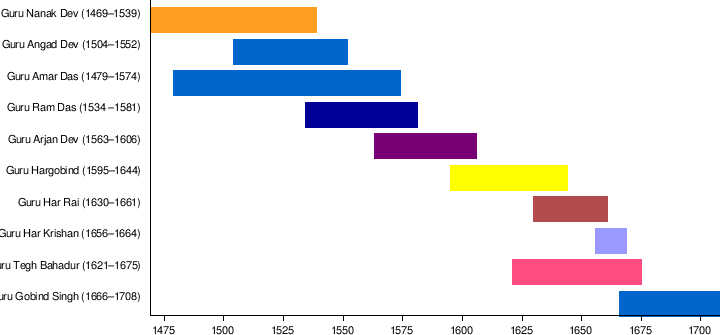
If we plot the birthplaces of all our Sikh gurus as centers of dharmic importance, the map would looks something like this
| Guru | Place (old) | Place (new) | Dates | In Indian Punjab? |
| Guru Nanak Dev Ji | Nankana Sahib, Punjab, Delhi Sultanate | Nankana Sahib, Punjab, Pakistan | 14 April 1469 – 22 September 1539 | No |
| Guru Angad Dev Ji | Muktsar, Punjab, Mughal Empire | Sri Muktsar Sahib, Punjab 152026, India | 31 March 1504 – 29 March 1552 | Yes |
| Guru Amar Das Ji | Amritsar, Punjab, Mughal Empire | Amritsar, Punjab, India | 5 May 1479 – 26 April 1552 | Yes |
| Guru Ram Das Ji | Lahore, Punjab, Mughal Empire | Lahore, Punjab, Pakistan | 24 September 1534 – 1 September 1581 | No |
| Guru Arjan Dev Ji | Goindval, Punjab, Mughal Empire | Goindwal Sahib, Punjab 143422, India | 15 April 1563 – 30 May 1606 | Yes |
| Guru Hargobind Sahib Ji | Amritsar, Lahore Subah, Mughal Empire | Amritsar, Punjab, India | 19 June 1595 – 28 February 1644 | Yes |
| Guru Har Rai Ji | Kiratpur Sahib, Lahore Subah, Mughal Empire | Kiratpur Sahib, Punjab 140115, India | 16 January 1630 – 6 October 1661 | Yes |
| Guru Har Krishan Ji | Kiratpur Sahib, Lahore Subah, Mughal Empire | Kiratpur Sahib, Punjab 140115, India | 7 October 1661 – 30 March 1664 | Yes |
| Guru Tegh Bahadur Ji | Amritsar, Lahore Subah, Mughal Empire | Amritsar, Punjab, India | 1 April 1621 – 11 November 1675 | Yes |
| Guru Gobind Singh Ji | Patna Sahib, Bihar Subah, Mughal Empire | Patna Sahib, Jhauganj, Hajiganj, Patna, Bihar 800008, India | 5 January 1666 – 7 October 1708 | Yes |
| Guru Granth Sahib | Takht Sri Damdama Sahib | Near, Sangat – Talwandi Road, Talwandi Sabo, Punjab 151302, India | 29 August 1604 – present | Yes |
Noteworthy observations
- The birthplace of our 1st and 4th gurus is outside Indian Punjab and we do not have continuous, direct and free access to our spiritual roots
- Sikh population is dwindling in Pakistan and cases of persecution again Sikhs in Pakistan is a daily affair.
Sikh Population in Pakistan
If it is clear to us that the place of birth of two of our gurus is of significant civilizational importance to us, then we could at least have solace knowing that our Sikh brothers & sisters in Pakistan have access to those centers and are empowered to fly the Khalsa flag high… Not quite.
Prior to independence in 1947, 2 million Sikhs resided in the present day Pakistan and were spread all across Northern Pakistan, specifically the Punjab region and played an important role in its economy as farmers, businessmen, and traders.
https://en.wikipedia.org/wiki/Sikhism_in_Pakistan
Sikh organizations, including the Chief Khalsa Dewan and Shiromani Akali Dal led by Master Tara Singh, condemned the Lahore Resolution and the movement to create Pakistan, viewing it as welcoming possible persecution; the Sikhs largely thus strongly opposed the partition of India.
Kudaisya, Gyanesh; Yong, Tan Tai (2004). The Aftermath of Partition in South Asia. Routledge. p. 100. ISBN 978-1-134-44048-1.
Sikh population in Pakistan has drastically come down within the past two decades – from around 40,000 in 2002 to 8,000, say rights campaigners.
https://www.indiatoday.in/india/story/sikhs-on-verge-of-extinction-in-pakistan-campaigner-1593674-2019-08-30
The same article goes on to cover the inhumane atrocities committed by the Pakistani state on our Sikh brothers and sisters across the border.
The teen is a daughter of a granthi, or a priest, from a local gurdwara in the same Nankana Sahib neighbourhood.
In a video, her family has alleged she was forcibly picked and converted to Islam. In a separate video, the woman is heard denying coercion.
For the tiny Sikh community in Pakistan though, her consent on tape sounds little convincing. For them, there’s more to her recorded message than meets the eye.
Pakistani authorities excluded the Sikhs from the most recent census in 2017, the country’s first national headcount in 19 years. So, there’s no real figure of its population in Pakistan. But rights campaigners say its size has drastically come down within the past two decades – from around 40,000 in 2002 to 8,000 now, they say.
https://www.indiatoday.in/india/story/sikhs-on-verge-of-extinction-in-pakistan-campaigner-1593674-2019-08-30
The path forward for Khalsa Unification
- Pakistan has to be broken apart and the land returned to their rightful owners (Sikhs, Sindhus, Mahajirs, Pashtuns, Balochs)
- Pakistani Punjab must merge with Indian Punjab to give us free access to birthplace of Guru Nanak Dev Ji and Guru Ram Das Ji
The constitutional framework to achieve this will take some work. However, until such a time comes the Khalistan movement must be channeled to unite the Sikh land and not to divide it further. If anything, the division of the holy land of Punjab by partition was a beadbi of the holy land, the holy gurus and the rich civilization this land has birthed.