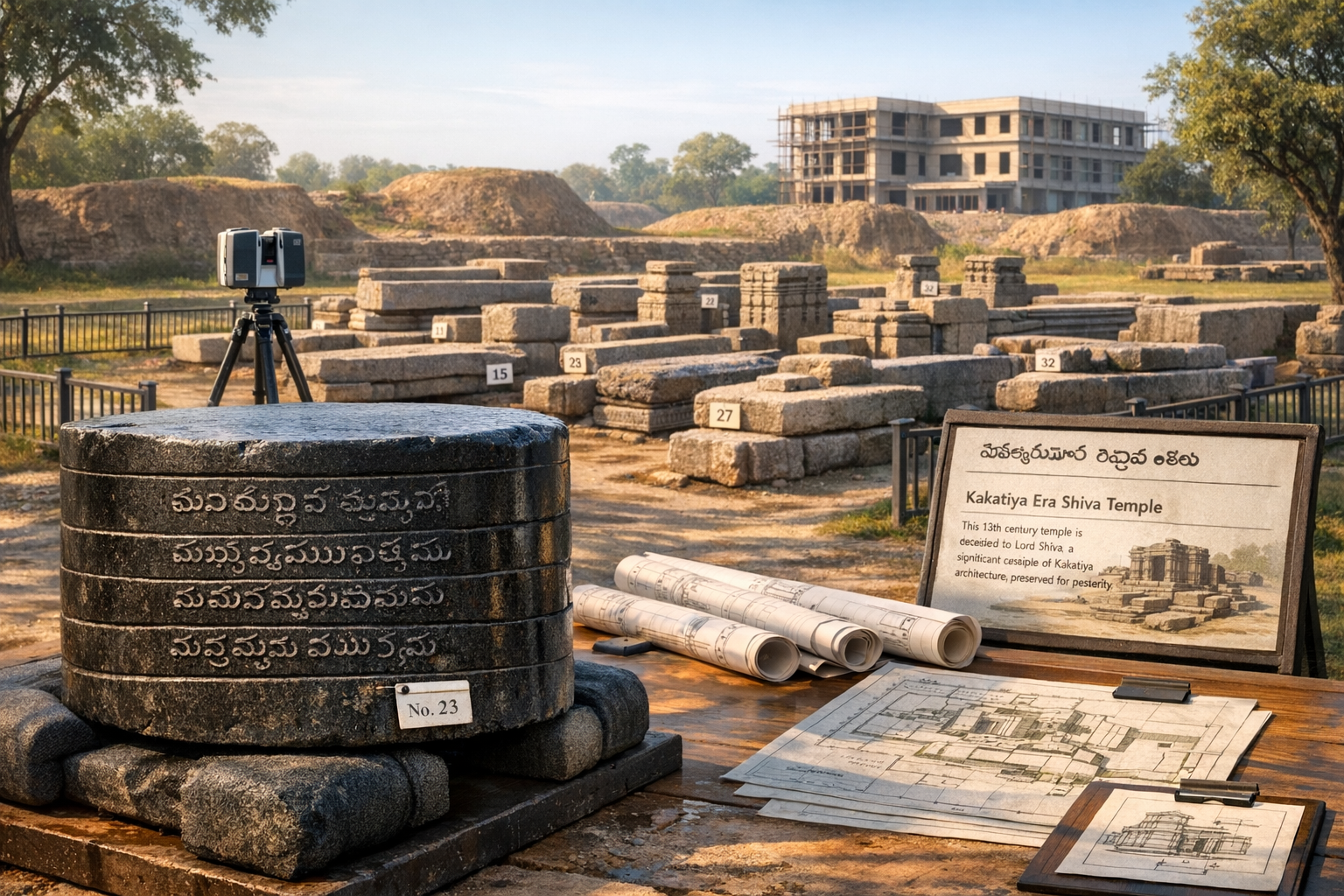
An 800-year-old Kakatiya-era Shiva temple in Ashok Nagar, Khanapur Mandal (Warangal, Telangana), was razed during the construction of a government Integrated School, drawing widespread concern from heritage advocates and local communities. The small shrine contained a rare seven-line Telugu inscription dated February 1231 A.D. that addressed the Kakatiya ruler Ganapatideva as “Maharaja” and “Rajadhirajulu,” placing the site squarely within the documented historical landscape of the Kakatiya dynasty.
“The ancient Shiva temple falls under the purview of the State Archaeology department but was razed to the ground using a bulldozer to make way for an Integrated School being constructed by the government. This is not fair to the history of Telangana,” observed Kotha Telangana Charitrabrundam convener Sreeramoju Haragopal, who brought the development to public attention. His statement crystallized a core worry among conservationists: that unprotected yet significant heritage assets are slipping through procedural gaps when public works advance on tight timelines.
Eyewitness descriptions emphasize the site’s distinctive materiality and setting: a small temple with “shiny pillars that appear as if machined and not sculpted,” situated in an open area associated locally with older mud fortifications. The location lies along the road between Shikargarh Fort and an ancient mud fort, in a landscape that once interlaced defensive earthworks, ponds, and sacred spaces.
“The temple was in a dilapidated condition as there was no worship in the premises and no deity. But it could have been easily resurrected without much effort or it could have been left alone and the school built around it,” Mr. Haragopal added. That assessment echoes global conservation charters which recommend integrating heritage structures within new public infrastructure where feasible, rather than removing them.
Historian D. Satyanarayana, reacting to the demolition, noted: “I had deciphered the seven-line incised inscription in Telugu on the temple mandapa pillar. The Department of Heritage Telangana also recorded an older inscription on the temple in 1965. The inscription shares how a certain piece of land was donated near toddy plantation. The Heritage Department should step in now and do some damage control.” The record, in other words, carried not only royal titulature but also a trace of social-economic life in the region eight centuries ago.
Elaborating on the temple’s larger setting, Mr. Satyanarayana added: “The ancient mud fort that is locally known as Kota Katta is part of the temple complex. The fort had ponds on all four corners. Near the pond was the temple that had beautifully carved pillars, beams and jambs. The inscription on the pillar is dated to February 1231 A.D. It is really unfortunate that a temple of such importance has been destroyed. It could have been easily dismantled and reassembled.” His remarks underline the feasibility of anastylosiscareful dismantling and reassemblylong recognized as a best-practice method in heritage conservation.
Following public backlash, officials in Congress-ruled Telangana have publicly stated that the temple will be rebuilt stone-by-stone. Reporting, including coverage by The Hindu (Serish Nanisetti), indicates that the pledge has been made in response to community concern, signaling an important opportunity to embed rigorous conservation standards into the proposed reconstruction.
The Kakatiya context heightens the loss. Inscriptions invoking Ganapatideva as “Maharaja” and “Rajadhirajulu” are historically illuminating, offering epigraphic anchors in a region whose monumental legacy includes the famed Kakatiya temples of Warangal and its environs. The UNESCO inscription of the Kakatiya Rudreshwara (Ramappa) Temple further demonstrates the international importance of this architectural tradition; even modest shrines can yield critical data on patronage, craftsmanship, and local landholding patterns.
Beyond the immediate event, the incident exposes systemic challenges faced by thousands of unprotected or lightly documented shrines across India. Many lie outside the formal purview of the Archaeological Survey of India (ASI) and depend on state departments whose inventories, buffer-zone mappings, and Heritage Impact Assessments (HIA) may be uneven or incomplete. In such contexts, infrastructure expansion can unintentionally overrun heritage assets unless due diligence, cross-departmental clearances, and community consultations are conducted at the planning stage.
Any stone-by-stone reconstruction must begin with salvage archaeology and scientific documentation. Recommended steps include systematic recovery and cataloguing of all architectural fragments; georeferenced site mapping; high-resolution photogrammetry and 3D laser scanning; epigraphic rubbings and RTI (Reflectance Transformation Imaging) for the inscriptional surfaces; material analysis (stone, mortar, and finishes); and structural assessment to determine load paths and foundation design for re-erection. Anastylosis should guide the process, using original components wherever possible and clearly marking any necessary modern insertions.
Special attention must be devoted to epigraphic conservation. The seven-line Telugu inscription should be stabilized through controlled cleaning protocols, microclimatic monitoring, and non-invasive consolidation where needed. A bilingual interpretive panelTelugu and Englishshould present the inscriptional content, historical context (1231 A.D., Ganapatideva), and details of the conservation methodology, promoting both transparency and public learning.
For the long term, a protective micro–heritage zone around the temple footprint, with well-defined setbacks from the school structures, would minimize recurrent risk. Clear wayfinding, lighting, and low-height perimeter demarcation can help prevent inadvertent damage, while a digital repository (open-access images, scans, and translations) will ensure that the temple’s knowledge value remains widely available regardless of future contingencies.
Community sentiment in Warangal and across Telangana reflects sorrow and a desire for constructive remedies. In keeping with the shared civilizational ethos of India’s dharmic traditionsHinduism, Buddhism, Jainism, and Sikhismpublic response has emphasized lawful, peaceful stewardship over confrontational rhetoric. A cross-tradition “Dharmic Heritage Forum” at the district level could institutionalize this spirit, bringing together scholars, monks, temple trustees, gurdwara and vihara committees, local educators, and state officials to develop rapid-response protocols for at-risk sites.
Pragmatic next steps for stakeholders include: ensuring an independent technical review of the site’s debris and surviving context; commissioning a Heritage Impact Assessment for the integrated school project; formally associating ASI and Department of Heritage Telangana experts with the reconstruction plan; and inviting civil-society participation (for instance, via INTACH Warangal) in documentation and public interpretation. Education officials can, in turn, integrate place-based history into the new school’s curriculum, transforming a painful episode into a living classroom for heritage conservation.
The Warangal incident should become a turning point rather than a precedent. With transparent inquiry, best-practice reconstruction, and inclusive community participation, it is possible to honor the Kakatiya legacy, safeguard the inscription that names Ganapatideva as “Maharaja” and “Rajadhirajulu,” and demonstrate that development and heritage preservation can proceed hand in hand. Done well, the rebuilt shrine can stand as a durable symbol of accountable governance, scholarly rigor, and the shared guardianship of India’s cultural inheritance.
Inspired by this post on Hindu Human Rights Blog.