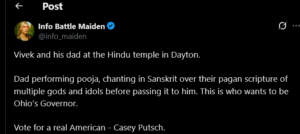
Following Vivek Ramaswamy’s Ohio primary victory, a wave of online commentary resurfaced that fixated not on policy or performance, but on his Hindu faith. A short clip circulating on social media showed Ramaswamy and his father at a Hindu temple in Dayton, where a traditional puja was performed and Sanskrit verses were chanted. In some fringe posts, this ordinary scene of worship was framed with pejorative labels and insinuations, exemplifying the pattern in which non-Abrahamic traditions are periodically misrepresented in American political discourse.
The rhetoric accompanying the clip recycled familiar tropesdescribing Hindu scriptures as “pagan,” disparaging murtis (sacred icons) as “idols,” and casting doubt on civic belonging by invoking the idea of a “real American.” Though presented as political critique, such framings function as religious litmus tests and draw on Hinduphobic stereotypes that have long targeted Hindu Americans and other dharmic communities. They shift debate away from constitutional principles toward identity policing, undermining pluralism at precisely the moment when democratic participation should be celebrated.
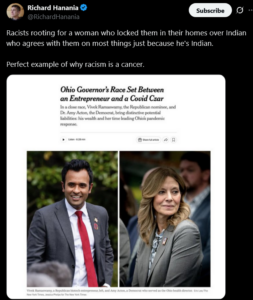
Several observers from across ideological lines condemned the bigotry. One widely shared comment noted that preferring a candidate who locked citizens down during the pandemic over an Indian American who shared many of one’s policy views was a vivid reminder that “racism is a cancer.” Another commentator pointed out that Ramaswamy reportedly carried every county in Ohio, suggesting that the loudest sectarian critiques were largely online and often anonymous. Together, these reactions underscored a gap between high-engagement outrage on social platforms and broader electoral behavior on the ground.
It is useful to name this phenomenon clearly. Hinduphobia is a form of religious prejudice that stereotypes, erases, or denigrates Hindu beliefs, symbols, and practitioners. In the United States, it often appears as a rhetorical conflation of “polytheism,” “idolatry,” and “paganism” with moral or civic inferiority. Such framings not only misrepresent Hindu traditions; they also ignore the shared ethical foundations of the broader dharmic familyHinduism, Buddhism, Jainism, and Sikhismwhich converges on values such as ahimsa (non-violence), seva (selfless service), karuna (compassion), and sarbat da bhala (the welfare of all).
From a constitutional perspective, these attacks are at odds with basic civic norms. Article VI of the U.S. Constitution prohibits any religious test for public office, and the First Amendment guarantees free exercise of religion. In practice, these principles mean candidates ought to be evaluated on governance, integrity, and policynot on where or how they worship. Religious freedom is not a partisan talking point; it is a structural safeguard that strengthens American democracy by protecting minorities and majorities alike.
Context about the temple practices depicted in the video helps counter mischaracterizations. A puja is a devotional rite that may involve offering flowers, lighting a lamp, or reciting Sanskrit verses to invoke darshan (sacred seeing) and cultivate inner discipline. Murtis are not worshiped as mere objects; they are consecrated focal points for devotion, akin to icons or stained glass in other traditions. Theologically, Hindu thought spans non-dual Advaita, qualified non-dual Vishishtadvaita, and dualist Dvaita streams, alongside bhakti traditions centered on one’s ishta devata (chosen form of the Divine). Far from a monolith, Hindu practice is diverse yet unified by a search for dharma (right order) and moksha (liberation).
For many Hindu American families, scenes like a parent guiding a child to ring a temple bell or repeat a Sanskrit mantra are ordinary, formative, and deeply American in their exercise of religious liberty. These experiences mirror the Sabbath candles, Sunday school classes, or gurdwara langar familiar to other communities. Reducing such moments to caricature strips them of dignity and erodes the mutual recognition that plural societies require.
Digitally, the speed and reach of outrage cycles are amplified by algorithms that privilege spectacle over substance. Decontextualized clips, anonymous handles, and bot-like activity can produce an illusion of consensus or crisis. Here, healthy information hygiene matters: cross-verify claims, consider primary sources, and weigh whether a narrative is mobilizing emotion to substitute for evidence. Analysts have long noted that high-velocity, low-veracity content tends to harden bias and distract from policy.
Electoral data from the Ohio primarywhere Ramaswamy reportedly performed strongly across the mapsuggests that much of the sectarian pushback was not reflected in voter behavior. While online invective can feel omnipresent, it often represents a narrow slice of the electorate. Conflating the loudest voices with the largest constituencies leads to misguided strategy and further polarization.
There is also a constructive path forward for civic dialogue. Dharmic traditions offer a vocabulary for pluralism that is both ancient and practical: the acceptance of multiple valid paths, the discipline of inner restraint, and the ethic of service. These concepts resonate with the American experiment, where disparate beliefs coexist under shared rules and rights. Affirming dharmic unitybetween Hindus, Buddhists, Jains, and Sikhshelps inoculate communities against divide-and-rule tactics that pit neighbors against one another.
For faith leaders, educators, and civic groups, several steps are actionable. Clarify the difference between theological debate and bigotry; one interrogates ideas, the other targets people. Teach the basics of Hindu practice in interfaith forums to dispel myths. Encourage newsrooms and platforms to apply consistent standards against religious stereotyping. And invite candidates of every background to discuss how their moral formation informs public service, without reducing them to a single identity marker.
Ultimately, the question raised by the Ohio episode is not whom to support at the ballot box, but how to protect space for conviction without coercion. When citizens can bring their whole selveswhether through Sanskrit chants in a Dayton temple or hymns in a Sunday churchpublic trust grows and democratic legitimacy deepens. The best answer to Hinduphobic smear campaigns is not reciprocal contempt; it is principled pluralism, civic literacy, and a renewed commitment to dharmic unity and American constitutionalism.
Inspired by this post on Hindu Human Rights Blog.