A short video widely circulated on social media during Holi 2026 appears to show a man standing on a rooftop discarding loose material toward celebrants below before slipping and falling. The footage triggered intense debate and emotive commentary. A careful, evidence-based reading of the clip, combined with established safety, legal, and crowd-management principles, helps separate verifiable facts from conjecture and points to concrete steps communities can take to keep Hindu festivals such as Holi joyful, lawful, and safe for all.
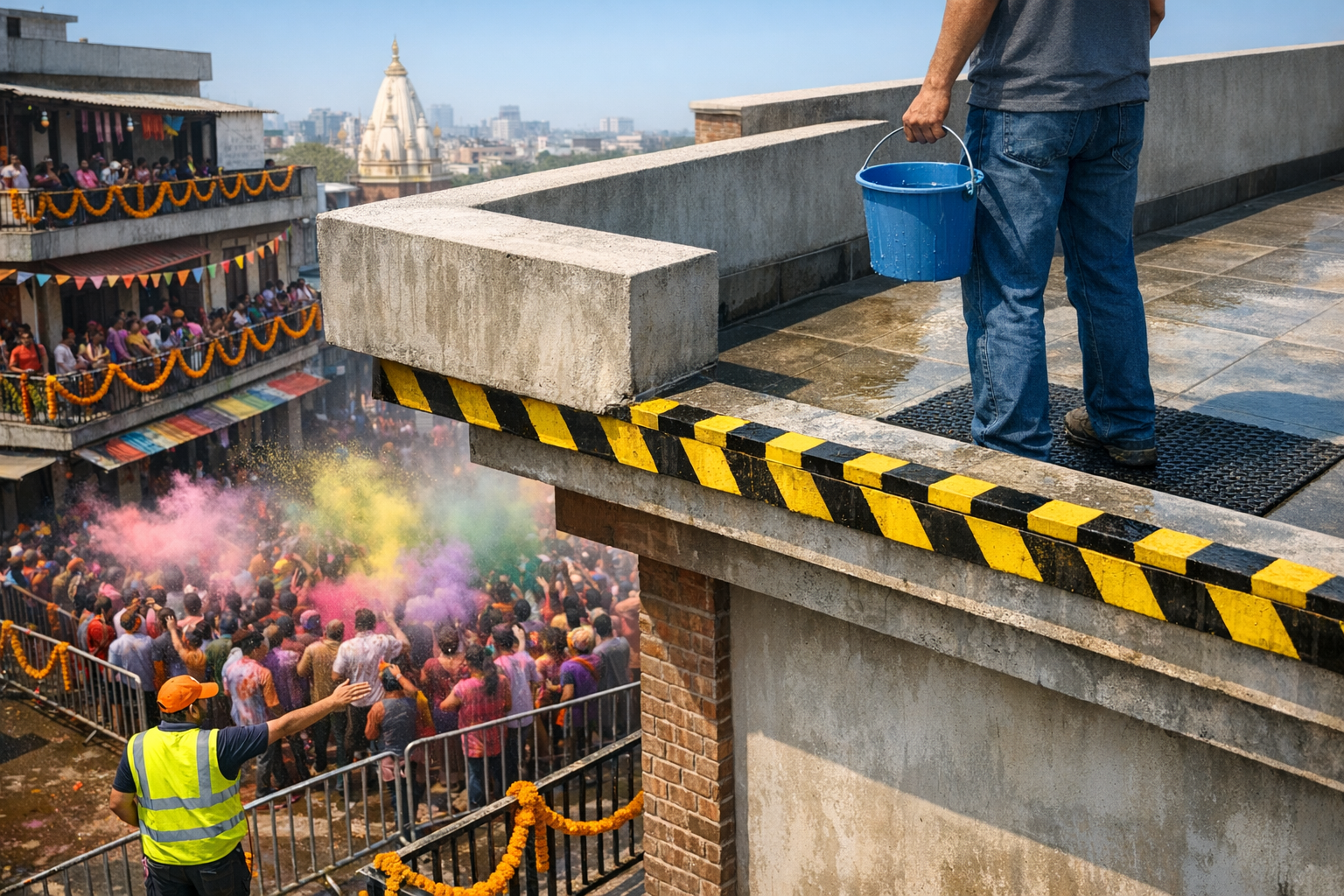
What the footage depicts can be summarized cautiously. The vantage point is street level; the camera captures an individual on a roofline holding a bucket-like container. As loose material is tipped over the edge, the individual’s center of gravity appears to shift beyond the parapet, prompting a loss of balance and a fall. The camera angle does not clearly reveal where the person lands or the immediate aftermath, and no location markers or timestamps are visible in the circulating version reviewed.
Several posts accompanying the clip claim the individual survived. At the time of analysis, open-source confirmation from official hospital bulletins or police statements was not readily accessible. In such circumstances, responsible reporting calls for restraint: it is ethical to note that unverified injury-status claims exist while avoiding speculation beyond available evidence.
Holi is among the most visible public celebrations in India, and it thrives on spontaneity, color, and convivial community spirit. The festival’s inclusive ethos often draws neighbors, friends, and colleagues across diverse backgrounds to shared spaces. Precisely because Holi encourages open-air gathering, the duty of care for safety becomes collective: residents, festival organizers, local authorities, and bystanders all share responsibility for minimizing avoidable risks.
From a safety-engineering perspective, throwing or dropping objects from a height into a crowd is inherently hazardous. Basic physics illustrates why. Gravitational potential energy is given by E = m × g × h. A seemingly small 1.5 kg mass released from a 7 m rooftop carries roughly 1.5 × 9.81 × 7 ≈ 103 joules of energy upon impactsufficient to cause serious blunt-force injury depending on contact area and angle. Even loose soil or debris becomes dangerous when concentrated or when it strikes the head, face, or eyes.
The fall itself underscores risks associated with rooftop activity during festivals that involve water, colored powders, and reduced friction surfaces. Typical static coefficients of friction for smooth ceramic tiles range around 0.4 in dry conditions but can drop below 0.2 when wet. Colored water, oils, or damp powders used during Holi can further reduce traction. A minor forward lean while handling a container at an edge can shift the resultant center of mass beyond the support polygon, making a slip or toppling event likely.
Built-environment norms in India recognize these hazards. The National Building Code (NBC) of India specifies parapet or guarding heights for accessible terraces, commonly not less than 1.05 m in many occupancies, and emphasizes safe access, drainage, and slip resistance. Older structures or informal modifications may not meet current standards, and ad hoc rooftop use during festivals can expose unguarded edges, weak railings, or slippery substrates that dramatically elevate risk.
Indian law provides clear frameworks for addressing endangerment. Sections 336–338 of the Indian Penal Code address acts that endanger life or cause hurt by rash or negligent conduct. Section 268 defines public nuisance, with Section 290 prescribing punishment in certain cases. Depending on local orders, provisions of the Code of Criminal Procedure (for example, preventive actions under Sections 107/151 or compliance with prohibitory orders under Section 144) may also apply to unsafe conduct in public spaces.
Effective crowd management during Hindu festivals benefits from institutional guidance. The National Disaster Management Authority’s Manual on Crowd Management outlines practical measures: route planning, segregated entry and exit, designated safe zones, barricading of sensitive perimeters, real-time communication with local police, and trained marshals elevated at vantage points to monitor roofs, balconies, and intersections. These measures reduce both inadvertent hazards and deliberate mischief.
Open-source intelligence methods can help communities and journalists verify viral video claims without amplifying disinformation. Useful steps include reverse-image and keyframe searches, cross-referencing weather and shadow angles to estimate time of day, geolocating via unique architectural features or signage, triangulating from multiple viewpoints if additional clips surface, and seeking confirmation from local authorities. This discipline curbs rumor cascades and prevents innocents from being wrongly accused.
Disinformation thrives on emotionally charged content. Words that ascribe criminal intent, collective blame, or communal identity to an unidentified individual in a short, context-poor clip can inflame tensions and undermine communal harmony. Ethical practice therefore avoids unverified labels, focuses on behaviors rather than identities, and centers the immediate priorities of medical care, public safety, and due process.
Holi’s social fabric is strongest when neighbors coordinate proactively. Many localities have found success by establishing pre-festival resident–organizer briefings, mapping procession routes away from fragile structures, appointing mixed-faith volunteer marshals, and keeping helpline numbers visible at congregation points. Interfaith Dialogue initiatives and mohalla committees have shown that early communication, transparency, and shared responsibility reduce conflict and improve safety.
For households overlooking busy lanes, practical precautions include securing loose materials, avoiding edge work during peak crowd flow, and designating a single, dry, non-slippery observation point behind the parapet. Residents should never lean out with containers at roof edges, particularly when surfaces are wet. For organizers, public-address reminders about rooftop safety and respectful conduct help set expectations early.
Lawful celebration is a shared obligation. Festival participants must respect private property, heed instructions from marshals and police, and avoid behavior that could be construed as public nuisance or endangerment. Conversely, residents and shopkeepers should report hazards through official channels rather than confront crowds directly, thereby allowing trained personnel to de-escalate.
The values of Dharmaahimsa, empathy, and mutual respectoffer a time-tested compass for plural societies. Dharmic traditions across Hinduism, Buddhism, Jainism, and Sikhism emphasize restraint, compassion, and the sanctity of life. Reaffirming those principles during exuberant occasions like Holi strengthens interfaith relations, reinforces unity in diversity, and ensures that celebration never comes at the expense of safety or dignity.
In summary, the viral rooftop video highlights a preventable risk rather than a predetermined communal narrative. A careful, fact-based approach focused on safety engineering, applicable law, crowd-management good practice, and digital verification yields constructive lessons. Communities that pair celebration with conscientious preparation keep Holi joyous, inclusive, and secure for everyone.
Inspired by this post on Hindu Human Rights Blog.