The case known as the "Death of Raghu the Poddar" offers a vivid lens on corporate power, legal ambiguity, and community sensitivities in Mughal-era Bengal. It illuminates how a single dispute at the English East India Company’s post in Kasim Bazar escalated into a regional controversy, leaving a lasting imprint on institutional memory and public discourse.
Within half a century of Thomas Roe receiving a trading Farman from Jahangir, the East India Company expanded steadily across the East Coastmost notably Madras, Machilipattanam, and Bengalwhile maintaining a flourishing factory at Surat. During the same period, the Mughal Empire experienced transitions of rule and the accession of Aurangzeb. Administrative austerity and centralization coexisted with persistent provincial challenges, especially in revenue management and maritime commerce.
Each Company fort, factory, and trading post functioned as a quasi-sovereign enclave with rules and procedures framed in England and enforced locally through Courts and Committees answerable to Directors in London. Indian partners and employees were bound to Company law rather than to the laws of the Mughals or regional authorities where the EIC operated. This corporate sovereignty included coercive disciplinary powersup to torture and capital punishmentover Indian employees, a structure that repeatedly produced friction with local society.
The episode that unfolded between 1673 and 1676, later remembered as the Case of Raghu the Poddar, became notorious in Company archives and Bengal’s public memory. Beyond its immediate facts, it invites reflection on ethical trade, shared civic order, and the importance of justice that honors local sensibilitiesprinciples cherished across dharmic traditions.
By the 1660s, Fort St. George (Madras) served as the EIC’s nerve center while Bengal’s trade grew in strategic importance. Provincial administration in Bengal was strained by factionalism and rent-seeking, with Farmans often treated as negotiable instruments in a competitive environment that drew European companies into complex relationships with local officials. Stability depended on fairness and restraintvalues vital for social cohesion across communities.
In this climate, the Dutch VOC gained formidable influence. Contemporary observers, such as the surgeon Wouter Schouten in 1663, described the Dutch lodge at Chinsurah as imposing and well-ordered, with stone-built bastions and warehouses near the Ganges. The English commenced a new lodge as the old site eroded under strong river currents, signaling both environmental risk and commercial ambition along the Hooghly.
By the early 1670s, commercial rivalry intensified. In 1672, a VOC official imprisoned a local Bengali businessman over unpaid debts; the businessman’s wife was publicly humiliated and died by poison soon after. The Diwan of Hooghly, Balchand, issued a Mazhar and alerted Shaista Khan, the Governor of Dacca. Swift reprisals followed: trade was halted for months, supplies were cut off, employees were detained, and substantial monetary penalties were exacted before operations resumed. The English Company drew a clear lesson: harming local honor, even when disciplining a subordinate, could trigger far-reaching political and commercial consequences.
Several notable figures intersected in the events at Kasim Bazar: Raghu the Poddar (cashkeeper, 1671–1673); Anant Ram (a House Broker and Raghu’s rival); Raghu’s business partners, Murad Chand and Neem Chand; Vincent Mathias (Chief of the EIC at Kasim Bazar) and his deputy John Marshall; George Knipe (resident official), along with the silk dyers John Naylor and Richard Mosely; the provincial Diwan of Hooghly, Balchand; Joseph Hall (an influential EIC official at Balasore and rival to Vincent); and Streynsham Master (Company Agent for Machilipattanam and Bengal), who ultimately adjudicated the matter.
“Poddar” originally denoted a cashier or treasurer. Raghu served as the EIC’s cashkeeper at Kasim Bazar between 1671 and 1673 and also ran a small shop. His predecessor, Anant Ram, resented losing the role and became Raghu’s determined adversary.
In 1673, Vincent and Marshall accused Raghu of theft and misappropriation. The charges cited shortages “delivered into his charge,” an additional “Accompt of Cash which the said Podaur [Poddar] was charged with in the Companys bookes,” and alleged abuse of “the company in the Saile [sale] and Mintage of Silver at Rajmahal.” Yet the record reveals important ambiguities: the total deficit was never clearly stated; the Company’s silver sent with Raghu and his partners to Rajmahal in December 1672 was only returned in June 1673; and the shortfall was calculated at Rs. 818, of which Rs. 150 had been recovered by August 1673.
As August progressed, pressure mounted. When requests for the balance met evasions, Vincent resorted to coercion. He summoned Raghu and his son, applying a Chabuk to the son because Raghu was elderly and frail. Raghu pleaded for time and promised payment in installments. Concerned that further force could invite local backlash akin to the VOC’s troubles in Hooghly, Vincent stopped the punishment and delegated recovery to Anant Raman assignment that created its own perils.
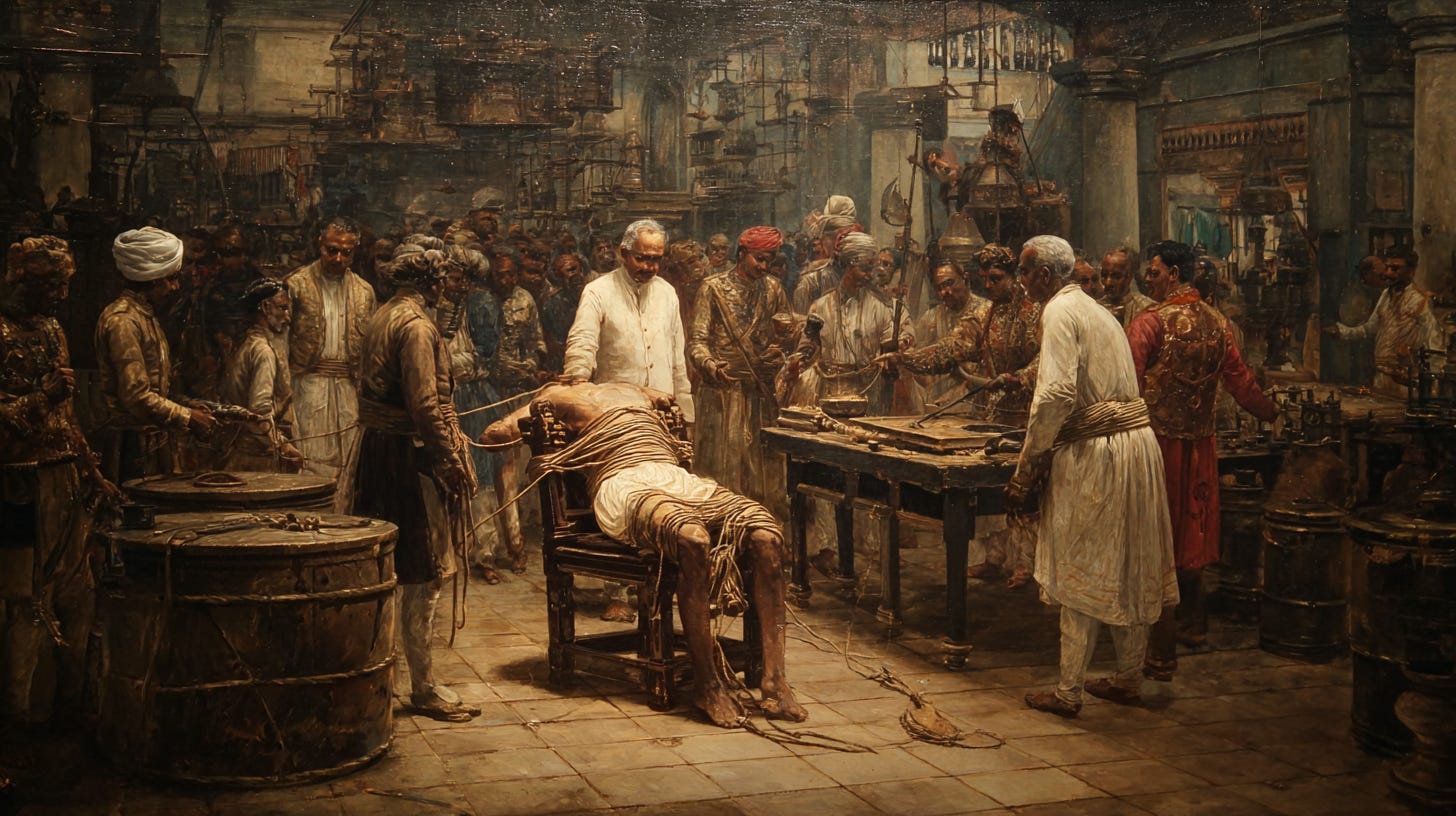
On 21 August 1673, Vincent, Marshall, and Richard Edwards left Kasim Bazar at dawn. With them away, the factory was in the hands of George Knipe, John Naylor, and Richard Mosely. They summoned Raghu and asked him to test “two sorts of gold,” which Anant Ram had brought. Raghu assessed a difference of two rupees per tola (about 12.5 percent) between the samples, whereupon Anant Ram accused him of slighting his honor and demanded immediate settlement. Guards then fettered Raghu, and he received blows on the soles of his feet with a small switch before being held for more than an hour and released.
When Vincent returned that evening, Raghu and his partners greeted him at the gate but said nothing about the incident. In the early hours of 22 August, at around 3 a.m., Raghu died. Rumors quickly circulatedsome alleging suicide, others suggesting poison. Such speculation drew upon contemporary notions of honor, yet across dharmic traditions life is held sacred, and justice is ideally pursued through due process rather than self-harm or retaliatory humiliation.
The aftermath placed Anant Ram, Vincent, and, by extension, the EIC under intense scrutiny. The adjudication that followedled by Streynsham Masterwould test the limits of corporate authority, the necessity of procedural clarity, and the imperative to respect local communities. The episode underscores the timeless civic principles of fairness, compassion, and restraint that sustain harmony among Hindus, Buddhists, Jains, Sikhs, and all who shared Bengal’s plural public life.
To be continued.
Inspired by this post on Dharma Dispatch.