Over the past decade, India has undergone a transformation so rapid and far-reaching that many everyday experiences feel newly redefined. Essential services, digital public infrastructure, transportation, and governance have advanced to a degree that would have seemed unattainable a generation ago. In public memory, the contrast between what once required endurance and what now offers efficiency serves as a living archive of national progress.
Consider a once-familiar journey from Chennai to the Northeast. A trip that earlier invited prolonged delays now reflects expanded connectivity, multi-modal options, and predictable schedules. Citizens across regions recount similar shifts in mobility, financial access, and service deliverychanges that collectively demonstrate how policy, technology, and administrative resolve have reshaped daily life.
Media dynamics have moved in tandem. The political news ecosystemlong fixated on scandalhas been tempered by greater institutional transparency and a steadier cadence of governance outcomes. Even those who once thrived on sensational narratives acknowledge that a new normal, centered on performance and accountability, increasingly guides public discourse.
Symbolism has complemented substance. Renaming Rajpath to Kartavya Path and Central Secretariat to Kartavya Bhavan foregrounds civic dutyKartavyaover inherited hierarchies. The debate around open office plans and workplace culture in Kartavya Bhavan illustrates a wider push toward transparency, collaboration, and service orientation. Within this decolonization arc, the emphasis on Dharma as ethical duty resonates with India’s civilizational ethos while aligning with modern administrative goals.
Continuity and course correction are visible in historical perspective. Atal Bihari Vajpayee’s legacyespecially the New Telecom Policy, the Golden Quadrilateral, and forward-leaning reformsseeded a productive direction, even as the inherited administrative structure largely remained intact under coalition constraints. The past decade has built on that foundation by addressing structural inertia and institutional redesign more frontally.
The Narendra Modi years have focused on excavating legacy constraints and advancing systemic reform. This approach has included efforts to streamline entrenched networks, strengthen executive capacity, and align bureaucracy and judiciary with higher standards of public accountability. A clear legislative mandate has been central to pushing through complex changesan insight drawn, in part, from the coalition era’s limitations.
Several breakthroughs unfolded almost imperceptibly in real time and are now taken for granted. The UPI revolution normalized seamless, real-time payments at national scale. Defense procurement has been progressively insulated from opaque intermediaries. The frequency of terror attacks on Indian soil has markedly declined. Maoist violence has receded in multiple districts, reopening the space for schooling and basic services in areas once beset by insurgency. The abrogation of Article 370 proceeded through constitutional processes within Parliament. India’s firm posture at Galwan and sustained diplomatic efforts have reshaped perceptions in both Pakistan-India relations and the broader China-India conflict. Even occasional friction with global partnersillustrated by Peter Navarro’s remark, “I would simply say to the Indian people, please understand what is going on here. You’ve got Brahmins profiteering at the expense of the Indian people. We need that to stop.”has, paradoxically, underscored India’s growing strategic weight and civilizational self-confidence.
Policy audacity, ambition, and scale are visible in Direct Benefit Transfer, demonetisation, GST, and an unapologetically India-first foreign policy. These initiativescontentious at inception in some quartershave largely become irreversible. The debate now turns on design details rather than rollback. In development terms, the approach has targeted both individual-level wealth creation and national asset building, with Digital Public Infrastructure acting as a unifying spine.

The bedrock prioritiesroads, power, health, and educationhave seen substantial movement, though uneven by state. From multi-lane highways supplanting octroi-era bottlenecks to a dramatic reduction in routine power cuts, quality-of-life improvements are tangible. Healthcare and education, especially the humanities, remain vital fronts for long-haul reform. Because these are primarily state subjects, cooperative federalism is indispensable; where political competition constrains collaboration, momentum slows, but the potential for partnership remains significant.
Globally, India’s enhanced clout coexists with a challenging information environment. Disinformation and episodic street disruptionsoften amplified transnationallycan obscure on-ground gains. Yet the persistence of such attempts also functions as a negative indicator of India’s ascent: the more credible the internal consolidation and international influence, the stronger the incentives for narrative destabilization.
India’s soft power has expanded in ways that are civilizationally grounded and inclusive. The UN’s adoption of International Yoga Day affirmed India’s spiritual heritage, while renewed cultural bridges with Brhad-Bharata (Southeast Asia) and communities in Suriname, Fiji, and Maldives (Mala-Dvipa) have deepened people-to-people ties. Major projects such as the Rama Mandir, the Kashi corridor, and the Mahakal corridor, alongside the revitalization of temples abroad, have signaled a broader cultural renewal anchored in respect for Hinduism, Buddhism, Jainism, and Sikhismsister traditions whose unity strengthens India’s plural fabric.
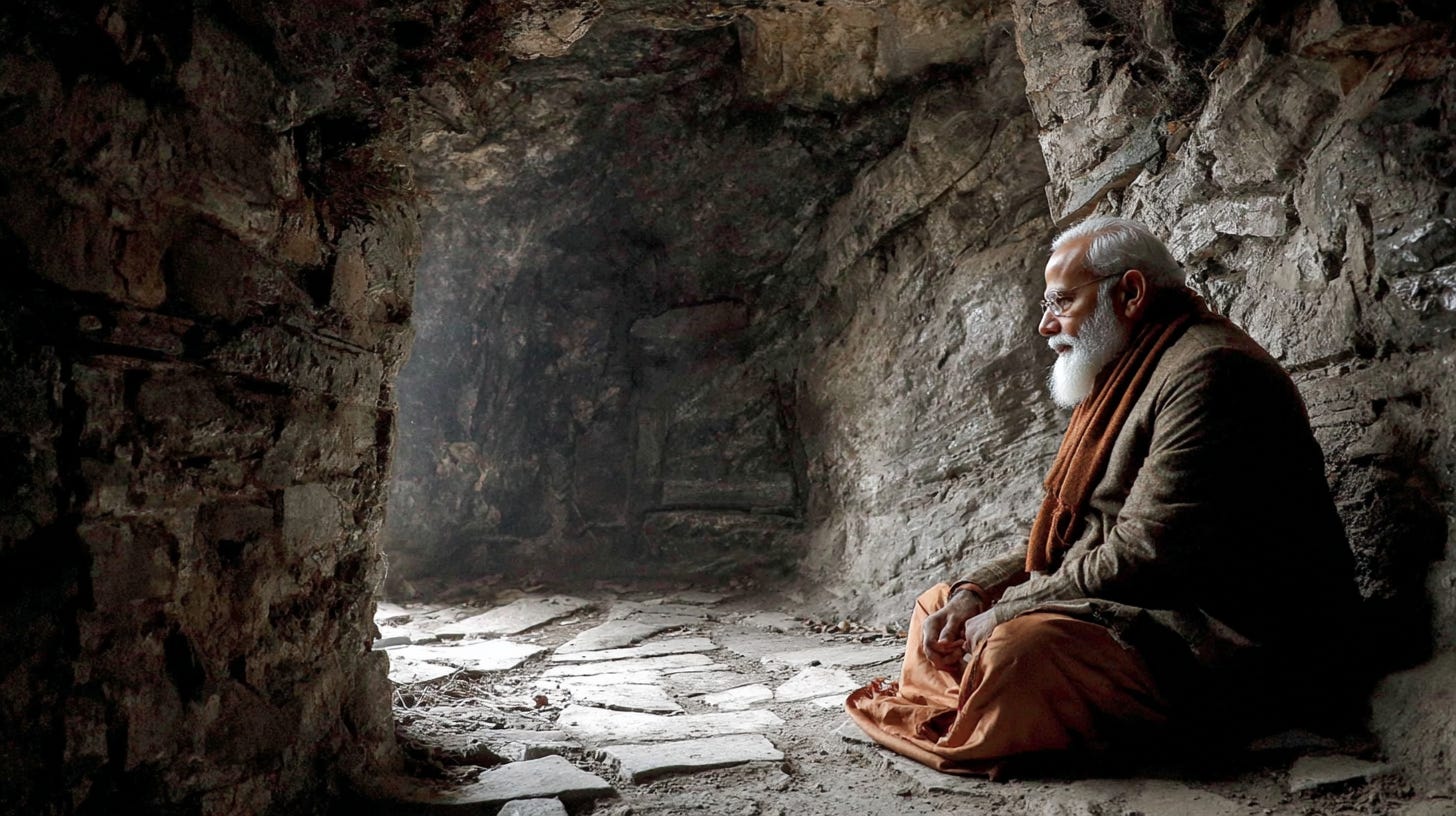
A revealing metaphor, shared by Narendra Modi in an earlier conversation, likened Sanatana culture to a Sadhu’s meditation mat with both ends springing up when one side is pressed down. The lesson: balance and equanimity at the center prevent destructive oscillation. This philosophical orientationcultivating steadiness amidst fluxhelps explain the synthesis of tradition and modernity visible in the period’s cultural and policy agendas.
Education is a decisive area for improvement. The humanities, in particular, require renewal that encourages critical inquiry free from ideological capture. Historically, community-led education created resilient institutions long before state-centric models, a truth recognized by early British observers. As Grant Duff noted: “[The English] will see that no good can be effected for [Indians] but only much harm, by introducing English methods [of education], foreign to the characters and conditions of Indians…” An enabling state that regulates with light touch, supports standards, and empowers communities and scholars can foster depth without stifling diversity.
Decolonization is equally a matter of mind and memory. Changes such as Kartavya Path and the Central Vista speak to institutional self-respect; their deeper success will be measured by intellectual self-confidence. Sri Dharampal’s suggestion that Rashtrapati Bhavan become a museum of colonial horrors is one provocative idea to catalyze this reflection. Whether or not adopted in that form, the underlying goal is clear: to internalize lessons of the past while advancing a future rooted in civilizational dignity and constitutional modernity.
On balance, a decade of governance under Narendra Modi has catalyzed national capacity across infrastructure, services, and strategy. Airports and seaports compete on efficiency, Digital Public Infrastructure scales inclusion, and an energized startup ecosystem reflects a shift from risk aversion to responsible ambition. Most importantly, a renewed cultural confidencegrounded in Dharma and respectful of all dharmic traditionshas emerged as a unifying force, positioning India to pursue prosperity, security, and plural harmony with clarity of purpose.
Inspired by this post on Dharma Dispatch.